August 14th, 2026
Dental IT Support in Miami, FL (Practices & DSOs)
Industry Research — Service Areas
In Miami-Dade County, 1,799,905 residents speak Spanish at home. Fewer than one in four speak only English, so a breach notice written in English alone is written for the smallest part of the room.
Dental IT support in Miami runs into a problem no other major metro has at this scale. Florida law tells you what a breach notice must contain, HIPAA tells you when to send it, and neither one tells you what language to send it in. A third rule does, and it is the one that catches Miami practices.
Medix Dental IT has worked exclusively in dental for more than 20 years, supporting everything from single offices to multi-location DSOs. The gap below is a good example of what a dental-specific provider catches and a generalist does not.
An English-Only Breach Notice Can Be Legal and Still Fail
Start with what the statute actually demands. Section 501.171(4)(e) of the Florida Information Protection Act sets the minimum content of a patient notice: the date or estimated date range of the breach, a description of the personal information involved, and contact information the patient can use to ask what was held about them. Nothing in that paragraph mentions language. Neither does the HIPAA Breach Notification Rule.
Now put that against the county. The Census Bureau’s 2024 American Community Survey one-year estimates show 2,033,083 Miami-Dade residents age five and older speak a language other than English at home, 75.7 percent of that age group, and 1,799,905 of them speak Spanish. Only 653,847 speak English exclusively. A notice that satisfies every word of 501.171(4)(e) in English can still leave most of a Miami patient list unable to read what happened to their records.
The rule that closes the gap sits outside both statutes. A dental practice that participates in Medicare or Medicaid receives federal financial assistance, which brings it under Title VI of the Civil Rights Act and Section 1557 of the Affordable Care Act. Those require reasonable steps to give people with limited English proficiency meaningful access to the practice’s services. HHS guidance on Section 1557 is explicit that language assistance must be free, accurate, and timely, and HHS has pointed to translating frequently encountered communications as one of those reasonable steps.
So a Miami practice that bills Medicare or Medicaid can run a technically compliant breach notification and still have a civil-rights problem, because compliance was measured against the wrong rule. The fix is preparation: know which languages your patient list reads, and have the notice template ready in those languages rather than commissioning a translation during the week you are least able to manage one. That belongs in the compliance file next to the incident-response plan.
Florida’s breach statute has a second trap involving the Attorney General copy requirement, which our Tampa dental IT page covers in full. This is statutory research rather than legal advice, and a practice facing an actual incident should have counsel read both alongside its own facts.
Two Counties, One Practice, and a Hurricane Season
Miami practices also operate across a split most metros do not have. Miami-Dade and Broward run separate emergency management and separate evacuation zones, so a group with offices in both can find one side of the county line open while the other is still dark.
Hurricane Irma made the point in September 2017. Florida Power and Light reported restoring more than 4.1 million customers within six days, with Miami-Dade nearly 95 percent restored at that point. That is a fast utility response by any measure, and it still left thousands of businesses waiting.
The operational lesson is about where the records live rather than where the power is. If a Doral office holds the only copy of the schedule and Doral is the side still waiting on restoration, the Fort Lauderdale office cannot simply absorb those patients. Untested backups are not backups, and a recovery plan that has never been timed is a hypothesis. A cybersecurity assessment asks it plainly: when did someone last restore from your backup, and how long did it take?
Dental IT Services Built for the Miami Market
Florida is one of the most corporate-affiliated dental markets in the country. ADA Health Policy Institute data for 2024 puts Florida DSO affiliation at 23.2 percent of all dentists, above the national 16.1 percent and up from 20.9 percent in the same series a year earlier. The generational split underneath is the real story: 42.7 percent of Florida dentists within five years of dental school are DSO-affiliated, against 11.5 percent of those more than 25 years out.
Sage Dental, headquartered in Boca Raton, runs offices across both counties including Downtown Doral, Coral Gables, West Kendall, West Miami, Miami Beach, North Miami Beach, Pinecrest, Pembroke Pines, Hollywood, Davie, and Weston. Aspen Dental operates offices in Miami and Hialeah. Independent practices here compete for the same staff and patients as groups running standardized systems, which raises the floor on what a solo office needs its technology to do.
What we run for Miami practices and groups:
- Enterprise-grade cybersecurity. Managed detection and response, identity governance, and tenant-level monitoring across Microsoft 365 or Google Workspace. Antivirus is not a cybersecurity program.
- Backup and disaster recovery designed around a two-county footprint, so an outage in one does not strand the records the other needs. See our approach to backup and disaster recovery.
- Dental software expertise across Dentrix, Eaglesoft, and Open Dental, including imaging and CBCT workflows, with cloud hosting through Open Dental Cloud.
- Incident-response documentation that accounts for who your patients are, including which languages the notice has to exist in before an incident rather than during one.
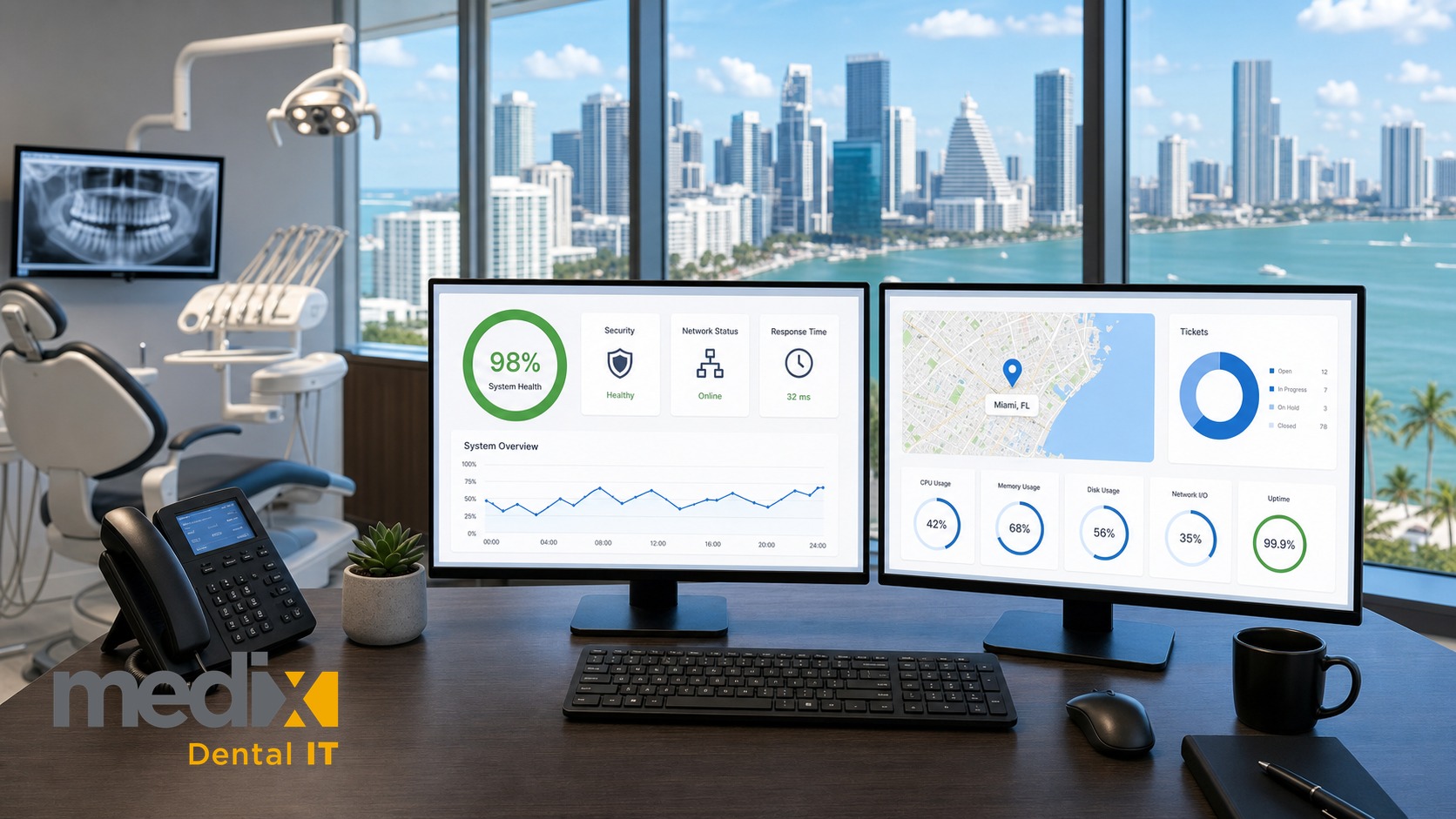
- IT KPI reporting on uptime, MFA adoption, endpoint compliance, and backup health. If your IT partner cannot show you a dashboard, they are not managing anything.
We support practices across Miami-Dade and Broward, including Hialeah, Doral, Kendall, Coral Gables, Aventura, Miami Beach, North Miami Beach, Homestead, Fort Lauderdale, Pembroke Pines, Hollywood, Plantation, Coral Springs, and Weston.
The defensive baseline is not complicated, and the payoff is measured. Microsoft researchers found that multifactor authentication reduces the risk of account compromise by 99.22%. In a market where a growing share of practices answer to a corporate parent that will eventually audit their security posture, treating that baseline as optional is an expensive position. Our DSO tech playbook covers what repeatable looks like across locations, and we are happy to compare notes on your setup.
Miami Dental IT Support FAQs
What areas around Miami does Medix Dental IT support?
We support practices and DSOs across Miami-Dade and Broward counties, including Miami, Hialeah, Doral, Kendall, Coral Gables, Aventura, Miami Beach, North Miami Beach, Pinecrest, Homestead, Fort Lauderdale, Pembroke Pines, Hollywood, Plantation, Coral Springs, Davie, and Weston. We run remote-first with on-call dispatch, so response does not depend on how far across the metro you sit.
Do we have to send a breach notice in Spanish?
Neither the Florida statute nor the HIPAA Breach Notification Rule says so directly. The obligation comes from elsewhere: if your practice takes Medicare or Medicaid, Title VI and Section 1557 require reasonable steps to give patients with limited English proficiency meaningful access, and HHS has treated translating frequently encountered communications as one of those steps. With 67 percent of Miami-Dade residents age five and older speaking Spanish at home, and 75.7 percent speaking some language other than English, an English-only notice is difficult to defend as reasonable. Decide this before an incident, not during one.
What does Florida law actually require a breach notice to say?
Section 501.171(4)(e) sets three minimums: the date or estimated date range of the breach, a description of the personal information involved, and contact information the patient can use to ask what the practice held about them. It is a short list, and meeting it is not the same as communicating effectively with your patient base.
Our offices are in both Miami-Dade and Broward. Does that change anything?
Operationally, yes. The two counties run separate emergency management and reopen on separate timelines, so a storm can leave one office closed while the other is taking patients. The systems question is whether the open office can actually work: whether schedules, imaging, and records are reachable from any location or tied to hardware sitting in whichever building is still without power.
Do you support Miami DSOs and multi-location dental groups?
Yes, and South Florida is one of the most corporate-affiliated dental markets in the country at 23.2 percent statewide. The work is mostly about making acquired offices resemble each other: a single security baseline, one identity model, endpoint policy that does not vary by which practice a location used to be, and reporting that lets leadership see all of it in one place instead of calling fourteen office managers.
What dental software does your Miami team support?
We support the full dental stack, including Dentrix, Eaglesoft, Open Dental, Dolphin, Carestream, Sidexis, Ortho2, and Planmeca, along with the imaging hardware and CBCT workflows that go with them.
Just be a dentist®
© 2026 Medix Dental