
September 30th, 2026
8 Best Dental AI Software Tools for Practices & DSOs (2026)
Industry Research — AI in Dentistry
Dental AI in 2026 is a noisy category. Dozens of vendors, every one of them claiming AI, and very few honest buyer’s guides written from inside an MSP that deploys these products across multi-location groups every week.
The AI tools for dental practices below are the ones I would actually recommend to a practice owner or DSO operator who has decided to buy and needs to know which vendor fits the operating reality of running a dental practice. If you are still deciding where AI belongs in your group at all, start with how dental practices and DSOs should use AI first. Each tool below gets a deployment model, the PMS integrations the vendor publishes, what it costs (or why it does not say), an honest take on where it shines, and where I would hesitate. Vendor-reported numbers are flagged as such because none of them are independently audited.
How We Evaluated These AI Tools
Six evaluation criteria separate AI tools that work at one location from AI tools that survive a multi-location rollout. The differences look subtle on a feature chart and become very loud during implementation.
- PMS integration depth across Open Dental, Dentrix, Dentrix Ascend, Eaglesoft, Curve, and Denticon. A tool that only works with Dentrix is a strategic constraint the day you acquire an Open Dental practice. If the platform underneath is still an open question, how the major PMS platforms actually compare is the decision to make first.
- BAA and HIPAA posture. Every vendor handling protected health information needs a current Business Associate Agreement with subcontractor flow-down and a documented sub-processor list. The vendor that hesitates here is telling you something.
- Dental-specific accuracy. Generic AI tools retrofitted for dental tend to miss on PMS data structures, dental terminology, and clinical workflow nuance.
- Multi-location rollout fit. Identity federation, single-pane reporting, central provisioning, role-based access. The difference between five locations and twenty-five locations is rarely the AI. It is the operating layer underneath.
- Pricing transparency. A few vendors publish real numbers. Most route everything to a sales call. Pricing opacity at a 20-location group becomes a procurement problem.
- Vendor stability. Funding stage, leadership track record, dental case-study count, and whether the company is still shipping new features or just maintaining the platform.
AI Tools for Dental Practices in 2026
Eight tools below, ordered by category but covered as a single ranked list. The three clinical imaging leaders have separated more than they had a year ago, mostly on regulatory clearance count and on how much non-imaging workflow each one now carries. Real differentiation also runs through the operations, communication, and revenue cycle side, which is where most groups actually feel the difference day to day.
| Tool | Category | FDA-cleared | PMS integration | Best for | Pricing |
|---|---|---|---|---|---|
| Overjet | Clinical imaging | Yes (12 clearances, latest K261059, Aug 2026) | Open Dental, Dentrix Core, Dentrix Ascend, Denticon, CareStack | Mid-to-large DSOs with centralized billing | Contact sales |
| Pearl | Clinical imaging | Yes (8 clearances, latest K250525, Nov 2025) | Eaglesoft, Open Dental, Planet DDS, Henry Schein One, Carestream | Groups prioritizing case acceptance | Contact sales |
| Videa (formerly VideaHealth) | Clinical imaging | Yes (4 clearances, latest K251002, Sept 2025) | Open Dental, Dentrix Core/Ascend/Enterprise, Denticon, Eaglesoft | Single-vendor clinical AI suite | Contact sales |
| Dental Intelligence | Front-office / ops | No | Open Dental, Dentrix, Eaglesoft, Denticon, Fuse | Consolidating analytics and engagement | Contact sales |
| Adit | Front-office / ops | No | Dentrix, Dentrix Ascend, Open Dental, Eaglesoft, Curve, Denticon, 20+ | Smaller groups consolidating comms | Contact sales |
| Yapi | Front-office / ops | No | Dentrix, Dentrix Ascend, Eaglesoft, Open Dental | Small groups on Dentrix or Open Dental | Contact sales |
| Dentina.AI | AI patient comms | No | Open Dental, Dentrix, Eaglesoft, Curve, Denticon, 11 total | Practices losing after-hours calls | From $299/mo billed annually, or $374/mo billed monthly, per location |
| Vyne Trellis | Revenue cycle | No | PMS appointment books (verify) | Groups consolidating claims workflow | Contact sales |
Dental AI Software vs. Dental AI Platform: What’s the Difference?
A dental AI platform is a suite that layers multiple AI functions over a shared data model. Overjet and Pearl are platforms: imaging, voice, analytics, and payer workflows under one login. Dental AI software usually means a point tool that does one job well, like an AI receptionist (Dentina.AI) or a revenue-cycle engine (Vyne Trellis).
The distinction matters at scale. A solo office can run two or three point tools without friction. A multi-location group is usually better served by a platform for the core clinical layer, then a small number of best-in-class point tools around it, so identity, reporting, and Business Associate Agreements stay manageable across every location.
1. Overjet (Clinical Imaging AI)
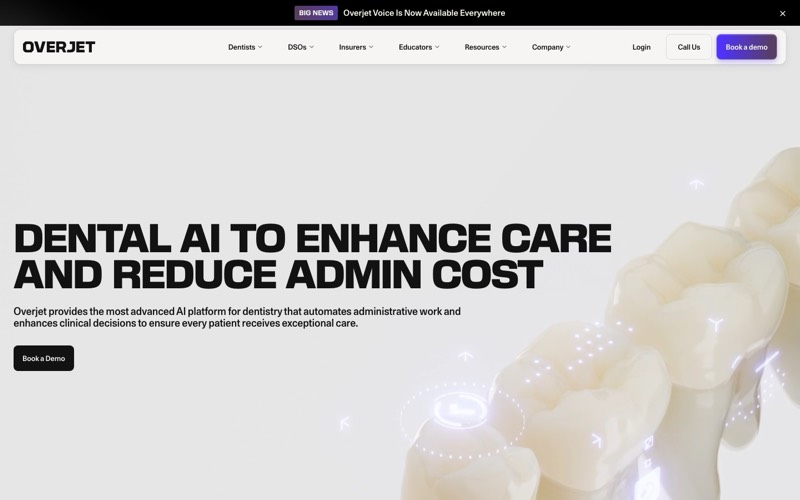
Overjet is the clinical AI vendor here most clearly built for the enterprise buyer, with Vision AI and IRIS for imaging, the Voice AI Suite for ambient clinical notes, and a payer-integration layer that ties claims to clinical findings. Insurance Verification, ReviewPASS, DSO Analytics, and AI-powered credentialing round out the platform. Overjet also acquired DentalBee in December 2025, adding voice-powered clinical documentation to the platform.
PMS integrations: Open Dental, Dentrix Core, Dentrix Ascend, Denticon, and CareStack per the vendor’s own Voice AI setup selector, which carries dedicated setup pages for Dentrix Core and Denticon. Overjet does not publish a single consolidated integrations page, so confirm your system in procurement.
Pricing: Contact sales.
Where it shines: twelve FDA 510(k) clearances, more than any other vendor on this list, spanning caries, calculus, periapical radiolucency, charting, CBCT, and a pediatric-specific algorithm. Add 1,000+ payer integrations for Insurance Verification (homepage-verified) and large-DSO traction with Dental Care Alliance and Jefferson Dental as named clients.
Where I’d hesitate: the platform is best matched to mid-to-large DSOs with the operational maturity to actually use payer-tied workflows, and pricing stays behind a sales call. Single-doctor offices will find the value harder to capture. Overjet’s patent and copyright suit against VideaHealth, which ran through 2024 and 2025, ended on December 22, 2025 when both parties jointly stipulated to dismissal with prejudice. Nothing was adjudicated and neither side was found to have infringed, so it is no longer a procurement consideration.
Best for: mid-to-large DSOs and groups already running centralized billing.
2. Pearl (Clinical Imaging AI)
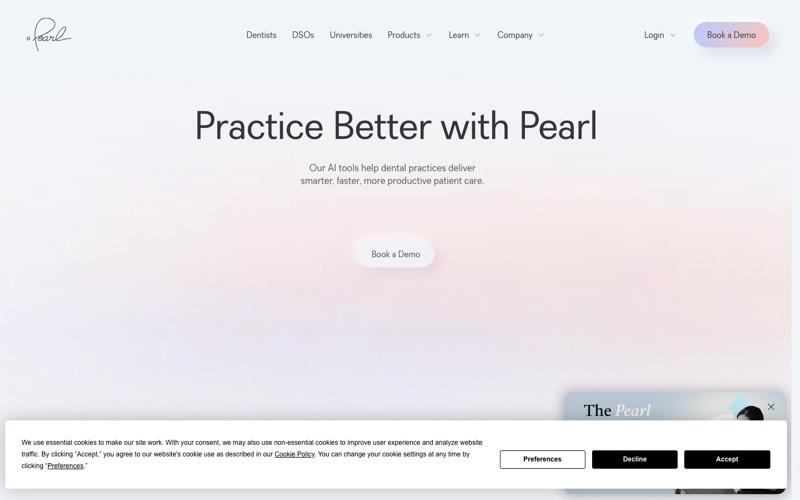
Pearl is the other major clinical imaging suite in dental, anchored by Second Opinion® for 2D radiograph analysis with separate FDA clearances for 3D, panoramic, and periapical work. The platform also includes Second Opinion 3D®, Practice Intelligence®, RCM™, Calibrate®, Precheck™, and Pearl Voice™ for charting.
PMS and imaging integrations: Patterson/Eaglesoft, Open Dental, Planet DDS, Henry Schein One, and Carestream. Pearl counts 40+ integrations across imaging and practice management systems, and names 30+ partners specifically on its partnerships page. Confirm your own system there rather than relying on the headline count.
Pricing: Contact sales.
Where it shines: eight FDA clearances under Pearl, Inc., seven of which landed in 2025, covering 2D, 3D, panoramic, pediatric, and periapical work. The vendor reports 29,000+ practices across 120+ countries, a 37% lift in disease detection, and a 30% lift in case acceptance.
Where I’d hesitate: the breadth of the suite creates real procurement and training overhead at multi-location scale. Premium pricing tier, and the platform is heaviest where you already have radiologists and treatment planners accustomed to clinical decision support.
Best for: multi-location groups with case-acceptance optimization as a board-level priority.
3. Videa, formerly VideaHealth (Clinical Imaging AI)
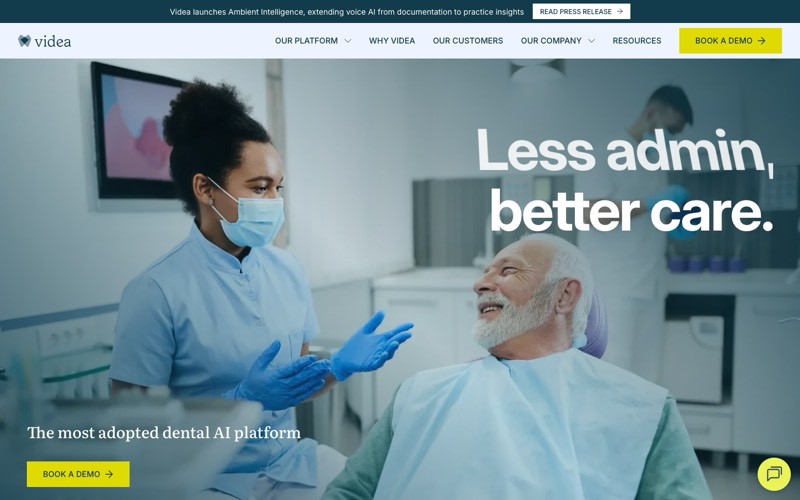
Videa (renamed from VideaHealth in April 2026) positions itself as an AI dental assistant spanning Clinical Assist, Voice Notes, Voice Perio, Daily Dashboard, Insights, Clean Claims, and AutoVerify.
PMS integrations: Open Dental, Dentrix Enterprise, Dentrix Core, Dentrix Ascend, Denticon, and Eaglesoft, per Videa’s published FAQ, which also lists imaging systems including Carestream, Dexis, Sidexis and Apteryx XVWeb. Confirm your versions in procurement.
Pricing: Contact sales.
Where it shines: the vendor reports 90,000+ clinicians on the platform and ships a broader documentation and operations layer than imaging alone, including ambient clinical notes and perio voice charting. Its most recent FDA clearance, Videa Dental AI (K251002), came through in September 2025.
Where I’d hesitate: Videa publishes its integration list in a July 2025 blog FAQ, so get support for your exact PMS and imaging versions in writing before you sign. Much of its distribution runs through Dentrix, where it is the engine behind Dentrix Detect AI, which is worth understanding if you are not a Dentrix group.
Best for: groups that want a single clinical AI vendor covering imaging, documentation, and operations insights together.
4. Dental Intelligence (Front-Office and Operations AI)
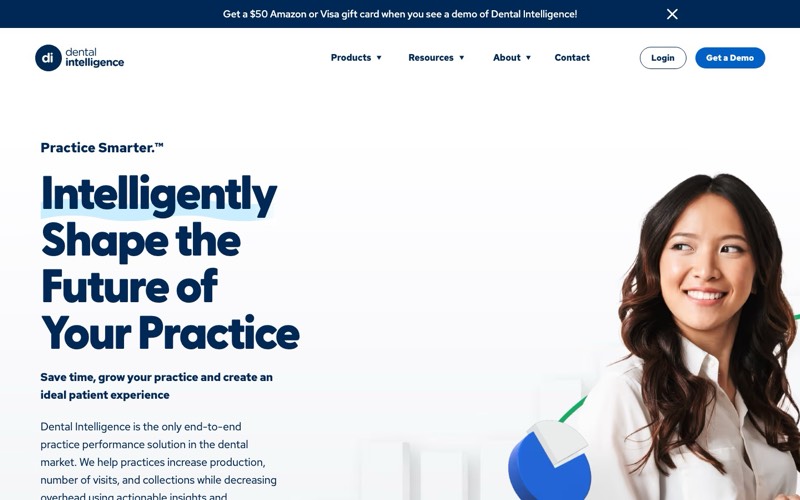
Dental Intelligence is a practice-performance platform covering analytics, patient engagement (now incorporating the former Modento product), online scheduling, payments, and digital forms in one place.
PMS integrations: Open Dental, Dentrix, Dentrix Ascend, Dentrix Enterprise, Eaglesoft, Denticon, Fuse.
Pricing: Contact sales.
Where it shines: the homepage-verified 10,000+ practices, coverage spanning all three Dentrix variants including Dentrix Enterprise, which most competitors here do not touch, and a real cross-location analytics layer. In June 2026 the vendor launched AI Receptionist, which handles calls in 70 languages with one-time-PIN identity verification, and Explorer, a conversational analytics layer. Together they close most of the agentic-AI gap this platform used to have, though both are new enough that they are a pilot rather than something to standardize twenty locations on this year.
Where I’d hesitate: there is no published DSO-scale track record behind the new AI features yet, and pricing is quoted rather than published, which slows procurement at a group evaluating several vendors at once. Some legacy Modento UX still surfaces in the patient engagement layer.
Best for: multi-location groups consolidating multiple point tools into one analytics and engagement layer.
5. Adit (Front-Office and Operations AI)
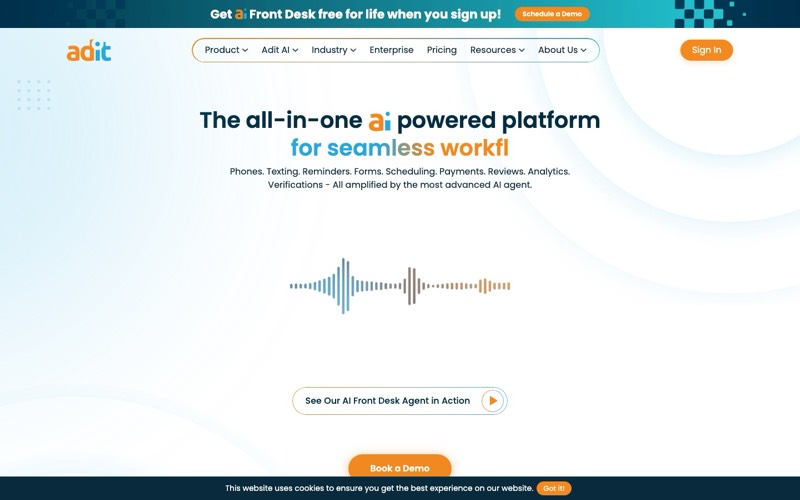
Adit is an all-in-one practice management platform with AI Front Desk and AI Call Intelligence as native modules, alongside texting, scheduling, payments, reviews, and analytics.
PMS integrations: Dentrix, Dentrix Ascend, Open Dental, Eaglesoft, Curve, Denticon, AbelDent, Tracker, and RevolutionEHR, part of the longest published integration list of any tool here, which also reaches orthodontic systems like Cloud9, Dolphin and OrthoTrac.
Pricing: Contact sales.
Where it shines: the vendor reports 5,000+ practices, 30,000+ active users, and 2.4M+ calls per month flowing through the platform, plus 150,000+ appointments booked by AI and 500,000+ AI calls handled, though the vendor attaches no timeframe to those last two figures.
Where I’d hesitate: all-in-one platforms force a rip-and-replace decision. A group already standardized on Dental Intelligence or Weave faces a real migration cost. Adit publishes no pricing at all, which becomes a procurement problem the moment you are comparing it against a vendor that does.
Best for: single-location and smaller multi-location practices looking to consolidate phones, texting, and front-office AI into one vendor.
6. Yapi (Front-Office and Operations AI)
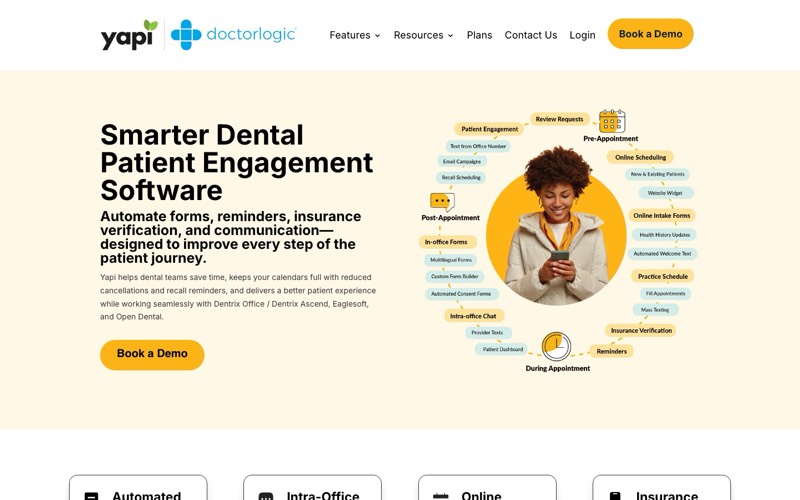
Yapi is a dental-specific patient engagement and intra-office communication platform with insurance verification, digital forms, online scheduling, and reminders. Yapi merged with website and marketing provider DoctorLogic in March 2025 and now goes to market as Yapi + DoctorLogic, which matters if you are buying patient comms and practice marketing from separate vendors today.
PMS integrations: Dentrix, Dentrix Ascend, Eaglesoft, Open Dental.
Pricing: Contact sales.
Where it shines: 200+ insurance carriers verified through the platform, a dental vertical focus since 2009, and one of the cleaner intra-office messaging layers in the market.
Where I’d hesitate: the AI feature surface is referenced as SmartAI Tools without deep public documentation. PMS coverage is the narrowest of the front-office tools here, with no Curve and no Denticon, which becomes a constraint for any group acquiring practices on those platforms. Multi-location reporting is less developed than DSO-specific operations platforms.
Best for: single and small multi-location practices on Dentrix or Open Dental needing strong patient comms and insurance verification.
7. Dentina.AI (AI Patient Communication)
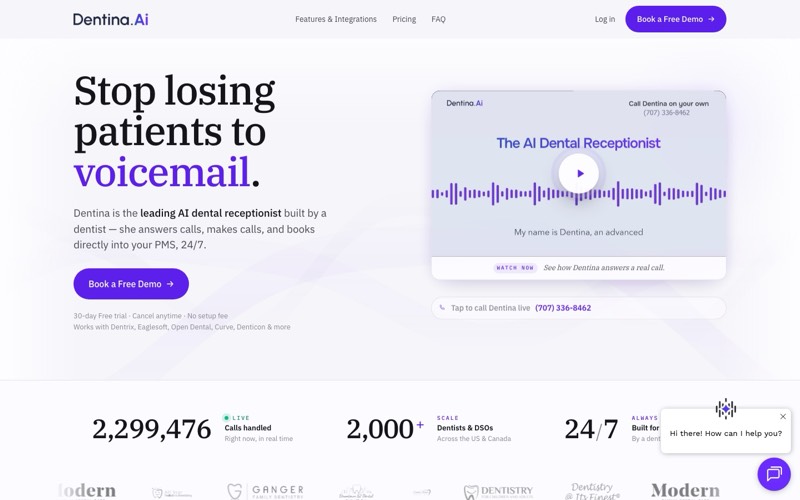
Dentina.AI is a 24/7 AI dental receptionist built by a dentist (founder Peter Gabbay, DDS) that answers inbound calls, books appointments, and writes results back to the PMS in real time. The vendor reports 2,000+ dentists and DSOs across the US and Canada, and runs a live counter of calls handled on its homepage that had passed three million by late August 2026.
PMS integrations: Open Dental, Dentrix, Dentrix Ascend, Dentrix Enterprise, Eaglesoft, Curve, Denticon, Cloud9, Dolphin, OrthoTrac, PracticeWorks.
Pricing: Standard starts at $299/month billed annually or $374/month billed monthly; Premium starts at $399/month billed annually or $499/month billed monthly, per location, up to three providers. It is one of the few vendors on this list that publishes a number at all.
Where it shines: unlimited concurrent calls, English and Spanish standard with 57 languages on Premium, real-time PMS write-back, and a 30-day free trial. Eleven supported systems is wide coverage for a point tool, and it reaches both the ortho platforms and Dentrix Enterprise.
Where I’d hesitate: the company is newer than incumbents like Weave or Adit, with fewer published DSO-scale case studies. Voice is the primary modality. If your group needs deep omnichannel (chat, social DM, web messaging) as the spine, evaluate carefully.
Best for: practices and groups losing the 30-40% of inbound calls that arrive outside business hours, when the front desk cannot answer.
8. Vyne Trellis (AI-Assisted Revenue Cycle)
Vyne Trellis is a cloud RCM platform for claims, attachments, eligibility, ERAs, and payer communications with workflow automation across the revenue cycle. Parent company is Napa EA/MEDX LLC.
PMS integrations: integrates with PMS appointment books. Specific PMS list is not on the Trellis product page. Verify in procurement.
Pricing: a single monthly unlimited service fee with the exact dollar amount via sales.
Where it shines: the vendor reports 84,000+ practices, 112M claims per year, $5.4B in monthly claims, 96% claim acceptance, and 800 payer connections. Those are vendor-reported and unaudited, but no other tool here publishes claims volume in that range.
Where I’d hesitate: Trellis is positioned as revenue acceleration with automation, not as a generative AI product. Groups looking for LLM-driven denials work or AI-summarized payer correspondence should compare against newer AI-RCM entrants. PMS integrations need confirmation in diligence.
Best for: multi-location groups consolidating claims, attachments, and eligibility into one workflow before layering AI on top.
Building Your AI Stack: Solo vs Group vs DSO
Practice scale changes the AI conversation entirely. A solo practice does not need the same investment as a 25-location group running centralized billing, where the operating layer underneath the AI is often what quietly discounts EBITDA at multi-location groups.
- Solo practice (1 location): one clinical AI tool (Overjet, Pearl, or Videa) plus one operations tool (Adit, Yapi, or Dental Intelligence). Stop there. Three vendors is the practical ceiling.
- Small group (2-5 locations): add a 24/7 receptionist layer (Dentina.AI or equivalent) to absorb peak-hour calls and after-hours coverage. Consolidate ops and engagement on one platform. Do not run three overlapping comms tools.
- DSO (6+ locations): evaluate against the six criteria above with multi-location rollout fit and BAA posture weighted highest. A DSO technology playbook is the right framework for sequencing these decisions across an acquisition pipeline rather than per-practice.
The pattern across our deployments: groups that try to stack five AI vendors at once spend twelve months in integration purgatory. Groups that pick two or three, get them deployed cleanly, and add a fourth in year two see compounding returns. The groups that get the most out of any of these tools tend to standardize the stack across locations first, because AI deployed onto six different configurations is six different rollouts.
Dental AI Software FAQs
How much does dental AI typically cost?
Most dental AI vendors do not publish pricing at all. Of the eight tools here, only Dentina.AI lists a number: Standard starts at $299/month billed annually or $374/month billed monthly, and Premium at $399/month billed annually or $499/month billed monthly, per location, up to three providers. Everyone else routes you to a sales call, which means the real cost depends on your location count, provider count, and how hard you negotiate. Ask every vendor whether the quote scales with locations or with providers before you compare two numbers, because the two structures produce very different totals at fifteen offices.
What is the best AI dental notes software?
There is no separate winner to buy here anymore. Ambient documentation has been absorbed into the clinical platforms, so the honest answer is that you evaluate it as one feature of whichever imaging vendor you pick rather than as its own purchase. The question that decides it is not transcription quality, which is broadly good across all of them now. It is whether the finished note lands in your practice management system as a structured note your team can actually use, or as a block of text somebody has to re-key. Ask for a live demo against your own PMS and your own vocabulary, with a real perio case, before you believe any accuracy number a vendor quotes you.
Which AI is best for dental practices?
It depends on which problem you are solving and how many locations you run. For clinical imaging, Overjet holds the most FDA clearances at twelve, Pearl has eight, and Videa has four. For front-office operations, Dental Intelligence and Adit consolidate analytics, scheduling, and communications. For after-hours calls, Dentina.AI answers around the clock. A solo practice should run one clinical tool and one operations tool and stop there. A multi-location group should weigh PMS integration depth and BAA posture above feature lists, because those are what actually break during a rollout.
Is there free dental AI software?
Not in any meaningful way for a practice. Every tool in this comparison is a paid commercial product. Dentina.AI offers a 30-day free trial, and it is worth asking any vendor whether they will run a pilot at one location before you commit the whole group. Treat a trial or pilot as the realistic entry point rather than looking for a free product, and use it to test PMS write-back against your own data.
Do dental AI vendors sign a BAA?
They should, and you should not sign anything until they do. Any vendor that touches protected health information needs a current Business Associate Agreement with subcontractor flow-down and a documented sub-processor list, which covers the clinical imaging, patient communication, and revenue cycle tools here. Ask for it in writing during procurement rather than after. A vendor that hesitates on a BAA, or that cannot tell you which subcontractors touch your data, is telling you something about how they will handle an incident.
What Happens Next in Dental AI
The interesting shift over the next eighteen months will not be more AI tools. It will be which ones survive the integration test. Most multi-location groups will not have bandwidth for eight separate AI vendors with eight separate logins, eight identity baselines, and eight per-chair invoices. The tools on this list that consolidate, integrate with the dominant PMS platforms, and ship with real identity governance will compound. The rest will quietly sit unused inside dashboards nobody opens.
Posted in AI in Dentistry