
September 30th, 2026
AI in Dentistry: How Dental Practices and DSOs Use AI in 2026
Industry Research — AI in Dentistry
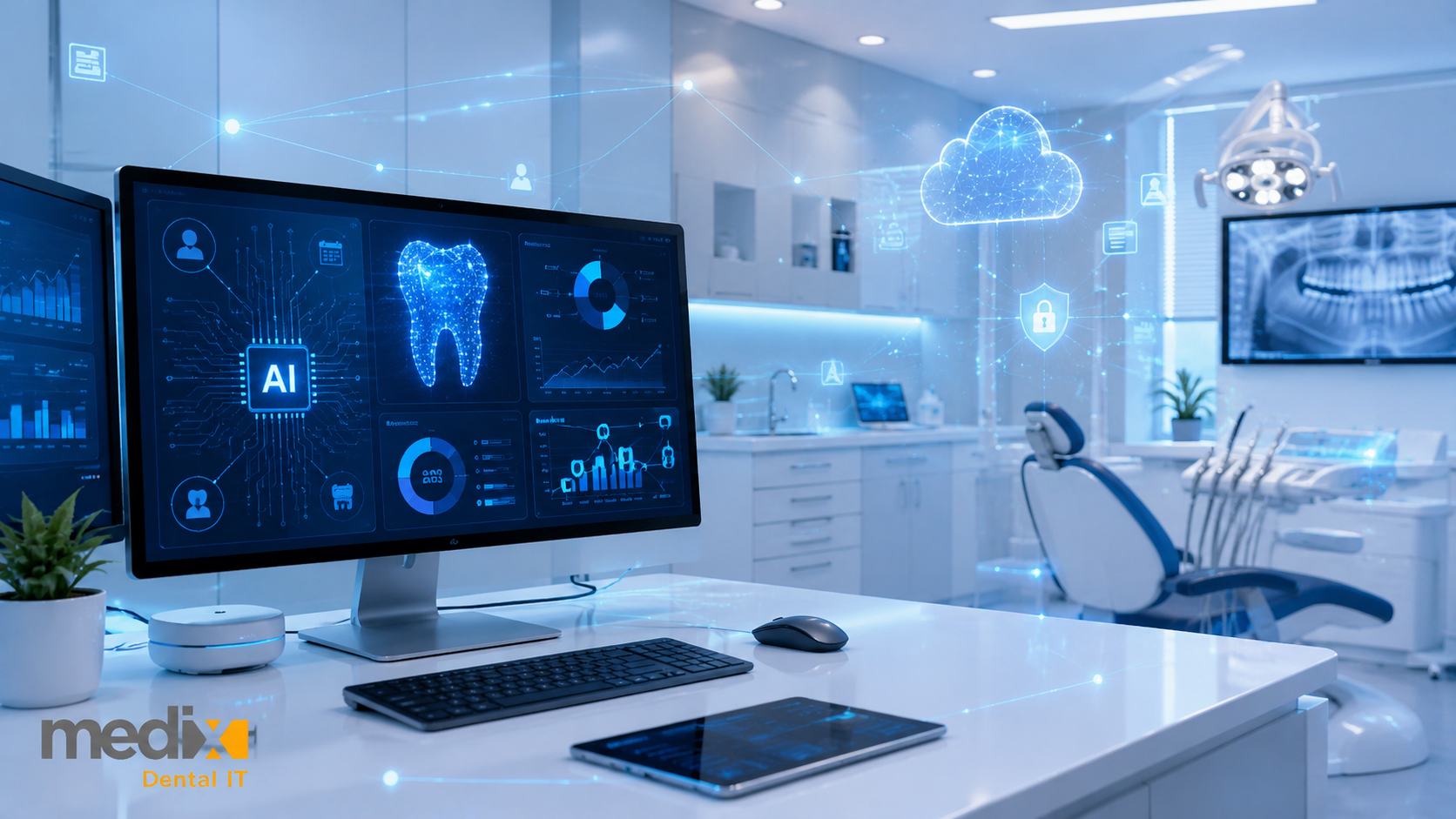
How dental practices and DSOs can use AI is no longer a clinical question. Imaging, scheduling, billing, and patient communication are all being rebuilt around it. For the 16.1% of US dentists already affiliated with a DSO, and the 27% of dentists less than ten years out of school who joined one (ADA Health Policy Institute, 2024 data), AI is becoming an operational standard rather than an experiment.
AI in dentistry is the use of machine learning and computer vision to read radiographs, support treatment planning, and automate front-office work like scheduling, billing, and patient communication. Practices use it to detect caries, bone loss, and periodontal disease earlier, and to cut the manual load on the front desk.
For a solo practice, the question is which tool to start with. For a multi-location group, the question is harder. It is how AI gets deployed consistently across ten, fifty, or two hundred practices without creating ten, fifty, or two hundred new security and governance problems.
Most of what is written about AI in dentistry assumes a single office adopting a single tool. That is half the story. The other half is what happens when a growing group, or a DSO that acquired practices on different PMS platforms, different imaging vendors, and different staff training baselines, tries to layer AI on top of that mix. Without a standardization plan it turns a productivity tool into a compliance liability.
This is an operator’s view of how dental practices and DSOs are actually using AI in 2026, with practical guidance for both solo offices and multi-location groups.
What Is AI in Dentistry?
AI in dentistry falls into two broad buckets. Clinical AI reads and interprets images: FDA-cleared tools flag caries, calculus, bone loss, and periodontal disease on radiographs and CBCT scans, and support treatment planning. Operational AI handles the practice around the chair: AI receptionists answer calls and book appointments, recall automation fills the schedule, and coding tools speed up billing and claims. For a side-by-side view of the specific vendors in each bucket, see our ranked guide to the best AI software for dental practices.
For a patient or a clinician, the near-term value is earlier detection and less missed pathology. For a practice owner, it is front-desk hours saved and higher case acceptance. For a multi-location group, it is all of that made consistent across every location, which is where the operator work begins. No, it does not replace the dentist. It changes what the dentist and the team spend their time on.
Where AI Is Actually Being Used in Dentistry Today
Four categories matter for both single-office leaders and DSO leadership. Treat them as separate decisions, not a single platform play.
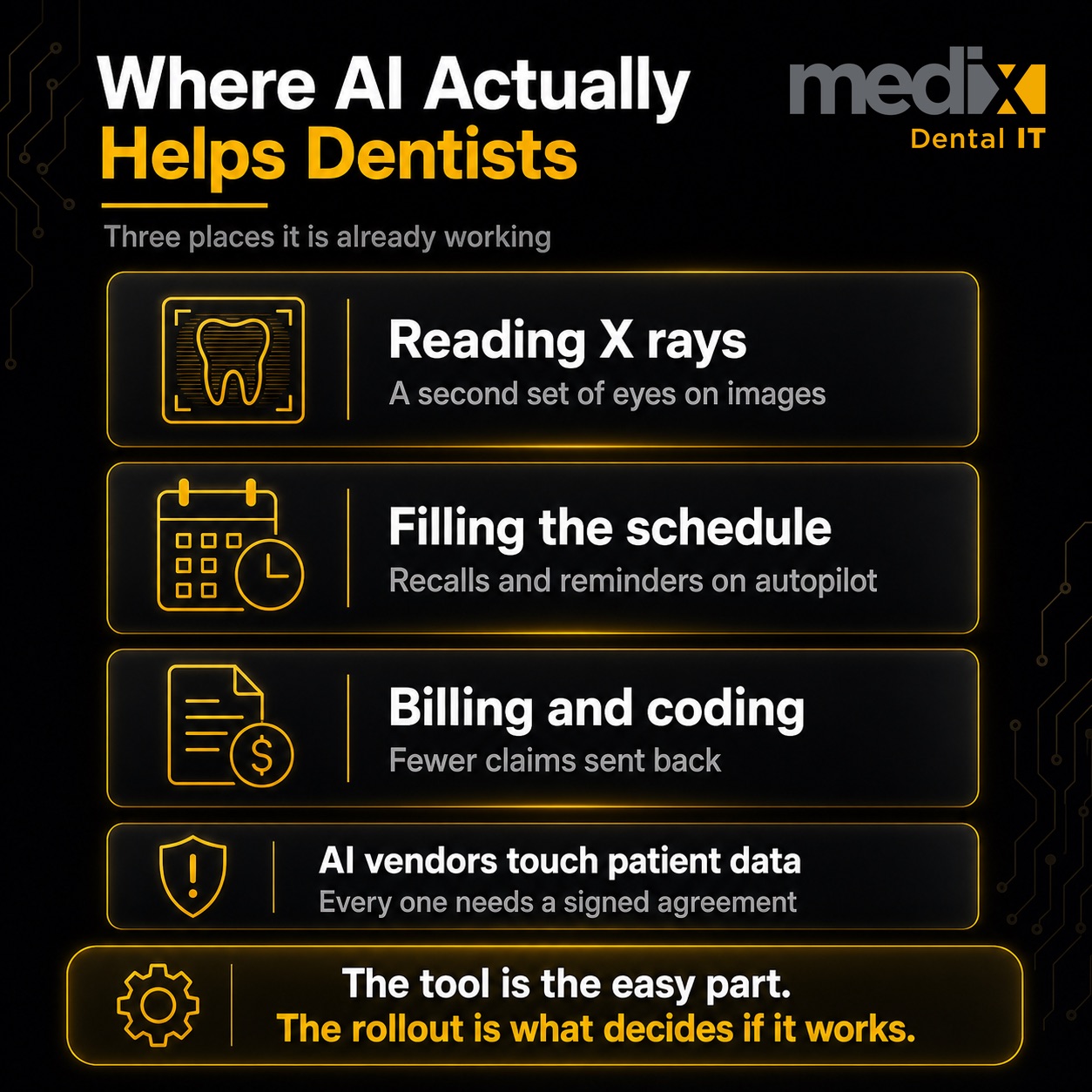
Clinical AI. AI-assisted imaging interpretation, treatment planning, and clinical decision support. The most mature category. FDA 510(k) cleared tools include Pearl (K210365), Overjet (K222746 for Caries Assist and K251514 for CBCT Assist), and VideaHealth (cleared in January 2024 for 30+ detections). Vendor-reported outcomes are improving. Pearl reports its AI helps clinicians catch 37% more disease across more than 29,000 practices using the platform. Videa Health reports a 119% increase in caries detection and a 20% lift in case acceptance among its users. Both numbers are vendor-reported, but the FDA clearances are not.
Front-office AI. AI receptionists, scheduling agents, recall automation, billing and CDT/CPT coding, and AI-powered patient communication. Tools include Weave, Yapi, and emerging voice-first agents. Most front-office AI integrates directly with PMS platforms like Dentrix and Open Dental. The integration depth varies wildly by vendor, which is exactly where DSOs get burned.
Voice AI is also moving into the operatory. Voice charting lets a clinician call out perio readings and findings hands-free, and ambient scribes can draft clinical notes from the chairside conversation. Treat these like any other AI vendor with access to patient data: a signed BAA, a clear answer on whether audio is retained and for how long, and a check of your state’s recording-consent rules before the first patient conversation is captured.
Multi-location operations AI. Provider performance analytics, diagnostic consistency benchmarking across locations, scheduling capacity optimization, and AI-powered data warehouses that pull from PMS, imaging, billing, and marketing systems. This category barely exists in solo-practice content because solo practices do not need it. For DSOs it is the highest-leverage category.
Governance and risk AI. Less talked about. AI is now part of the cybersecurity threat surface, not just the productivity stack. AI-generated phishing, voice cloning, and deepfake invoice fraud are real and present. Microsoft Research found multifactor authentication reduces account compromise risk by 99.22% (a 2023 study of general MFA), yet a meaningful share of dental organizations still treat it as optional.
If a practice or group does not have an explicit position on each of these four categories, it does not have an AI strategy. It has an AI vendor list.
The Dental AI Vendor Decision Framework
A single-office decision is “does this tool work?” A multi-location decision adds four more questions. Solo practices can run a lighter version of this filter. Groups should run every AI vendor through all of it before signing.
| Criterion | What to verify | Why it matters at scale |
|---|---|---|
| FDA clearance | Specific 510(k) K-number, indication for use, dental-specific scope | Clinical AI without clearance is an audit and malpractice exposure |
| BAA terms | Business Associate Agreement signed before any PHI flows, with subcontractor flow-down clauses | One unsigned BAA across 30 locations is a HIPAA finding waiting to happen |
| PMS integration | Native support for the PMS platforms in your group, not just “API available” | Mixed-PMS DSOs need vendors that support all platforms, not one |
| Enterprise identity | SSO support (SAML, Entra ID), role-based access, MFA enforcement | Per-location logins do not scale and cannot be audited |
| Multi-tenant reporting | Org-level analytics across locations, not just per-office dashboards | A COO cannot benchmark providers from ten separate vendor portals |
| Pricing model | Per-provider, per-location, or per-image, and contract scalability | Some vendors price for solo offices and quietly punish DSO scale |
| Disclosure compliance | Whether the tool triggers state-level AI disclosure laws | California AB 3030 (Jan 2025) requires a disclaimer and instructions for reaching a human on AI-generated patient messages about clinical information, unless a licensed or certified provider read and reviewed the communication. Texas SB 1188 (Sept 2025) requires practitioners who use AI for diagnosis to tell patients |
This table is the part of the conversation most AI vendors do not want to have. It is the part that matters.
How to Roll Out AI Across One Practice or Many
Most posts on dental AI cover what tools exist. They skip how to actually deploy them. The deployment sequence is what separates the practices that get value from the ones that get audited.
Here is the sequence we recommend, whether the rollout is a single office or a fifty-location group.
1. Pick one category, not all four. Start with clinical imaging AI or front-office AI. Do not roll out both simultaneously. Each one creates its own staff training and integration load.
2. Run a single-location pilot for 60 to 90 days. Choose a location with a stable provider, a current PMS deployment, and a manager who actually wants the pilot. Measure the right baseline before turnover skews the numbers.
3. Define the KPIs before the pilot starts. For clinical AI, that is case acceptance rate, missed pathology rate, and clinician override rate. For front-office AI, that is recall booking rate, no-show rate, and front-desk hours saved per week. Without baseline numbers, every vendor case study sounds great.
4. Standardize before you scale. If the pilot works, write the deployment playbook before adding the second location. PMS integration steps, user provisioning, MFA enforcement, training curriculum, BAA execution, and the off-boarding process when a provider leaves. If it is not documented, it does not scale.
5. For groups, add locations in cohorts. Three to five locations at a time, not all at once. Each cohort surfaces edge cases the pilot missed, and each cohort gives the next one a smoother rollout. A solo practice can skip this step and move to step six directly.
6. Build a quarterly governance review. Vendor performance, KPI trends, security incidents, false positive and false negative rates on clinical AI, and any state regulatory changes. AI is not a deploy-and-forget category.
A roll-up only becomes a platform when its operating environment is repeatable. AI is no different.
Where AI Becomes a Cybersecurity Problem
AI is reshaping the threat surface as much as it is reshaping the productivity stack. Every practice needs to plan for both sides of that shift, and groups need to plan for it at scale.
AI-generated phishing is now context-aware and indistinguishable from legitimate communication. Voice cloning is being used to impersonate office managers and clinicians in invoice fraud attempts. Deepfake video is starting to surface in vendor impersonation scams. The signals dental staff were trained to spot in 2020 are gone.
At the same time, AI tools themselves are part of the attack surface. Every AI vendor with PHI access becomes a third-party risk. Every AI tool with a browser plug-in becomes a credential exposure path. Every AI receptionist with call recording becomes a wiretap compliance question. The Lisota v. Heartland Dental & RingCentral case in the Northern District of Illinois, which challenged AI monitoring of practice phone calls under the federal Wiretap Act, was dismissed with prejudice in July 2026. The federal Wiretap Act claim failed, but the case shows that AI call monitoring can draw litigation, and state recording-consent laws are a separate question.
The defensive baseline does not change because AI is involved. Enterprise MFA. Endpoint detection and response. Identity governance inside Microsoft 365 or Google Workspace. Quarterly vulnerability management. A vendor risk register. The same baseline that any modern dental IT support program should already cover. The 99.22% MFA risk reduction figure from Microsoft Research applies whether the attack is AI-generated or not. The question is whether MFA is actually enforced across the entire organization.
Antivirus is not a cybersecurity program. Adding AI to the practice does not change that. It only raises the cost of getting it wrong.
Where AI Sits in the Dental Data Strategy
PMS dashboards show outcomes. They do not show drivers. AI’s quiet value, especially at multi-location scale, is in the data warehouse layer, not the imaging plug-in.
A practice or group that unifies PMS, imaging, billing, marketing, and patient communication data into a single warehouse can use AI for things a single dashboard cannot reach. Predictive patient retention modeling. Payer performance analysis across locations. Provider-level diagnostic consistency benchmarking. Marketing ROI tied to actual treatment acceptance rather than lead volume. Scheduling capacity optimization across a region.
This is the difference between a dashboard and a data warehouse. Reporting versus intelligence. Most dental groups are still measuring outcomes. The ones that win the next five years will measure drivers.
Open Dental supports this directly. Several large DSOs are running hundreds of locations on a single Azure-hosted Cloud Open Dental database (opendental.com). That is the architectural pattern that lets AI work across an organization rather than inside a single office.
The Bottom Line for Dental Practices and DSOs
Dental AI is past the “should we look at this?” stage. The tools are real, the FDA clearances are real, and the operating leverage is real for practices and groups that deploy them with discipline.
What separates the offices and DSOs that get value from the ones that get audited is not vendor selection. It is governance, standardization, and a deployment sequence that treats AI as a platform decision rather than a per-office experiment. Pick a category. Run a pilot. Build the playbook. Scale in cohorts. Review quarterly.
If you are running a single office or scaling past ten locations and trying to figure out which AI categories actually justify the deployment cost, we publish dental IT roadmaps and vendor evaluation frameworks regularly. Happy to compare notes.
How Dental Practices and DSOs Can Use AI FAQs
How should a single dental practice start using AI?
Start with one category, not all four. Most solo practices begin with either clinical imaging AI (Pearl, Overjet, VideaHealth) or a front-office tool like an AI scheduling agent or recall automation. Define the baseline metrics before turning the tool on, run it for 60 to 90 days, and decide based on real numbers rather than vendor case studies. Confirm a signed Business Associate Agreement is in place before any patient data flows to the vendor.
How do DSOs deploy AI across multiple locations without creating inconsistency?
DSOs that succeed with AI standardize before they scale. That means selecting one AI category at a time, running a 60 to 90 day single-location pilot with defined KPIs, writing a deployment playbook before adding the second location, and rolling out in cohorts of three to five locations. AI deployed without a playbook becomes ten different configurations in ten different offices, which is the opposite of what a multi-location group needs.
Which AI tools in dentistry are FDA cleared?
As of 2026, Pearl holds FDA 510(k) clearance K210365 for 2D imaging and a separate clearance for 3D. Overjet holds K222746 for Caries Assist and K251514 for CBCT Assist. VideaHealth received clearance in January 2024 covering more than 30 detections. Other tools may be marketed as AI-assisted without holding a 510(k) clearance, which matters for clinical use and audit defense. Verify the K-number directly at fda.gov before deploying a clinical AI tool in a multi-location group.
Does AI in dentistry create new HIPAA or compliance risks?
Yes. Every AI vendor with access to protected health information is a third-party risk that must be governed under a signed Business Associate Agreement, with subcontractor flow-down clauses. AI receptionists with call recording can trigger wiretap claims in two-party-consent states. California AB 3030 (effective January 2025) requires a disclaimer and instructions for reaching a human on AI-generated patient messages about clinical information, unless a licensed or certified provider read and reviewed the communication. Texas SB 1188 (effective September 2025) requires practitioners who use AI for diagnosis to disclose that use to patients. DSOs need to audit AI usage across all locations the same way they audit any other PHI-handling system.
What is the ROI of AI for a multi-location dental group?
ROI depends on category and deployment discipline. Clinical AI vendors publish case acceptance and detection lifts, with Videa Health reporting a 20% lift in case acceptance and a 119% increase in caries detection among its users (vendor-reported figures). Front-office AI typically targets recall booking rate, no-show rate, and front-desk hours per location. The honest answer is that DSOs that deploy AI without baseline KPIs cannot calculate ROI at all. Define the baseline before the pilot.
Can AI work with mixed PMS environments across acquired practices?
Sometimes. Most AI vendors integrate with Dentrix, Eaglesoft, or Open Dental, but not always all three. DSOs growing through acquisition often inherit mixed PMS deployments, which forces a choice. Either standardize the PMS environment first, or select AI vendors that support the entire PMS mix in the group. Vendors that “support APIs” but lack native integration tend to create more work than they save at scale.
How does AI affect a DSO’s exit multiple or PE diligence?
AI usage is becoming a diligence item the way cybersecurity became one five years ago. Buyers and lenders look at vendor contracts, BAA coverage, data flow documentation, and whether AI is deployed consistently or as a per-location experiment. Unintegrated AI usage looks like the same operational complexity that already discounts valuation. Integrated AI usage, governed by a real playbook, can support a higher multiple by demonstrating operational maturity.
Is Open Dental capable of supporting AI at DSO scale?
Yes. Open Dental supports Azure-based cloud deployment, and DSOs are running hundreds of locations on a single Cloud Open Dental database (opendental.com). Most integration-forward dental AI vendors build for Open Dental first. The misconception that Open Dental is only suitable for small practices costs DSOs years of avoidable platform migration.
What is AI used for in dentistry?
AI in dentistry is used for two main jobs. Clinically, it reads radiographs and CBCT scans to flag caries, bone loss, and periodontal disease earlier and to support treatment planning, using FDA-cleared tools like Pearl, Overjet, and VideaHealth. Operationally, it answers inbound calls, books and confirms appointments, automates recall, and speeds up billing and insurance coding. The clinical side improves detection and case acceptance; the operational side saves front-desk hours.
Will AI replace dentists?
No. Current dental AI is assistive, not autonomous. FDA clearances for tools like Pearl and Overjet cover detection support and treatment-planning aids, not independent diagnosis or treatment. A dentist reviews and confirms every AI-flagged finding, and clearances require a licensed clinician in the loop. What AI changes is where the dentist and team spend time, shifting effort from manual review and front-desk tasks toward clinical judgment and patient care.
How much does dental AI software cost?
Pricing varies by category. Most clinical imaging AI vendors (Pearl, Overjet, VideaHealth) route pricing through a sales call rather than publishing rates, and price per provider, per location, or per image. Front-office and AI-receptionist pricing varies by vendor and features, so check the current quote for each location. For a multi-location group, the real cost driver is not the per-seat rate but integration, identity governance, and Business Associate Agreement coverage across every location.
Posted in AI in Dentistry