June 15th, 2026
Dental IT Support Provider in Atlanta, GA – Secure Your Practice
Industry Research — Service Areas
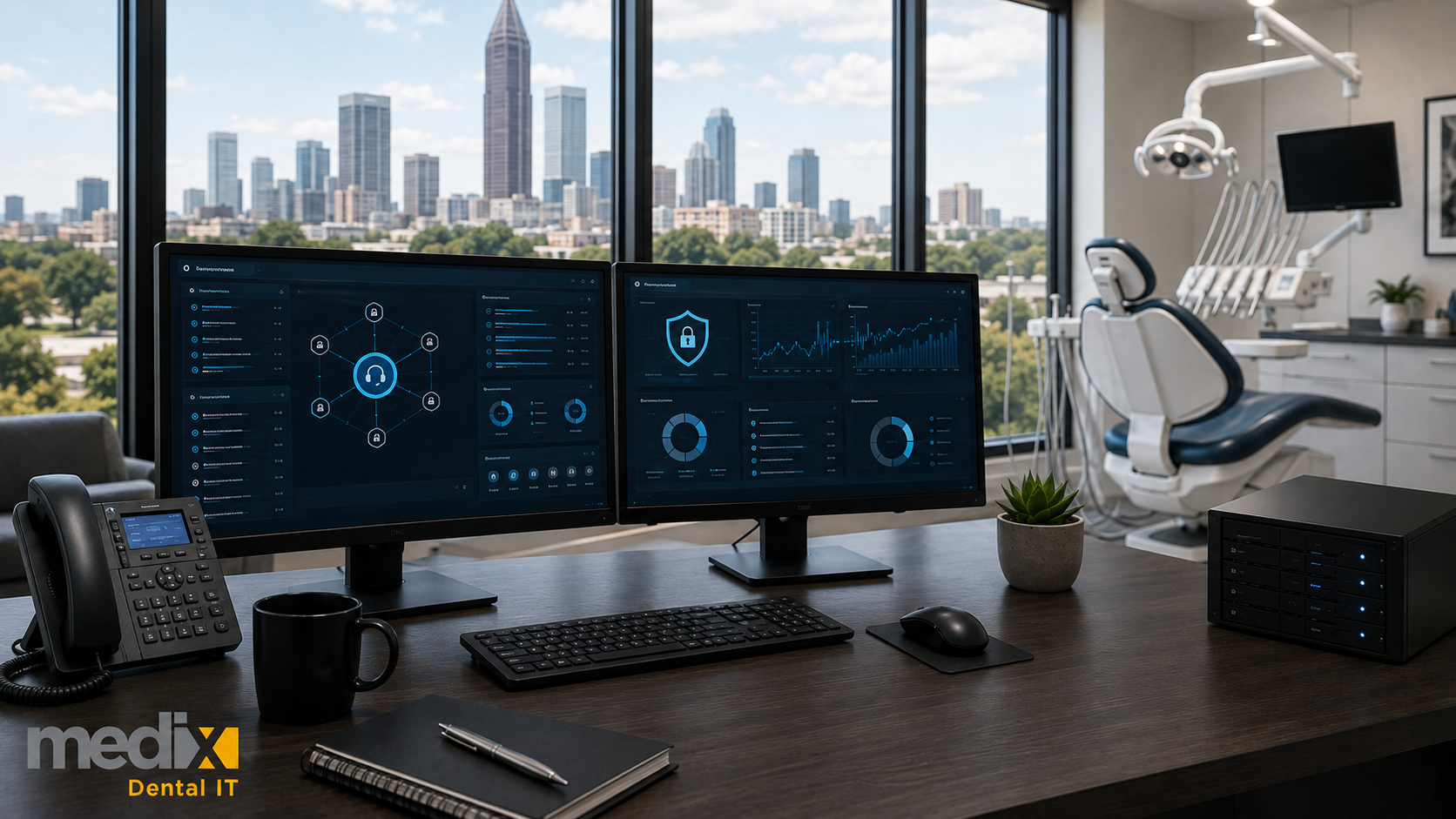
Strong dentistry in metro Atlanta takes more than skilled clinicians and modern operatories. It takes technology that holds up under pressure.
Running a dental practice in Atlanta dental IT support territory means protecting patient data, meeting HIPAA and Georgia-specific breach notification rules, and keeping practice management software, imaging systems, and phones running through every appointment. It also means planning for the summer storms that routinely take the power out across north Georgia. Medix Dental IT works with dental practices and DSOs across the Atlanta-Sandy Springs-Roswell metro on exactly that. The metro is now home to more than 6.4 million people (U.S. Census Bureau), the sixth-largest in the country and one of the fastest-growing. That growth reaches from Buckhead and Midtown out to Marietta, Alpharetta, Roswell, Sandy Springs, Johns Creek, Smyrna, Kennesaw, Decatur, Dunwoody, Duluth, Lawrenceville, and Peachtree City, all full of practices that depend on systems staying up.
Dental IT Support for Atlanta Practices and DSOs
Dental IT is not generic small-business IT. A dental network runs a specialized stack: Dentrix, Eaglesoft, Open Dental, Dolphin, Carestream, and Sidexis, often alongside CBCT imaging that produces large files and demands a HIPAA-aligned identity model. A generalist provider who treats a dental office like a law firm with a server tends to miss the details that quietly cost a practice real money. As Tom Terronez puts it, every minute of downtime is revenue walking out the door.
Medix Dental IT has worked exclusively in dental for more than 20 years and supports over 1,000 practices nationwide. Support is remote-first from a national operations center with on-call dispatch, so an Atlanta practice gets the same response whether the issue is a frozen workstation in Decatur or a server alert in Alpharetta. The goal is not to sell more technology. It is to keep what you already run boring and predictable, because boring is cheaper than chaos.
Key Dental IT Services for Atlanta Practices
Most Atlanta practices and groups need the same core set of services, delivered consistently rather than reactively.
Cybersecurity and HIPAA protection. Patient records are a target, and a dental office is a softer one than a hospital. Medix builds a layered defense and runs regular cybersecurity assessments so gaps are found before an attacker finds them, not after.
Data protection and disaster recovery. In a metro where summer storms take practices offline every year, backup is not a checkbox. Medix designs backup and disaster recovery that is tested, not assumed, so a practice can be back in the chair quickly after an outage.
24/7 support and monitoring. Systems are watched around the clock, so problems are caught before the front desk ever sees a spinning wheel.
Cloud and Open Dental hosting. For practices moving off aging on-site servers, Medix offers Open Dental cloud hosting that keeps records accessible and secure without a closet full of hardware.
Lifecycle planning. Hardware gets replaced on a schedule, not when it dies mid-appointment. Workstations run on a four-to-five-year refresh and servers on five-to-seven, so a Roswell practice is never running clinical software on a machine that should have been retired.
The Atlanta DSO Market Is One of the Most Active in the Southeast
Metro Atlanta is a serious DSO market, and several of the largest groups have a real local footprint. Sage Dental, one of the dominant operators across Georgia and Florida, runs offices including a Midtown Atlanta location on Peachtree Street. Great Expressions Dental Centers has a deep Georgia presence with multiple metro Atlanta offices. Aspen Dental operates in the Cumberland area off Cobb Parkway, Heartland Dental supports offices around Marietta and Austell, and PDS Health (formerly Pacific Dental Services, now headquartered in Henderson, Nevada) has offices in the Canton and Peachtree City areas.
When a group scales across that many locations, IT is what makes the growth real or fake. As Tom Terronez says, if your DSO operates like 15 separate practices, expect to be valued like 15 separate practices. The fix is a single security baseline, unified identity, and rolled-up reporting across every site. That is the difference between a platform and photocopying chaos. Medix builds IT for dental service organizations around exactly that standardization.
Summer Storms Are an Atlanta Dental IT Risk, Not Just a Weather Story
Atlanta does not get hurricanes the way the coast does, but it gets summer thunderstorms that take the grid down with regularity. On August 17, 2024, a single round of storms cut power to more than 22,000 Georgia Power customers across metro Atlanta and north Georgia (WSB-TV). That is not a freak event. From 2000 to 2023, 83 of Georgia’s 84 major power outages, roughly 99 percent, were weather-driven (Axios Atlanta, citing Climate Central). For a dental practice, an outage is not an inconvenience. It is a half-day of cancelled production if the recovery plan is not ready.
The grid is also getting tighter. Georgia Power projects roughly 8,500 megawatts of new load over the next six years, much of it from data centers, straining the same system Atlanta practices run on (Georgia Power 2025 IRP). None of that has to hurt a prepared practice. Uninterruptible power on the critical hardware, cloud failover for practice management, and a recovery plan that has actually been tested turn a storm into a non-event instead of a lost day.
Georgia Dental Cybersecurity and Compliance
Every Georgia dental practice operates under two compliance layers. HIPAA is the heavy one: the Breach Notification Rule requires notifying affected individuals no later than 60 days, notifying HHS, and notifying the media when a breach affects 500 or more people. Georgia layers its own statute on top, the Georgia Personal Identity Protection Act, O.C.G.A. § 10-1-912, which requires notice “in the most expedient time possible and without unreasonable delay.” Georgia sets no fixed day count for individuals and requires no notice to the state Attorney General. Because the state law is written narrowly for data brokers and collectors, HIPAA’s 60-day clock is the standard a dental practice should plan around. State law is a backstop, not the driver.
The defensive baseline that keeps a practice on the right side of both is consistent regardless of city. Enterprise MFA. Endpoint detection and response. Identity governance. Quarterly vulnerability management. A vendor risk register. The single highest-leverage item on that list is multifactor authentication, which Microsoft research found blocks more than 99.22 percent of account compromise attacks (Microsoft Research). Antivirus alone is not a cybersecurity program.
Why Atlanta Dental Practices Work With Medix
Dental focus, not a dental side practice. More than 20 years working exclusively in dental means Medix knows the software, the imaging, and the compliance overhead a generalist MSP learns on your dime.
Enterprise-grade cybersecurity by default. MFA, EDR, and identity governance are the baseline, not the upsell.
Real KPI reporting. Uptime, ticket trends, endpoint compliance, MFA adoption, backup health, and hardware age distribution, reported in plain numbers. If your current provider cannot show you a dashboard, they are not really managing anything.
Built for Atlanta’s growth and Atlanta’s weather. Standardized IT that scales cleanly as a group adds locations across the metro, with backup and failover designed for a region where summer storms are a when, not an if.
The Bottom Line for Atlanta Dental Practices
Atlanta dentistry runs on specialized software, a real compliance overhead, a growing threat surface, and a power grid that summer storms test every year. Generic IT support handles none of that well. Dental-specific IT handles all of it as the default.
If you are evaluating dental IT support for an Atlanta practice and want a second set of eyes on your current setup, we are happy to compare notes.
Atlanta Dental IT Support FAQs
What areas of metro Atlanta does Medix Dental IT support?
Medix supports dental practices and DSOs across the Atlanta-Sandy Springs-Roswell metro, including Buckhead, Midtown, Marietta, Alpharetta, Roswell, Sandy Springs, Johns Creek, Milton, Smyrna, Kennesaw, Decatur, Dunwoody, Brookhaven, Duluth, Lawrenceville, and Peachtree City. Support is remote-first with on-call dispatch.
How should an Atlanta practice prepare its IT for summer storm outages?
Three things: uninterruptible power on the critical hardware so a brief outage does not corrupt a database, cloud failover so records stay reachable, and a disaster recovery plan that has actually been tested. With 99 percent of Georgia’s major outages being weather-driven, the plan should assume an outage will happen, not hope it won’t.
How does Georgia breach notification differ from HIPAA?
Georgia’s statute, O.C.G.A. § 10-1-912, requires notice “in the most expedient time possible and without unreasonable delay” but sets no fixed deadline and requires no notice to the Attorney General. HIPAA is stricter: notice to individuals within 60 days, notice to HHS, and media notice at 500 or more affected. For a dental practice, HIPAA is the operative standard and Georgia law is a narrower backstop.
Do you support Atlanta DSOs and multi-location dental groups?
Yes. Multi-location groups get a single security baseline, unified identity across every site, and rolled-up KPI reporting that treats the group as one organization instead of a collection of independent offices. That standardization is what makes a roll-up operate, and value, like a real platform.
Which dental software does Medix support in Atlanta?
Medix supports the full dental stack, including Dentrix, Eaglesoft, Open Dental, Dolphin, Carestream, Sidexis, Ortho2, and Planmeca, along with the imaging and identity systems that run alongside them.
Posted in Service Areas