
July 1st, 2026
Dental IT Support Services in Kansas City – Protect Your Practice
Industry Research — Service Areas
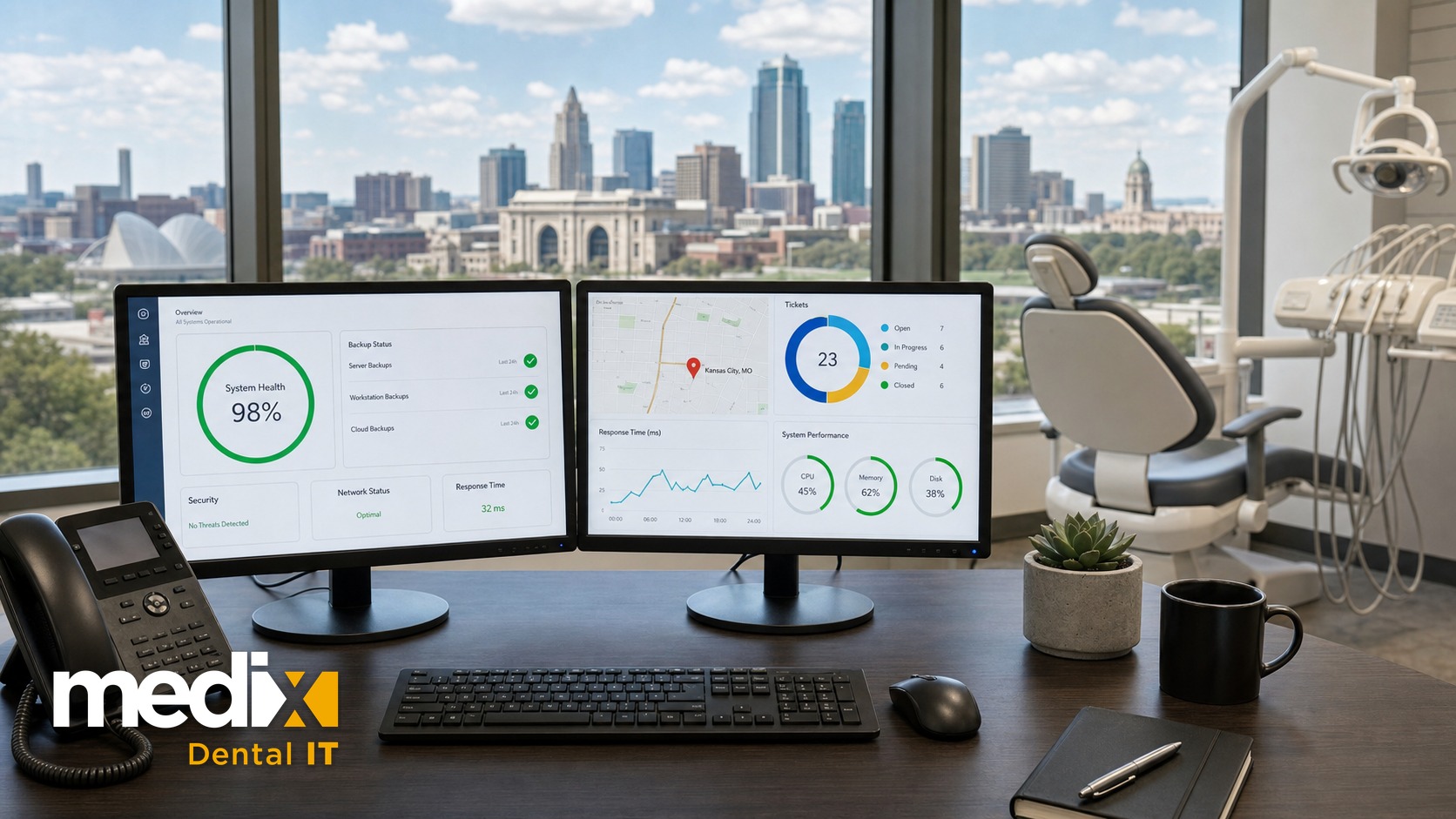
Kansas City is one of the few major dental markets split down the middle by a state line. That single fact changes how a practice here has to run its technology.
Dental IT support in Kansas City is not just help-desk coverage for a busy operatory. For any practice with patients on both sides of State Line Road, it is the difference between a clean compliance posture and a mess of conflicting breach-notification duties. At Medix Dental IT, we work exclusively with dental practices and dental service organizations (DSOs), and the metro’s two-state footprint is the first thing we account for.
The Two-State Problem Every KC Practice Should Understand
A dentist in Leawood and a dentist in Lee’s Summit answer to two different data-breach laws. If patient data is exposed, the two states do not ask for the same thing.
Missouri, under Mo. Rev. Stat. 407.1500, requires notice to affected patients without unreasonable delay. When a single breach touches more than 1,000 Missourians, you also have to notify the Missouri Attorney General and the national credit bureaus. Kansas, under K.S.A. 50-7a02, sets the same 1,000-person trigger for notifying the credit bureaus, but does not require notifying the state Attorney General the way Missouri does.
A KC-metro group that draws patients from both Johnson County and Jackson County can trip both regimes with one incident. That is on top of HIPAA, which applies everywhere. The practices that handle this well decide who notifies whom before anything goes wrong, not during the scramble.
Dental IT Support Across the Kansas City Metro
We support practices across the full metro, both states included: Overland Park, Olathe, Lenexa, Shawnee, Leawood, and Prairie Village on the Kansas side, and Independence, Lee’s Summit, Blue Springs, Liberty, and Raytown on the Missouri side, along with the urban core in Kansas City itself.
That reach matters because Kansas City is a real DSO market. Groups like Comfort Dental and Aspen Dental run multiple offices across the metro, and Heartland Dental supports practices here too. A multi-location group in this market cannot run each office as its own IT island. It needs one security baseline, one backup standard, and one place to see what is happening across every location.
What We Cover
- HIPAA-aligned network security built for the two-state compliance reality
- Monitored backup and disaster recovery for every location
- Cybersecurity assessments that find the gaps before an auditor or attacker does
- Practice management and imaging support for Open Dental, Dentrix, and Eaglesoft
- Staff training on the phishing and scam tactics aimed at dental front desks
Downtime Is a Local Risk in Kansas City
The metro sits in an active severe-weather corridor. The 2026 spring storm season brought more tornado activity than usual to the region, including a tornado that damaged buildings in Belton in April. Power and connectivity do not always survive those days.
For a dental practice, an outage during a storm is not an inconvenience. It is a day of production you cannot bill and a schedule you cannot see. Offsite, encrypted backups and a tested recovery plan are what let a KC practice keep treating patients when the local grid does not cooperate. An untested backup is not a backup. We verify that recovery actually works, not that a job merely ran.
Why Dental-Specific IT Beats a Generalist
A general IT company can keep computers online. It usually cannot tell you why your imaging bridge dropped mid-appointment, or how a cloud PMS migration should be sequenced so the front desk never loses a day. Dental practices run on a specific stack, and that stack has failure modes a generalist has never seen.
We have worked only with dental practices for over 20 years. For a KC group weighing whether to keep a local break-fix relationship or move to managed support, the honest comparison is total cost, not the hourly rate. Reactive support looks cheap until the day your schedule is dark and no one was watching to prevent it.
Serving Kansas City Practices and DSOs
Whether you run a single office in Waldo or a growing group with locations in both states, your technology should be one coordinated system, not a patchwork. If you operate more than one location, standardized IT is also what protects your valuation when it comes time to bring on a partner or sell.
If you want to see how we think about multi-location groups specifically, read our take on the best IT provider for DSOs. When you are ready to talk about your Kansas City practice, reach out and we will walk through where you actually stand.
Frequently Asked Questions
What areas of the Kansas City metro do you support?
We support dental practices across the entire metro on both sides of the state line. That includes Overland Park, Olathe, Lenexa, Shawnee, Leawood, and Prairie Village in Kansas, and Independence, Lee’s Summit, Blue Springs, Liberty, and Raytown in Missouri, plus practices in the Kansas City urban core.
How do Missouri and Kansas breach-notification laws differ for a dental practice?
Both states require you to notify affected patients without unreasonable delay. When a breach affects more than 1,000 people, Missouri (Mo. Rev. Stat. 407.1500) also requires notifying the state Attorney General and the credit bureaus, while Kansas (K.S.A. 50-7a02) requires notifying the credit bureaus but not the Attorney General. A metro practice with patients in both states can face both sets of duties at once, on top of HIPAA.
Do you support multi-location dental groups and DSOs in Kansas City?
Yes. Kansas City is a real DSO market, and multi-location groups are where dental-specific IT matters most. We give a group one security baseline, one backup standard, and centralized visibility across every location instead of a separate setup at each office.
Which dental practice management systems do you support?
We support the platforms KC practices actually run, including Open Dental, Dentrix, and Eaglesoft, along with the imaging systems that connect to them. If your group is moving to a cloud-based PMS, we sequence the migration so your front desk does not lose a working day.
How does severe weather affect dental IT planning in Kansas City?
The metro sees regular severe-weather and tornado activity, which can take out power and internet with little warning. The protection that matters is offsite, encrypted backups plus a recovery plan you have actually tested, so a storm day does not turn into lost patient records and lost production.
Is a dental-specific IT provider really better than our general IT company?
For a dental practice, yes. A generalist can keep machines online but rarely understands the imaging-to-PMS bridge, dental cloud migrations, or the compliance duties tied to patient records. A provider that works only with dental practices has seen your exact failure modes before and can prevent them, not just react.
Posted in Service Areas