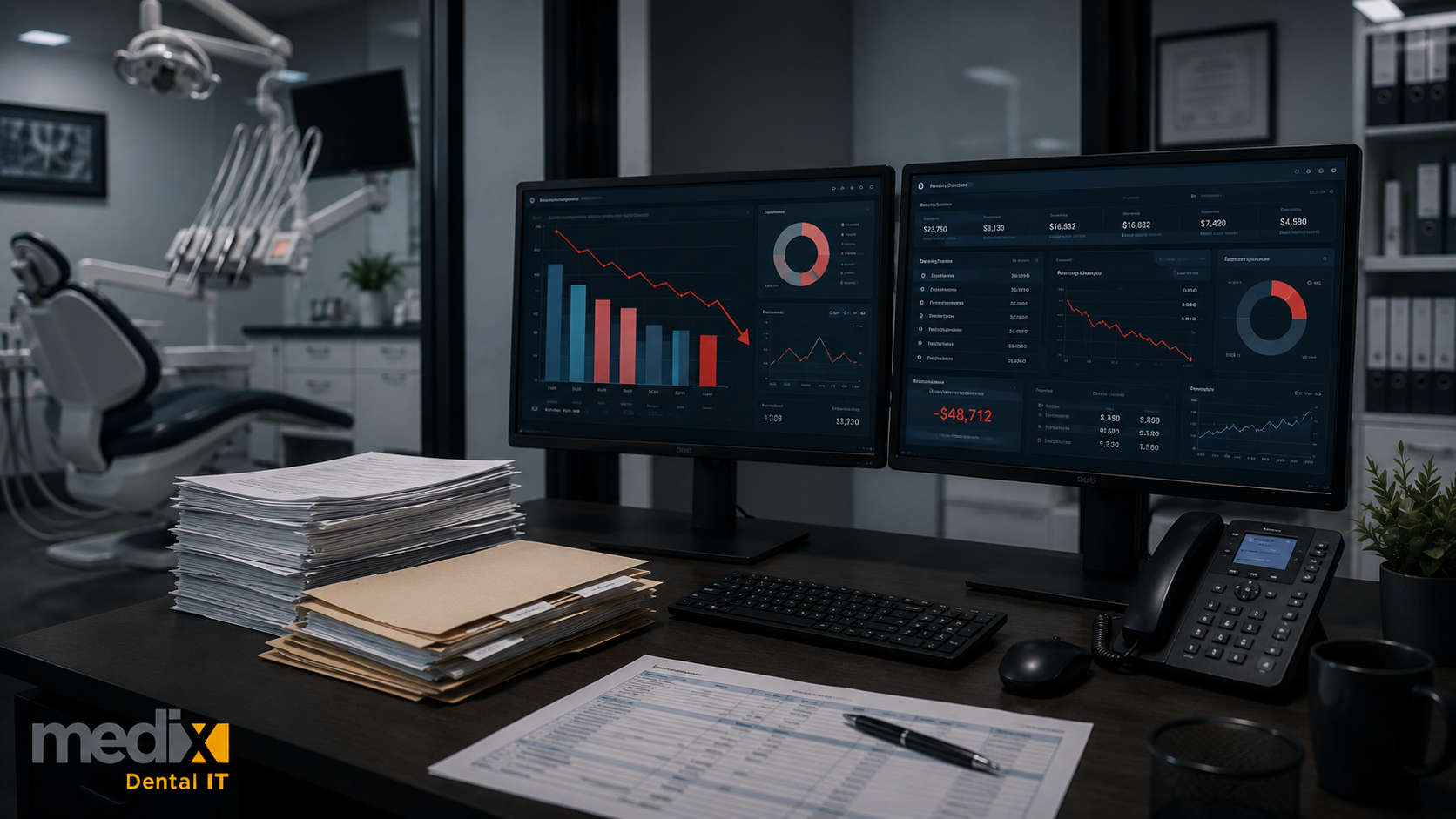
Most dental group operators do not think of IT as a margin issue. Hardware shows up as CapEx, MSP fees show up as OpEx, and cybersecurity shows up as an insurance line. Nobody is pointing at IT during a quarterly EBITDA review.
That is exactly why IT is one of the most expensive line items in a multi-location dental group. The drag is quiet, it is spread across categories that do not roll up cleanly, and it compounds every time a group acquires another location.
This is a financial-lens read on what IT actually costs a multi-location group, and what it costs again at the exit table.
The Multiple Is Where IT Shows Up Loudest
Here is the line I keep coming back to with DSO leadership: full integration can increase your DSO valuation by 2–4x EBITDA. Most people see the cost of standardizing platforms. They do not see the multiplier it creates at exit. That is a big miss.
Buyers and lenders discount organizations with operational complexity, inconsistent systems, weak reporting, and unpredictable CapEx. Every one of those problems traces back to technology. If your 30 locations run 4 different PMS platforms, 3 different imaging systems, and a patchwork of security tools, a buyer does not see a platform. They see risk. They see integration cost. They discount accordingly.
VMG Health’s 2026 DSO M&A outlook frames technology governance and data integrity as core to where value is actually realized at scale. FOCUS Investment Banking lists cloud-based practice management, digital radiography, and automated communication systems among the qualitative drivers that support upper-range multiples. EBITDA is the story you tell. Integration is what makes it believable.
The Five Quiet IT Killers
A group at $10M in production with eight locations typically leaks somewhere around $400,000 in EBITDA per year across these five categories. At a 7x multiple, that is $2.8M of enterprise value sitting on the table. Numbers vary by group, but the pattern is consistent.
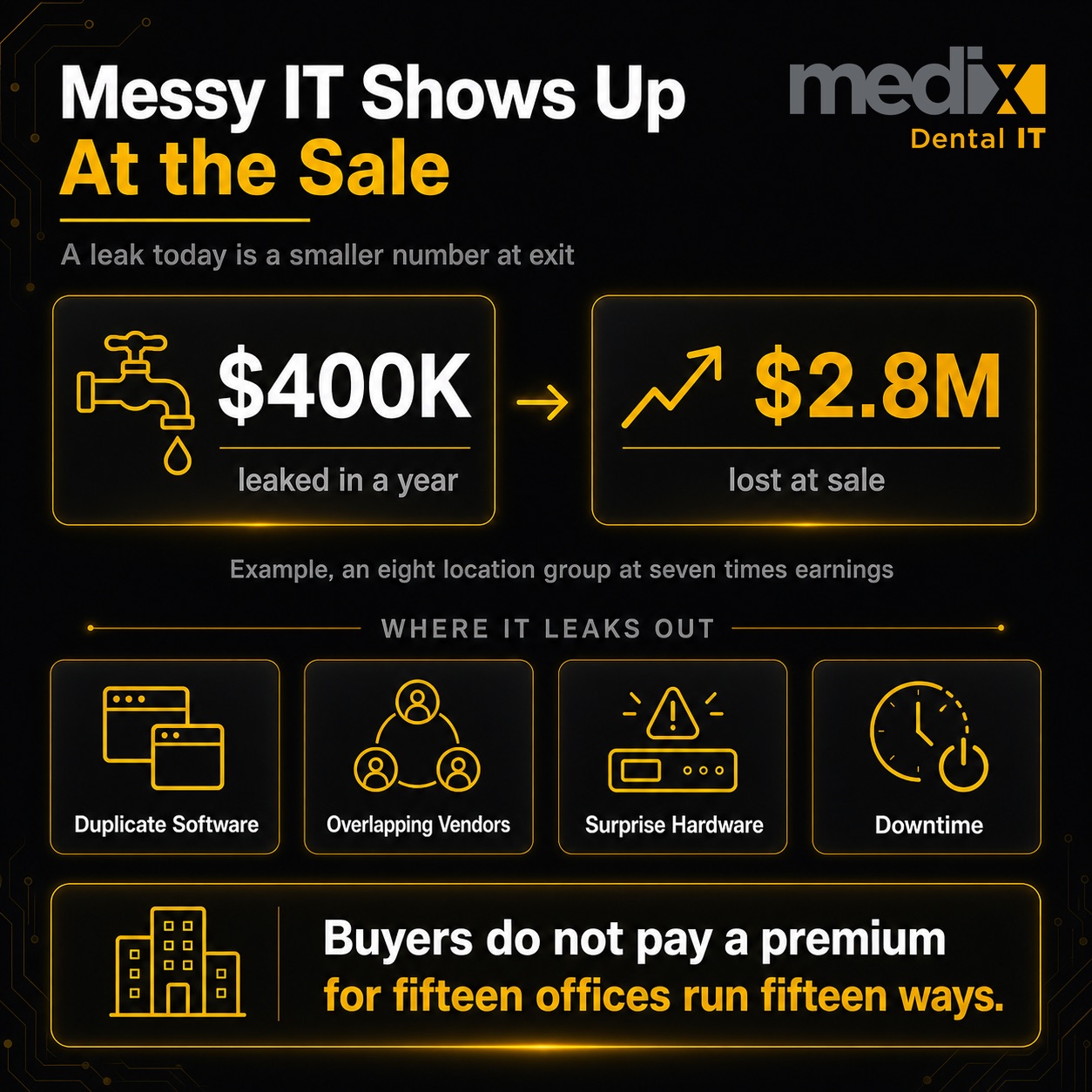
1. Inherited MSP overlap and the “keep the local IT guy” tax. One sentence has cost DSOs millions: “We will just keep the local IT guy at each practice.” At 5 locations, it feels manageable. At 20, you have 8 different MSPs, 8 different security baselines, 8 different ways tickets get handled, and zero unified reporting. Nobody owns the big picture. When something breaks, it is a blame loop between vendors who have never spoken to each other. You end up paying twice. Once for IT. Again in downtime, inefficiency, and data blindness. If your DSO operates like 15 separate practices, expect to be valued like 15 separate practices.
2. Unplanned CapEx from no refresh cycle. Unplanned server failures. Emergency workstation replacements. Reactive spending that blows up budgets. I have seen it too many times. The fix is boring: lifecycle planning. But boring is cheaper than chaos. Workstations stretched past five years and servers stretched past seven years generate emergency replacement spend, downtime during the swap, and a parade of one-off repairs that never make it into a capital plan. A planned refresh cycle (5 years workstations, 7 years servers, under active warranty throughout) turns CapEx into a budget line instead of a quarterly surprise. The acquisition IT pitfalls story is the same story told in advance.
3. Downtime per chair-hour. A server goes down. The front desk cannot check patients in. Hygienists are waiting. Providers are behind. The cost of an empty chair is always higher than the cost of solid infrastructure. Every minute of downtime is revenue walking out the door. Multiply average chair-hour production by lost hours per location per year, then by location count. The result is usually larger than the group’s annual IT spend.
4. Cyber-insurance premium creep and uncovered claims. Most dental organizations think their biggest cybersecurity risk is a hacker breaking through a firewall. It is not. It is the Microsoft 365 tenant nobody is monitoring. The former employee who still has access. The shared login six people use because it is easier. Insurers now underwrite on actual controls, not policy paperwork. Groups without enforced MFA, EDR, identity governance, and a vendor risk register pay more in premium and recover less on a claim. Microsoft Research found MFA alone reduces account compromise risk by 99.22%, yet a meaningful share of dental groups still treat it as optional.
5. The integration discount at the LOI table. This is the one operators feel last and hardest. Mixed PMS, mixed identity providers, no standardized backup, no rolled-up KPI reporting, and an unknown software inventory across locations all show up as buyer-side risk. Buyers price that risk by trimming the multiple, structuring larger holdbacks and earnouts, or pushing rep-and-warranty exclusions. The discount is rarely a single number on a single line. It is woven through the deal. A practice can have a CBCT and still be running on a server that belongs in a museum. Everyone is happy until they open the IT closet. That is not a technology problem. That is a six-figure surprise buried in the purchase price.
Your DSO Is Not Scaling. It Is Photocopying Chaos.
I have walked into organizations with 30, 40, even 50 locations where every single practice runs differently. Different PMS. Different security tools. Different vendors. Leadership calls it growth. What it actually is? A collection of locations with a shared logo. The groups that broke onto the list of the largest DSOs in the US got there by standardizing early, not by photocopying a different setup into every new office.
A roll-up becomes a platform when the operating environment is repeatable. Until then, every new location adds cost instead of leverage. Centralized services cannot centralize anything. Reporting is late, fragmented, or wrong. This is the part that gets called out in the failure modes of emerging DSOs. The fix is not more locations. The fix is making the ones you have work the same way.
What This Looks Like Fixed
The defensive baseline is the same one we apply across our national base. A single identity and access model across all locations. One security baseline. EDR and MFA enforced everywhere. A planned hardware refresh under warranty (5 years workstations, 7 years servers). Real KPI reporting that rolls up across locations every month: uptime, ticket trends, endpoint compliance, MFA adoption, backup health, restore test status, workstation and server age distribution. A strategic technology roadmap tied to the integration calendar, not the next acquisition’s surprise spend.
That is what closes the spread between a roll-up and a platform. Not a transformation. Not a buzzword. A standardized operating layer that holds together across every location the group already runs, and every location it acquires next. If you cannot operate as one, you will not be valued as one.
The Bottom Line
IT does not announce itself on the EBITDA line. It hides inside helpdesk overspend, surprise CapEx, downtime, insurance premiums, and the discount applied at the LOI table. At eight locations and $10M in production, the quiet leak is usually six figures a year and seven figures at exit. That is not an IT project. That is a financial strategy.
If you are running a multi-location group and want a second set of eyes on what your current IT setup is actually costing you in margin and multiple, we are happy to compare notes.
Posted in DSO