
August 31st, 2026
16 Largest Dental Service Organizations (DSOs) in the US for 2026
Industry Research — DSO

The DSO market keeps consolidating, and most of the public rankings are 18 months out of date.
This list of the largest DSOs in the US for 2026 is built from each company’s own current homepage and Becker’s Dental Review November 2025 ranking. A dental service organization, or DSO, is a company that contracts with dental practices to manage non-clinical operations like IT, HR, billing, compliance, and marketing so that clinicians can focus on patient care. The 16 organizations below are ranked by supported practice count, with ownership, states served, and the technology decisions each one had to make to scale.
Most readers of a list like this are not the CEOs of the DSOs on it. They are the operators benchmarking against them: directors of operations and IT at scaling groups, multi-location owners building toward DSO scale, vendors and diligence teams mapping the market. The table is the fast read. The commentary underneath each DSO is where the operating reality lives, with a closing section on the patterns groups scaling toward DSO size should be acting on right now.
If you only have a minute: the 5 largest DSOs in the US support more than 5,400 dental practices in 2026, and the top 10 alone support more than 7,400. About 16.1% of all U.S. dentists are now DSO-affiliated, rising to more than 1 in 4 among dentists less than 10 years out of school.
Quick reference: the 16 largest DSOs at a glance
Ranked by each company’s published count of supported offices, practices or locations, using each company’s most recent published figures through September 2026. Companies report in different units, so each figure is shown as the company publishes it. Ownership reflects the most recent verified public transaction. Counts are company-published snapshots and may change as practices open, close or are acquired.
| # | DSO | Locations | States | HQ | Ownership | Focus |
|---|---|---|---|---|---|---|
| 1 | Heartland Dental | 1,900+ | 39 + DC | Effingham, IL | KKR (majority) | General + specialty |
| 2 | Aspen Dental (The Aspen Group) | 1,100+ | Nationwide | Chicago, IL | Leonard Green + Ares | Multi-specialty |
| 3 | PDS Health | 1,000+ | 25 | Henderson, NV | Dentist-owned | Integrated dental + medical |
| 4 | MB2 Dental | 800+ | 45 | Carrollton, TX | Warburg Pincus + KKR + Charlesbank | General + specialty |
| 5 | Smile Brands | 600+ | 29 | Irvine, CA | Gryphon Investors | Multi-specialty |
| 6 | Smile Doctors | 580+ | 36 | Dallas, TX | PE-backed | Orthodontics |
| 7 | Sonrava Health | 400+ | 20 | Orange, CA | New Mountain Capital | General + ortho |
| 8 | Dental Care Alliance | ~400 | 24 | Sarasota, FL | Lender-owned | Multi-specialty |
| 9 | Affordable Care | 380+ | 39 | Morrisville, NC | Lender-owned | Tooth replacement / implants |
| 10 | Specialized Dental Partners | 275+ | 37 | Franklin, TN | PE-backed | Endo / perio / OS |
| 11 | SGA Dental Partners | 250+ | 26 | Richmond Hill, GA | Thurston Group | Multi-specialty |
| 12 | Great Expressions | 246 | 9 | Southfield, MI | Lender-owned | Multi-specialty |
| 13 | U.S. Oral Surgery Management | 240+ | 31 | Irving, TX | PE-backed | Oral surgery |
| 14 | Specialty1 Partners | 225+ | 29 | Houston, TX | Doctor-led | Endo + OS + perio |
| 15 | SALT Dental Partners | 222 | 21 | Phoenix, AZ | Doctor-led | Multi-specialty |
| 16 | North American Dental Group | 200+ | 15 | Pittsburgh, PA | Jacobs Holding | General |
Largest DSOs in the US for 2026
The 16 organizations below are ranked by supported practice count and profiled with operator-side context: what each one had to standardize, integrate, or rebuild to scale, and what groups still working toward DSO size can read from each profile.
1. Heartland Dental
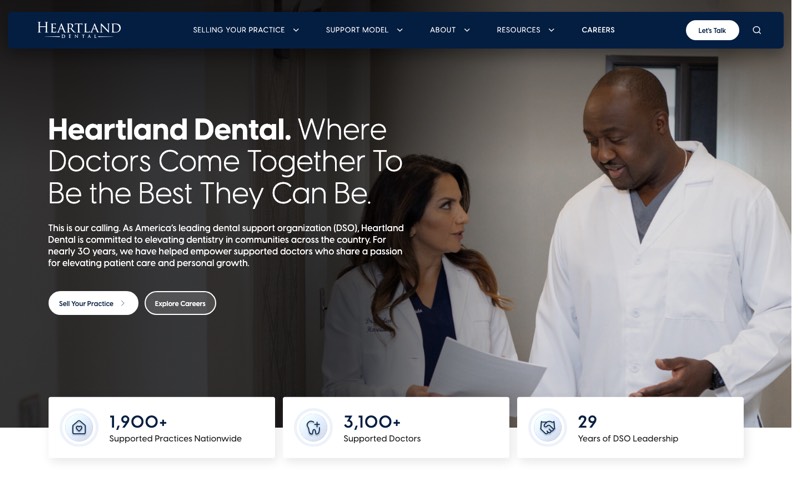
Heartland is the largest DSO in the U.S. by a wide margin, supporting more than 1,900 affiliated offices across 39 states and DC according to its corporate site. Founded in 1997 by Dr. Rick Workman, the platform is majority-owned by KKR (acquired in 2018). Heartland reported 3,100 supported doctors, 25,000+ team members, and 11.5 million patient visits in 2025, plus 75 de novo openings that year. The benchmark for any group benchmarking against Heartland is integration velocity: at this scale the constraint is not buying more practices, it is onboarding each new one onto a shared identity, security, and reporting platform fast enough that the next acquisition does not regress the network.
2. Aspen Dental (The Aspen Group)
Aspen Dental supports more than 1,100 offices nationwide and sits inside The Aspen Group, the multi-brand holding company that also owns ClearChoice Dental Implants, Motto, WellNow Urgent Care, Chapter Aesthetic Studio, and Lovet Pet, per aspendental.com. The Aspen Group is backed by Leonard Green & Partners, Ares Management, American Securities, and AustralianSuper, with management and affiliated dentists also holding equity. Each Aspen office is dentist-owned under a franchise/PC model. Operating five service lines under one corporate umbrella is the harder problem most observers miss. Each brand has its own clinical PMS requirements, and the back office has to standardize across all of it.
3. PDS Health (Pacific Dental Services)
PDS Health, formerly Pacific Dental Services, supports more than 1,000 locations across 25 states from its Henderson, NV headquarters and remains the largest dentist-owned DSO in the U.S. PDS describes itself as the “world’s first DSO to integrate Epic’s Comprehensive Health Records System into all supported dental practices”, the same platform used by major U.S. health systems. That single decision shapes everything downstream: integrated medical-dental records, hospital-grade clinical workflow, and a data architecture most dental groups do not attempt. The trade-off is platform cost and complexity, but PDS is one of the only operators at this scale that has consistently positioned dentistry inside the broader medical IT ecosystem rather than alongside it.
4. MB2 Dental
MB2 supports more than 1,700 dentists across its affiliated network per mb2dental.com, with a doctor-partnership model that positions the company as a dental partnership organization rather than a traditional DSO. The most recent recapitalization was a $525 million Warburg Pincus deal in November 2024 at a $3.5 billion enterprise value, with KKR and Charlesbank both retaining stakes. MB2 keeps clinical autonomy at the local level while centralizing IT, RCM, and compliance. The benchmarking lesson for groups in active roll-up mode is that integration cadence is the bottleneck. Integrating practices with mismatched PMS systems, different imaging vendors, and different on-prem network setups is a multi-year program, not a quarterly sprint, and the platforms that scale fastest are the ones that fix the cadence problem early.
5. Smile Brands
Smile Brands supports more than 600 affiliated offices across 29 states under 75+ affiliated brand names per its corporate homepage. Gryphon Investors has owned the platform since 2016, and Smile Brands completed the bolt-on of ~230-office Midwest Dental in December 2020, creating one of the largest multi-brand DSOs in the U.S. The 75-brand structure is the standout benchmarking case for any multi-brand operator. Each affiliated brand carries its own local equity and patient relationships, so the back-office IT, security, and reporting platform has to standardize without forcing brand consolidation. Groups acquiring under their own brand umbrella often underestimate how much of that infrastructure has to exist before brand-preservation becomes operationally viable.
6. Smile Doctors
Smile Doctors is the largest orthodontics-focused DSO in the U.S. The company reported passing 580 locations across 36 states in early 2026, run from its Dallas, TX headquarters. The platform was founded in 2015 by Dr. Scott Law, Dr. Dana Fender, and Dr. Greg Goggans. Smile Doctors operates proprietary patient-facing programs including Smile Doctors Anywhere (remote consults) and the Smile Express® workflow. Specialty DSOs face a different IT footprint than general dentistry. Imaging workloads are heavier, treatment planning runs longer, and patient communication has to manage 18-to-24-month cases. A general-purpose dental IT setup does not handle that gracefully without configuration work most providers underestimate.
7. Sonrava Health (Western Dental, Brident, and other brands)
Sonrava is the parent platform for Western Dental & Orthodontics, Brident Dental & Orthodontics, DentalWorks, Perfect Teeth, and Vital Smiles, with over 400 affiliated offices in 20 states per its homepage at sonrava.com, although its Affiliate with Us page still cites nearly 600 practices across 21 states. We rank it on the homepage figure. Sonrava has been owned by New Mountain Capital since 2012. The company runs an affiliated-network model that preserves regional brand identities rather than rebranding under a single name, and it is the largest Medi-Cal dental provider in California. Operating multiple regional brands under one platform creates real data architecture challenges most pure-dental DSOs do not face: cross-brand operational reporting only works when every service line feeds a unified data warehouse, not separate vendor dashboards.
8. Dental Care Alliance
Dental Care Alliance supports approximately 400 allied practices and 900+ dentists across 24 states per dentalcarealliance.net, with a portfolio split across 275 general practices, 70 pediatric and orthodontic offices, and 45 adult specialty offices. Established in 1991, DCA describes itself as the “only leading DSO of its size to have support divisions dedicated to each practice type.” In mid-2026 the platform went through a recapitalization that erased about $1.1 billion of debt and brought in $95 million of new capital, with trade reporting describing lenders taking control from its prior private equity owners. The multi-specialty, multi-division structure is the standout operating challenge. Running general, pediatric, orthodontic, and adult specialty workflows under one platform requires either deep PMS integration or a federated approach that most generalist DSOs do not attempt.
9. Affordable Care
Affordable Care, headquartered in Morrisville, NC, supports more than 380 affiliated practices across 39 states and describes itself as “America’s leading consumer retail healthcare company exclusively focused on tooth replacement solutions”. In August 2026 the company completed a transaction that transferred ownership to its existing lenders and cut roughly $1.0 billion of debt, about 65% of the total. Founded in 1975, the platform serves a focused clinical niche through its flagship Affordable Dentures & Implants brand and proprietary product lines like UltimateFit Denture, FIXEDSECURE, UNILOC FIXED, and SNAPSECURE. The narrower specialty makes standardization easier in theory, but on-site lab workflows, implant inventory tracking, and CBCT imaging at every location push the per-practice IT footprint up. “Narrow specialty” does not mean “simple IT.” It means a different complexity profile.
10. Specialized Dental Partners
Specialized Dental Partners supports 275+ affiliated practices and 450+ specialists across 37 states per specializeddental.com, focused on endodontics, periodontics, and oral and maxillofacial surgery. Founded in December 2018 and headquartered in Franklin, TN, the platform has scaled fast in the specialty consolidation wave with a partner model that emphasizes 100% clinical autonomy. Specialty DSOs collide with two technology realities that general DSOs do not. Clinical software is often vendor-specific to each specialty, and the referral pipeline from general dentists requires an integration layer most generalist platforms ignore.
11. SGA Dental Partners
SGA Dental Partners is the newest platform on this list, formed in June 2026 when Thurston Group united SGA, Gen4 Dental Partners, and Modis Dental Partners under a single banner. The combined platform supports more than 250 dental sites, over 500 dentists, and 26 states per sgadental.com, run from Richmond Hill, GA. A three-way merger is the hardest integration problem in this list. Each of the three platforms arrived with its own PMS footprint, its own identity setup, and its own security baseline, and the combined entity has to converge them while continuing to operate. Groups watching this one should watch the sequencing, because a merger of equals does not get the luxury of imposing one existing standard on the other two.
12. Great Expressions Dental Centers
Great Expressions Dental Centers is one of the older multi-specialty DSOs in the U.S., recognized in Becker’s Dental “52 DSOs to Know 2026” ranking with strong density in the Midwest and Southeast. GEDC has been through multiple private equity sponsor cycles, and trade reporting in 2023 said its lender, Ares Management, took it over as former owner Roark Capital exited. It is the archetype of the regional DSO with multi-state operating footprint. Regional density is its operating advantage. When the bulk of a DSO’s footprint sits inside a handful of states, the IT model can run a tighter regional helpdesk and a more aggressive standardization push than nationwide platforms can.
13. U.S. Oral Surgery Management (USOSM)
USOSM is a growing national network of affiliated oral and maxillofacial surgery practices, operating across 31 states from its Irving, TX headquarters per usosm.com. The platform was named a three-peat Becker’s “DSO to Know” in April 2026 and named to Inc.’s 2025 Regionals: Southwest list at No. 90. Oral surgery is one of the most equipment-intensive specialties in dentistry. CBCT, surgical microscopes, and anesthesia monitoring all generate clinical data that has to land somewhere secure and accessible. USOSM’s scale gives it the leverage to standardize that imaging and clinical-data architecture across surgical sites in a way that independent OS practices cannot afford.
14. Specialty1 Partners
Specialty1 Partners supports more than 225 locations and 350+ dental specialists across 29 states from its Houston, TX headquarters, per its August 2026 company announcement, focused on endodontics, oral and maxillofacial surgery, and periodontics. The platform is doctor-founded and doctor-led, and runs a proprietary Acumen Intelligence Engine support platform. Like USOSM and Specialized Dental Partners, Specialty1 has to manage referral-network technology as a first-class workflow. That is the part of the IT stack general DSOs build last and specialty DSOs build first.
15. SALT Dental Partners
SALT Dental Partners is a doctor-led multi-specialty DSO supporting 222 practice locations and 366 doctors across 21 states from its Phoenix, AZ headquarters per saltdentalpartners.com, with focus areas in pediatric dentistry, orthodontics, oral and maxillofacial surgery, and general dentistry. The dentist-led component changes the IT governance conversation. Clinicians who hold equity have a stronger voice in PMS selection, imaging vendor choices, and standardization decisions than at PE-only platforms. That can slow standardization but tends to produce higher long-term adoption of the systems that do get standardized. SALT’s tagline, “Enhancing Practices. Preserving Brands,” signals the same federated approach used by Sonrava and NADG.
16. North American Dental Group (NADG)
North American Dental Group supports more than 200 affiliated practices, 400+ dentists, and 500+ hygienists across 15 states per nadentalgroup.com. NADG operates as a multi-brand portfolio with regionally distinct practice identities. The brand portfolio model means the back-office has to support a range of brand experiences on a single shared infrastructure, which is the type of integration challenge that looks easy in a slide deck and difficult in production.
What the 2026 rankings tell DSO operators
Four signals matter for anyone running, vending into, or doing diligence on a DSO right now.
First, consolidation is accelerating at the new-dentist layer. According to ADA HPI data published in November 2025, more than 1 in 4 dentists less than 10 years out of school are now DSO-affiliated, a higher share than any prior cohort. The full-workforce number is 16.1% and has more than doubled since 2015. That figure comes from a near-census of practicing dentists rather than a survey, which is why we treat it as the one genuinely solid number in a category full of dental software statistics that do not survive scrutiny. The next decade of dentistry runs through DSOs whether the industry is ready or not.
Second, the technology gap between the top 5 and the rest is widening. Heartland, Aspen, PDS, MB2, and Smile Brands operate at a scale that forces them to run dedicated platform engineering teams. The 11 DSOs below them on this list are still relying on a mix of MSPs and internal IT leads. That gap is where most of the operational risk in a DSO acquisition gets created and where most of the integration cost gets discovered. We mapped the underlying patterns in our overview of IT challenges for growing DSOs, and the integration sequencing in our DSO tech playbook.
Third, a third ownership category is growing. Affordable Care and Dental Care Alliance both moved from private equity control to their lenders in 2026, and Smile Doctors has been reported to be refinancing. The pattern underneath all three is the same: leverage taken on in the near-zero-rate years of 2018 through 2022, meeting reimbursement that has not kept pace. Great Expressions got there first, passing to its lender in 2023 according to trade reporting. For an operator, a lender-owned platform behaves differently than a PE-owned one. Cost discipline gets tighter, capital projects get scrutinized harder, and IT spending that cannot show a return gets cut first. If you are a vendor or a diligence team, the ownership column on this table is no longer a two-way split.
Fourth, PE sponsors are pushing more acquisitions in 2026, not fewer. Becker’s reported in late 2025 that 69% of DSOs expect their sponsors to push acquisition activity higher in 2026. The DSOs that handle the next 18 months well will be the ones with a repeatable IT integration playbook, and an IT diligence process that catches problems before close (we wrote about this in avoiding IT pitfalls in dental practice acquisitions). The ones that do not will look bigger on paper and run worse in practice.
Half the names on this list will move three or more spots by 2030. The ones that climb will be the platforms that treated IT integration as the acquisition thesis, not the post-close cleanup.
What this list says for groups scaling toward DSO size
If you run a 3-to-25 location group, the practical value of a list like this is not the leaderboard. It is the pattern under the leaderboard. Every DSO above 500 locations made the same operational bet at a smaller size: standardize the operating environment before the next wave of acquisitions, not after.
Standardize the operating environment before the next wave of acquisitions, not after. That single sequencing call is what separates the platforms that crack a list like this one from the ones that stall out at 25 locations.
Three patterns repeat across every platform on this list that emerging groups can act on now:
1. Identity and security before PMS. The DSOs that scaled cleanly built a single Microsoft 365 or equivalent tenant early, with one identity layer governing every location. The ones that didn’t are still paying for it. PMS standardization is the visible decision, but identity standardization is the one that decides whether MFA, conditional access, and offboarding actually work at 50 locations. Payer portal logins are the exception, because those portals cannot join a directory at all. A dental-specific tool such as Unify Dental keeps those credentials separate but still governed.
2. KPI dashboards across locations, not per location. Every platform on this list reports operational and clinical KPIs centrally because that is what their boards demand. Groups under 10 locations often run anecdotal IT and operational reporting and discover at 15 locations that they can’t aggregate. Build the dashboard before you need the dashboard.
3. IT diligence as a pre-LOI gate, not a post-close cleanup. Every DSO on this list has either institutionalized IT diligence or paid for the lesson the hard way. Groups acquiring practice 3 through practice 10 are the ones most likely to under-scope IT in due diligence and absorb the surprise after close.
None of these are budget-breakers at small scale. They are sequence problems. Solve them in the wrong order at 5 locations and the cost compounds by location 15.
If your group is between 5 and 25 locations and any of these patterns sit in your tech debt right now, happy to compare notes. We do this integration and standardization work across the U.S. through our IT services for DSOs, and we have seen what each of the patterns above looks like at every stage of scale.
Largest DSOs in the US FAQs
What is the largest DSO in the US in 2026?
Heartland Dental is the largest DSO in the U.S. in 2026, supporting more than 1,900 affiliated practices across 39 states and DC per its corporate site. Founded in 1997 by Dr. Rick Workman, Heartland is majority-owned by KKR. The next four DSOs by location count are Aspen Dental, PDS Health, MB2 Dental, and Smile Brands. The top five combined support more than 5,400 dental practices.
How many DSOs are there in the US?
The Association of Dental Support Organizations represents 80 member DSOs supporting 13.5K dentists across 8,500+ practices. The total population of dental service organizations operating in the U.S. is larger when small regional groups are included, but ADSO members account for the vast majority of scaled DSO activity. Roughly 16.1% of all U.S. dentists are now DSO-affiliated, a share that more than doubled since 2015 according to the ADA Health Policy Institute.
Which DSOs are dentist-owned vs PE-backed?
Of the 16 largest DSOs in the U.S. in 2026, four describe themselves as dentist-led or doctor-led at the platform level: PDS Health, SGA Dental Partners, Specialty1 Partners, and SALT Dental Partners. Worth knowing that doctor-led and PE-backed are not opposites. Several doctor-led platforms still carry an institutional investor behind the clinicians, so the label describes who holds clinical and governance influence, not the absence of outside capital. Three platforms are now lender-owned: Affordable Care and Dental Care Alliance after 2026 debt restructurings, and Great Expressions, which trade reporting says passed to its lender, Ares Management, in 2023. The remaining nine are backed by private equity, most through multiple recapitalization cycles. Heartland is held by KKR, Aspen by Leonard Green and Ares, MB2 by Warburg Pincus, KKR, and Charlesbank, Smile Brands by Gryphon Investors, and North American Dental Group by Jacobs Holding.
What does the largest DSO list miss about scaling a dental group?
Location count is the headline metric, but it does not tell you which platforms are technically integrated and which are still operating as collections of acquired practices. A DSO with 600 standardized locations on a single identity and PMS platform is a different business than a DSO with 800 locations spread across mismatched on-prem servers and four different MSPs. The IT integration story is what separates valuation outcomes at the next recap, not raw practice count.
Posted in DSO