Picking dental practice management software feels like a software decision. For a growing group, it is closer to an architecture decision.
Here is the thing most lists will not tell you: the best dental PMS guides online are usually published by the PMS vendors themselves, which is why they rank their own product first. Medix Dental IT does not sell a PMS. We support the IT, security, and data infrastructure underneath them across single practices and multi-location DSOs, so we evaluate on what an operator and an IT buyer actually live with: data ownership, cross-location reporting, hosting model, integration depth, and total cost as you add chairs. This is a vendor-neutral look at seven platforms worth knowing in 2026.
Dental practice management software (PMS) is the software a dental office uses to book appointments, keep patient records, file insurance claims and collect payments.
Why the PMS Decision Is Really an Operations Decision
For a single office, a PMS runs scheduling, charting, billing, and imaging. For a multi-location group, the same software quietly decides whether centralized billing works and whether reporting takes minutes or weeks.
Here is what nobody tells DSOs. Most groups evaluate a PMS on features and price, then acquire ten practices on three different platforms and wonder why centralized services keep breaking. Unwinding that becomes a multi-year project nobody budgeted for. As Tom Terronez puts it, the PMS is not a tool, it is the operating backbone, and your group strategy should dictate your PMS choice, not the other way around.
The Best Dental PMS Software in 2026
These seven cover the realistic shortlist for a group or DSO, from independent and cost-controlled to fully cloud-native and enterprise.
1. Open Dental: Own Your Data and Your Architecture
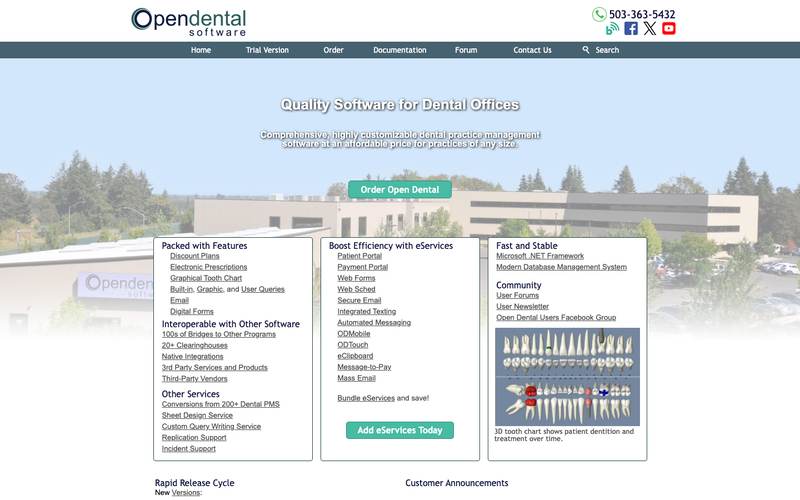
Open Dental is our top recommendation for groups that want control of their own platform. It is independently owned, a privately held Oregon company founded in 2003, which is rare in a market full of private-equity roll-ups.
Pricing is transparent and published: $199 per location per month for the first year, then $149, covering every computer at a location for up to three providers. Read the provider cap before you model it, because past three providers per location the fee adds $20 per month per provider, and hygienists do not count toward the cap. Those headline rates are the single-office path. Groups get a separate volume schedule the pricing headline does not mention: at four to nine offices the first year runs $169 per month per office instead of $199, and both paths settle at the same reduced rate once an office has been on support for twelve consecutive months. Open Dental calls that the current reduced rate and sets it at the figure published when an office reaches month thirteen, so treat today’s $149 as the rate now rather than a locked future price. The real DSO draw is openness. There is a documented public API and direct database read access for centralized reporting, plus conversion support from a wide range of legacy systems for groups consolidating mismatched practices. One clarification worth carrying into a vendor conversation: Open Dental is no longer open source, having moved from a GPL license to a proprietary one in version 24.4, though the company states that database access was unchanged by that shift. The openness that matters to a group, direct access to your own data, is still there. We compare the two platforms in detail in Dentrix vs Open Dental.
Where I would hesitate is the cloud question. Open Dental is primarily self-hosted, and while the vendor offers a hosted Open Dental Cloud option you can move to without contract lock-in (a one-time migration fee applies), running it at scale still means architecting it deliberately. As Tom told one operator running three platforms, out of those three, Open Dental all day. Pop it into Azure, add Clinics, and you have a centrally managed platform.
The flip side of owning your architecture is owning the security that protects it. In July 2026 Trend Micro documented an attacker controlling eight computers inside a dental clinic and reaching that clinic’s own Open Dental database. Read that carefully, because the detail that matters is what the report does not say. It cites no vulnerability in the Open Dental software and does not disclose how the clinic was breached in the first place. What was compromised was one clinic’s own machines, and the database was reachable from them. That is the self-hosting tradeoff stated plainly: the vendor maintains the software, but the environment around it, the endpoint monitoring, the network segmentation, and the identity controls, belongs to whoever runs the practice.
2. Curve Dental: Cloud Built for Small and Mid-Size Groups
Curve Dental is a cloud-only platform with no server option. Its all-in-one flagship is Curve SuperHero, though its site also uses the Curve Hero name. It is independently held under the entity CD Newco, LLC and backed by Battery Ventures, which is worth noting because it is often wrongly grouped under Planet DDS. It is not.
The vendor reports serving more than 100,000 dental professionals, and pricing is quote-based. For groups, Curve markets consolidated reporting, the ability to toggle between locations on one screen, and shared patient records without duplicate databases.
Where I would hesitate is the enterprise ceiling. Curve’s heritage is single-location and small-group cloud, and its dedicated DSO tooling is comparatively newer, so a large enterprise group should pressure-test cross-location reporting and scale against a same-size reference before committing.
3. Oryx Dental: Clinical-First Cloud With Published Pricing
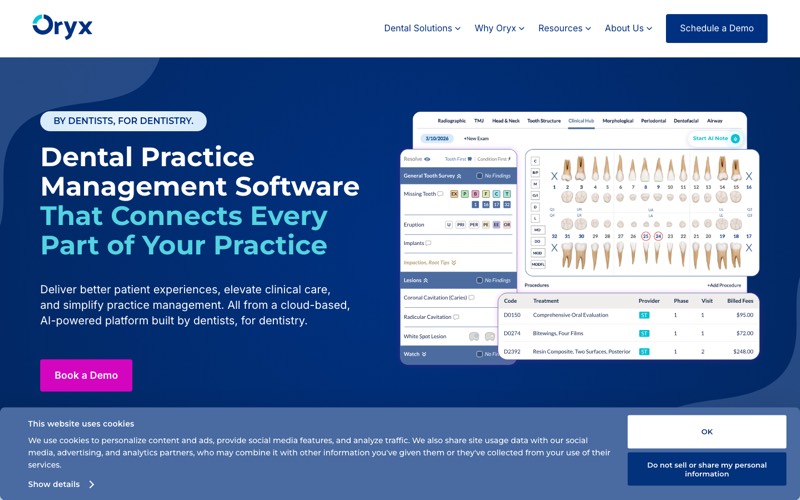
Oryx Dental is a cloud-only, all-in-one platform built on Google Cloud and designed around the clinical workflow rather than bolted onto billing. It is independent and self-funded, founded in 2016 by Dr. Rania Saleh, with no venture or private-equity ownership, which is uncommon at this tier.
Pricing is published and set per location: $650 per month for Pro, $899 for Automate, and $1,399 for the AI tier, each covering up to two providers. The platform folds charting, imaging, payments, and clinical decision support into one system, and the vendor reports use by more than 15,000 clinicians across five continents.
Where I would hesitate is enterprise depth. Oryx’s published rates are built around solo and small-group practices, and its Oryx Enterprise tier for DSOs and multi-location groups carries no published price at all, so a larger group is quoted rather than shopping a rate card. Oryx describes centralized reporting across every location. That description does not address financial consolidation across separate legal entities, and Oryx lists its SOC 2 audit as still in progress, so a larger group’s procurement and security teams will want both answered first.
4. Denticon: Built for Groups From Day One
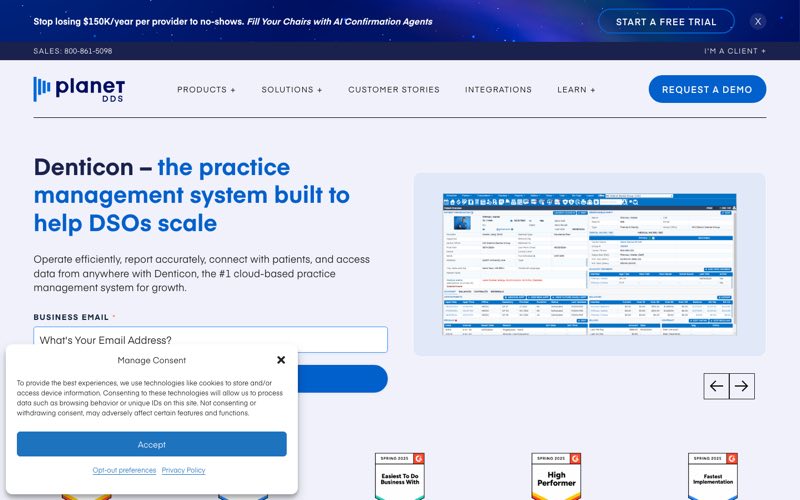
Denticon from Planet DDS is one of the strongest structural fits for a multi-location operator because it was built for groups rather than retrofitted from a single-office product. It is cloud-native with no on-premise option, sold inside the Planet DDS platform alongside Cloud 9 and the Apteryx imaging tools. In July 2026 Planet DDS announced DentalOS, which it describes as connecting Denticon and Cloud 9 on a single data layer. The company says DentalOS will roll out in phases, at no additional cost to Planet DDS customers.
Planet DDS reports more than 13,000 practices across its platform and publishes a starting price of $795 per month, with full pricing quoted by group size. The DSO value is org-wide visibility from one database, which is what makes centralized billing and cross-location reporting real.
Where I would hesitate is rollout. Planet DDS itself cites roughly eight weeks of implementation per location, so a fast-acquiring group should budget for a staggered migration and real data-conversion planning, not a quick switch.
5. Dentrix: Three Different Products, Pick Carefully
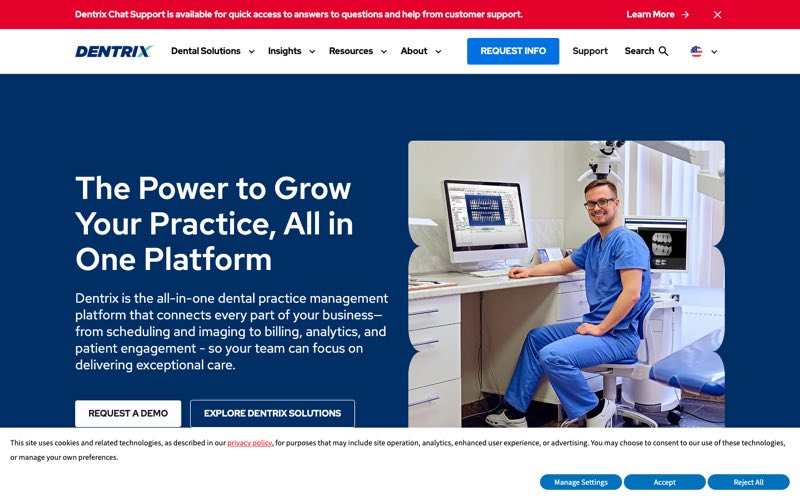
Dentrix is owned by Henry Schein One, the joint venture formed in 2018 between Henry Schein and Internet Brands. The trap for a DSO buyer is that “Dentrix” is really three products.
Classic Dentrix is the on-premise, server-based version, and Henry Schein One’s own comparison lists it with only limited multi-location support. Dentrix Ascend is the cloud-native product with centralized data across locations. Dentrix Enterprise is the large-group product built on a centralized SQL database. For a group, the relevant choices are Ascend or Enterprise, never classic. Ascend itself now sells in three tiers, Ascend Essentials, Ascend Pro, and Ascend Accelerate, which changes the buying conversation from picking a product to picking a tier inside one. Watch where the features you actually need sit, because multi-location management, claim volume, Eligibility Pro checks, and automatically generated clinical notes are split across the tiers rather than included in all of them. Neither the Ascend tiers nor Enterprise publish pricing, so cost is quote-based.
Where I would hesitate is brand confusion at purchase. Buying “Dentrix” for a scaling group can leave you with separate databases per office, so specify the exact product before you sign.
6. Eaglesoft: Fine for One Office, a Trap for a Group
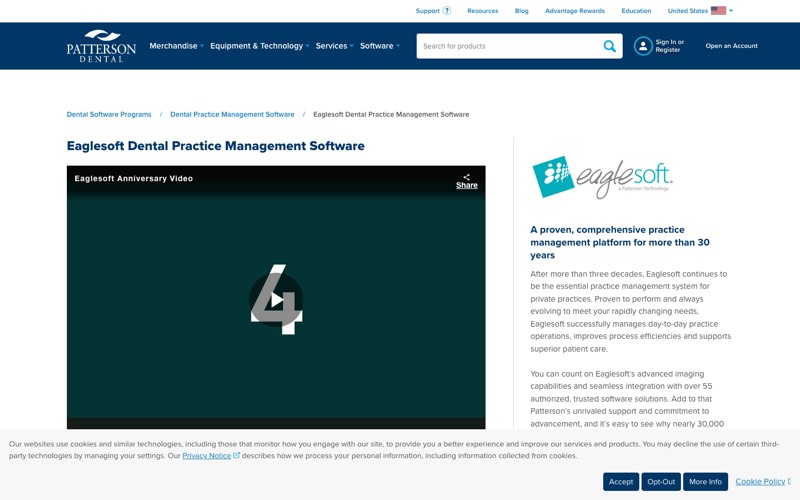
Eaglesoft is Patterson Dental’s long-running PMS, with nearly 30,000 users and more than three decades in the market. Patterson Companies was taken private by Patient Square Capital in 2025, so that is the current owner, and a common mix-up is worth correcting: Eaglesoft is a Patterson product, not a Henry Schein One product.
It is Windows-only and server-based. Patterson’s own hardware requirements say running it on a virtual machine is not supported and that the server must be wired to the network, which confirms a true on-premise architecture. Pricing is quote-based through Patterson, not published.
Where I would hesitate for a group is structural. Each location runs its own server and database, so there is no single source of truth across the org, and Patterson’s cloud-native play is a separate product, Fuse, not Eaglesoft itself.
7. CareStack: One Stack to Replace Four to Six Tools
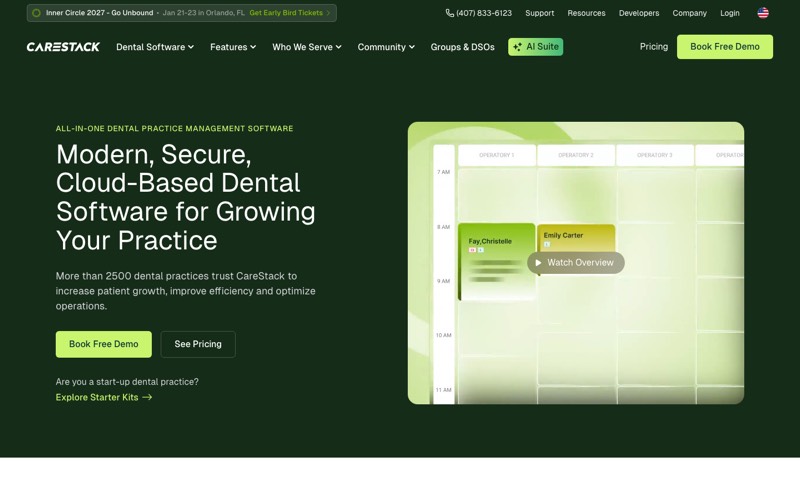
CareStack is a cloud-native, all-in-one platform that folds scheduling, billing, imaging, revenue cycle management, and analytics into one system, with self-stated HIPAA, SOC 2 Type 2, and ISO 27001 compliance. It is privately held and venture-backed, and Straumann Group holds a strategic minority, non-controlling stake taken in 2022.
Published pricing starts at $829 per month for Essentials and $1,299 for Intelligence, with custom plans for larger groups. Its Groups and DSOs offering targets 5 to 500-plus locations and pitches replacing four to six legacy tools with one stack, with named group customers including Espire Dental and Heritage Dental Partners.
Where I would hesitate is the ROI math. The widely cited 307 percent three-year ROI comes from a Forrester study commissioned by Straumann, CareStack’s own investor, and models a composite customer, so treat it as vendor-sponsored, ask for a same-segment reference, and validate imaging and clearinghouse compatibility per acquired practice before a rip-and-replace.
Common Ownership Myths Buyers Get Wrong
Three of these come up in almost every group evaluation we sit in on, and getting them wrong skews the shortlist:
Eaglesoft is not a Henry Schein One product. It belongs to Patterson Dental. Henry Schein One owns Dentrix.
Curve Dental is not part of Planet DDS. It is independent, held under CD Newco and backed by Battery Ventures. Planet DDS owns Denticon and Cloud 9.
“Dentrix” is not one product. Classic, Ascend, and Enterprise are three different architectures, and only two of them fit a group.
Ownership changes hands often enough that most published comparisons are out of date, so we keep a sourced record of who owns which dental PMS, and which market share numbers hold up.
Cloud or Server: The Question Underneath the PMS Choice
Server-based systems like classic Dentrix and Eaglesoft put a database in every office, so each location is its own island for reporting and its own risk for backup and downtime. Cloud-native systems centralize the data, which is what makes real cross-location reporting possible. Open Dental sits in the middle by design: self-hosted by default, but cloud-deployable with the right architecture. If you want the longer case for moving off in-office servers, we made it in why dental practices should transition to cloud-based PMS and imaging.
Specialty Practice Management Software: Ortho, Endo, Oral Surgery and Perio
My default for an orthodontic, endodontic or oral surgery acquisition is simple. Keep the specialty software if it does the clinical job, and put the IT effort into the layer underneath it: who runs the hosting, identity and MFA, imaging bridges and reporting.
Groups that add orthodontic, endodontic or oral surgery practices can inherit software built for that specialty. I have walked into organizations with 30, 40, even 50 locations where every single practice runs differently. Each specialty acquisition can add another system to that picture. Here is where the specialty systems we checked stand, taken from each vendor’s own site.
| System | Specialty | Vendor or disclosed owner | Cloud or server |
|---|---|---|---|
| OrthoTrac | Orthodontics | Carestream Dental | On-premise server, or Carestream-hosted (OrthoTrac Hosted) |
| Dolphin Management | Orthodontics | Patterson Dental Holdings, Inc. | Practice or group server, or hosted through Dolphin Cloud Sessions |
| Cloud 9 | Orthodontics | Planet DDS | Cloud |
| Edge Cloud | Orthodontics | Ortho2 (sold by Henry Schein One) | Cloud |
| Greyfinch | Orthodontics | Greyfinch, LLC | Cloud |
| WaveOrtho | Orthodontics | SmileSoft Solutions | Cloud-hosted, or self-hosted on your own server |
| TDOS | Endodontics | Valsoft (acquired TDO in 2024) | Cloud |
| PBS Endo | Endodontics | Henry Schein One | Server-based (Enterprise edition) |
| WinOMS | Oral surgery | Carestream Dental | On-premise server, or Carestream-hosted (WinOMS Hosted) |
| OMSVision | Oral surgery | Henry Schein One | Not published on its product pages |
| DSN | Oral surgery, periodontics, endodontics | DSN Software | Cloud, plus an on-premise version (DSN V30) |
Several of these still put a server somewhere. OrthoTrac and WinOMS come in on-premise or Carestream-hosted editions, PBS Endo Enterprise is server-based, and Dolphin runs on a practice or group server or through Dolphin Cloud Sessions. When an acquired practice runs an on-premise edition, someone now owns that server’s backups, patching and replacement schedule, so settle who before closing. Carestream’s newer product, Sensei Cloud, is pitched at DSO and OSO enterprises, so ask what a move off the older editions involves.
For perio, start with the group’s general platform. Open Dental, Curve, Oryx, Denticon and CareStack all document perio charting on their own sites. Have the vendor demo the practice’s surgical and recall workflows before the move. DSN is the specialty option, and its perio software covers implant workflows, recall programs, billing and patient communication.
Whichever systems you keep, check each one against the group’s standards: whether it can sit under one login and MFA policy, whether its imaging bridges survive the acquisition, and whether its data can feed specialty production into the same dashboard as general dentistry. Those answers become the IT plan after closing.
What to Verify Before You Commit
Whichever platform you shortlist, three checks save groups from expensive surprises. First, data ownership: confirm you can export your own patient records, clinical notes, and images in a usable format, without paying a ransom to leave. That is the most common switching-cost trap buyers miss. Second, cross-location reporting: ask to see consolidated reporting across multiple sites live, not in a slide. Third, integration: verify the imaging bridges, scanners, and clearinghouse or RCM tools you already run are supported, per location, before you standardize a mixed portfolio.
For groups built by acquisition, the migration itself is the project, and what a conversion actually costs per database is the line most buyers leave out of the model. We walk through the sequencing in five tips for practice management software selection and migration, and the standardization payoff is the one that drives valuation across the largest DSOs in the US: a group that operates as one platform gets valued like one.
The Bottom Line for Dental Groups
For operators who want control, openness, and a platform they can architect for the cloud, Open Dental is where we point most groups. The rest earn a real look depending on your size and how much of your stack you want one vendor to own. If you are adding orthodontic, endodontic or oral surgery practices, keep specialty software where it meets clinical needs and check that it fits the group’s identity, imaging and reporting standards. Remember why this guide reads differently: Medix does not sell a PMS, so the only thing we are selling you on is asking the right questions before you sign. If you want a second set of eyes from the IT and data side, our team helps groups standardize this every week through our DSO IT services.
Best Dental PMS FAQs
What does PMS mean in dentistry?
PMS stands for practice management software (sometimes practice management system). In dentistry, the PMS is the core platform that runs scheduling, charting, billing, insurance claims, and imaging for a dental practice. For a single office it is a productivity tool; for a multi-location group it is the operating backbone that decides whether centralized billing and cross-location reporting actually work.
What is the best dental PMS for a DSO or multi-location group?
For groups that want openness, transparent per-location pricing, and direct data access, Open Dental architected for the cloud is our top pick. Denticon and CareStack are strong cloud-native group platforms, and Dentrix Ascend or Enterprise fit groups already standardized on Dentrix. Match the platform to your growth plan, not to a popularity ranking.
What should I demand in writing about exporting my data before I sign?
Get specifics, not a yes. Ask which file formats your patient records and clinical notes export in, whether images come out as standard DICOM, whether there is an extra fee to export, and the guaranteed time to deliver your full dataset after you give notice. If a vendor will not put those four answers in the contract, treat that as the answer.
What is the one question to ask a Dentrix rep?
Ask which Dentrix you are actually buying: classic, Ascend, or Enterprise. They are three different products with three different architectures, and only Ascend and Enterprise centralize data across locations. Buying “Dentrix” for a growing group without specifying can leave you with a separate database in every office.
Do specialty practices need different practice management software?
For orthodontics, endodontics and oral surgery, my default is to keep a specialty system that handles the clinical work well, such as Cloud 9, TDOS or WinOMS, and set the group’s standards for hosting, sign-in security, imaging links and reporting feeds. Perio is different. Open Dental, Curve, Oryx, Denticon and CareStack all document perio charting, so a general platform is the place to start there. Either way, see the practice’s own workflows run live before you decide.
Posted in PMS