June 2nd, 2026
Dental IT Support Company in Chicago, IL (Practices & DSOs)
Industry Research — Service Areas
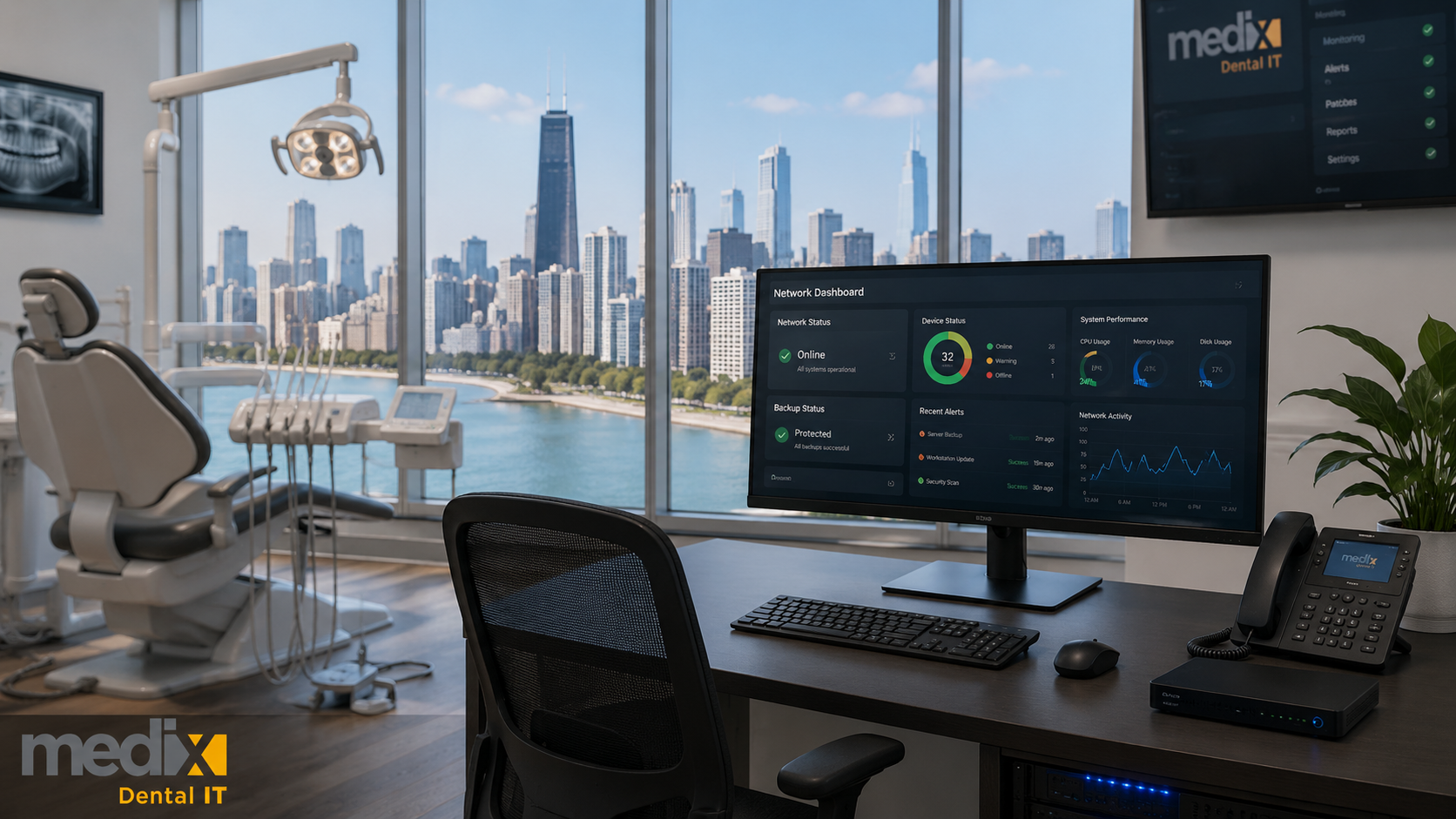
Running a dental practice in Chicago means more than skilled clinicians and modern equipment. It means protecting patient data, meeting HIPAA and Illinois-specific breach notification rules, and keeping practice management software, imaging systems, and phones running through every appointment. Medix Dental IT delivers Chicago dental IT support to practices and DSOs across Chicagoland built around exactly that.
Chicago is the third-largest metro in the United States, with roughly 9 million residents spread across Chicago, Naperville, Schaumburg, Evanston, Oak Park, Aurora, Joliet, Skokie, Arlington Heights, Elgin, Hoffman Estates, Orland Park, Tinley Park, Des Plaines, Wheaton, and the surrounding suburbs. Illinois is also home base for several of the largest DSOs in the country, and the Illinois Personal Information Protection Act sets breach notification rules every dental practice with Illinois patients has to meet.
Dental IT Support for Chicago Practices and DSOs
Dental IT support in Chicago is not the same job as supporting a generic small business. Dental practices run specialized software (Dentrix, Eaglesoft, Open Dental, Dolphin, Carestream, Sidexis), high-resolution imaging including CBCT, and a non-negotiable HIPAA-aligned identity and access model. A dental IT partner that does not understand that stack tends to fix tickets without fixing root causes.
Medix Dental IT has worked exclusively in dental for more than 20 years and supports more than 1,000 practices nationwide, from solo offices and dental specialists to multi-location groups and DSOs. Our team supports Chicagoland practices remotely from our national operations center, with on-call dispatch when on-site work is required.
Key Dental IT Services for Chicago Practices
The five areas that move the needle for a Chicagoland dental practice are the same ones we deliver across our national base.
Cybersecurity and HIPAA protection. Enterprise-grade cybersecurity assessments, MDR, identity governance, MFA enforcement, and tenant-level monitoring inside Microsoft 365 or Google Workspace. Antivirus alone is not a cybersecurity program.
Data protection and disaster recovery. Automated backup and disaster recovery with restore testing. Dental practices that cannot bring imaging and PMS data back inside hours lose production and patient trust on the same day.
24/7 support and monitoring. Endpoint monitoring, network monitoring, and after-hours coverage. Chicago practices opening early or running ortho and oral surgery extended hours need support that does not stop at 5 p.m.
Cloud and Open Dental hosting. Multi-location Chicagoland groups benefit from cloud-first deployment. Cloud Open Dental in particular scales to dozens or hundreds of locations on a single database, which matches how a growing Chicago group needs to operate.
Lifecycle planning. Servers and workstations on a planned 5-year refresh, 7 years maximum, with active warranties throughout. Stretching past that drives the kind of unplanned downtime and emergency replacement spend that wrecks margin.
Chicago Is a DSO-Dense Market
Illinois is one of the most DSO-saturated states in the country, in part because it is home base for some of the largest dental groups in the US. Heartland Dental, the largest DSO in the country, is headquartered in Effingham, Illinois, and the corporate home of Aspen Dental‘s parent organization sits in Chicago’s Fulton Market. Mid-size groups headquartered in and around Chicago add to the density, and national DSOs maintain affiliated practices across Naperville, Schaumburg, Aurora, and Joliet. The 15 largest DSOs in the US list reflects how much of the national DSO map runs through Illinois.
The shared characteristic of Chicago DSOs that scale cleanly is technology standardization. DSO IT services at scale require a single security baseline, unified identity and access, real KPI reporting across locations, and a deployment playbook that does not break when the next acquisition closes. Multiple MSPs across acquired practices create the opposite of that.
Illinois Dental Cybersecurity Compliance Is Tighter Than HIPAA
HIPAA is the federal floor for breach notification. Illinois adds an additional layer that catches every dental practice with patients in the state.
Under the Illinois Personal Information Protection Act, 815 ILCS 530, breached entities must notify affected individuals in the most expedient time possible and without unreasonable delay. When more than 500 Illinois residents are affected, the Illinois Attorney General must be notified through the official AG data breach portal. HIPAA breach reporting to the HHS OCR Breach Portal applies on top of Illinois requirements. The Illinois rule covers more data types than HIPAA does, including Social Security numbers, driver’s license and state ID, financial account numbers, biometric data, and username and email credentials combined with passwords.
The defensive baseline is the same one we apply across our national client base. Enterprise MFA. Endpoint detection and response. Identity governance. Quarterly vulnerability management. A vendor risk register. Microsoft Research found MFA alone reduces account compromise risk by 99.22%, yet a meaningful share of dental practices still treat it as optional. In Illinois, optional is an expensive position.
Why Chicago Dental Practices Work With Medix
The reasons dental practices and DSOs across Chicagoland choose Medix break down into four things that compound over time.
Dental focus, not a dental side practice. 20+ years exclusively in dental. Every engineer on our team works on dental software, dental imaging, and dental-specific cybersecurity every week. Generalist MSPs miss the details that quietly cost a practice real money.
Enterprise-grade cybersecurity by default. MDR, identity governance, M365 tenant-level monitoring, MFA enforcement, vulnerability management, and a real vendor risk register. Not antivirus plus a checkbox.
Real KPI reporting. Uptime, ticket trends, endpoint compliance, MFA adoption, backup health and restore test status, workstation and server age distribution. If a managed service partner cannot report on these monthly, it is not managed service.
Built for multi-location scale. Groups across Chicago, Naperville, Schaumburg, Aurora, and the wider metro need standardized identity, a single security baseline, and a disaster recovery posture that holds up when something goes wrong. That is the work, not generic ticket support.
The Bottom Line for Chicago Dental Practices
Dental IT support in Chicago is a different job than supporting a typical small business. The software is specialized, the imaging is bandwidth-heavy, and the compliance overhead is real. Illinois breach notification rules make every minute count when something does go wrong.
Whether you run a solo practice in Lincoln Park, a growing pediatric group across Naperville and Schaumburg, or a multi-location DSO consolidating acquired offices across Chicagoland, the questions are the same. Is the security posture actually enforced? Can the IT partner show you KPIs every month? Will the practice still operate when an office server or internet line goes down? Is lifecycle planned, or is it surprise CapEx?
If you are evaluating dental IT support for a Chicago practice and want a second set of eyes on your current setup, we are happy to compare notes.
Chicago Dental IT Support FAQs
What areas of Chicagoland does Medix Dental IT support?
We support dental practices across the Chicago metro including Chicago, Naperville, Schaumburg, Evanston, Oak Park, Aurora, Joliet, Skokie, Arlington Heights, Elgin, Hoffman Estates, Orland Park, Tinley Park, Des Plaines, Wheaton, Buffalo Grove, and the surrounding suburbs. Our team supports Chicagoland remotely from our national operations center, with on-call dispatch for on-site work when required.
How does Illinois breach notification differ from HIPAA?
The Illinois Personal Information Protection Act (815 ILCS 530) requires breached entities to notify affected individuals in the most expedient time possible and without unreasonable delay, and to notify the Illinois Attorney General when more than 500 Illinois residents are affected. HIPAA breach reporting to the HHS OCR Breach Portal applies on top of Illinois requirements. The Illinois rule covers more data types than HIPAA does, including Social Security numbers, driver’s license and state ID, financial account numbers, biometric data, and username and email credentials combined with passwords. A dental practice can have an Illinois notification obligation even on incidents that fall outside the federal HIPAA scope.
Do you support Chicago DSOs and multi-location dental groups?
Yes. A meaningful share of our client base operates multiple locations, including dental groups and DSOs scaling across Chicagoland. The work at multi-location scale is different from solo practice support: a single security baseline, unified identity and access, real KPI reporting that rolls up across locations, and a deployment playbook that holds together through the next acquisition.
Which dental software does Medix support in Chicago?
Our engineers work daily with Dentrix, Eaglesoft, Open Dental, Dolphin, Carestream, Sidexis, Ortho2, and Planmeca, including the imaging side of CBCT and intraoral systems. Open Dental in particular can be deployed in the cloud at DSO scale, which is increasingly the right pattern for growing Illinois groups consolidating acquired practices.
How fast can a Chicago dental practice switch to Medix?
Transitions vary by size and current setup. A solo practice with a single PMS, a small server, and three or four workstations typically transitions cleanly inside a few weeks. A multi-location Chicago group on mixed PMS or with inherited MSP relationships from prior acquisitions takes longer, and we plan transitions location by location rather than flipping everything at once. The goal is zero clinical downtime.
Posted in Service Areas