
April 28th, 2026
AI in Dentistry Is Creating a Cybersecurity Crisis No One Is Ready For
Industry Research — AI in Dentistry
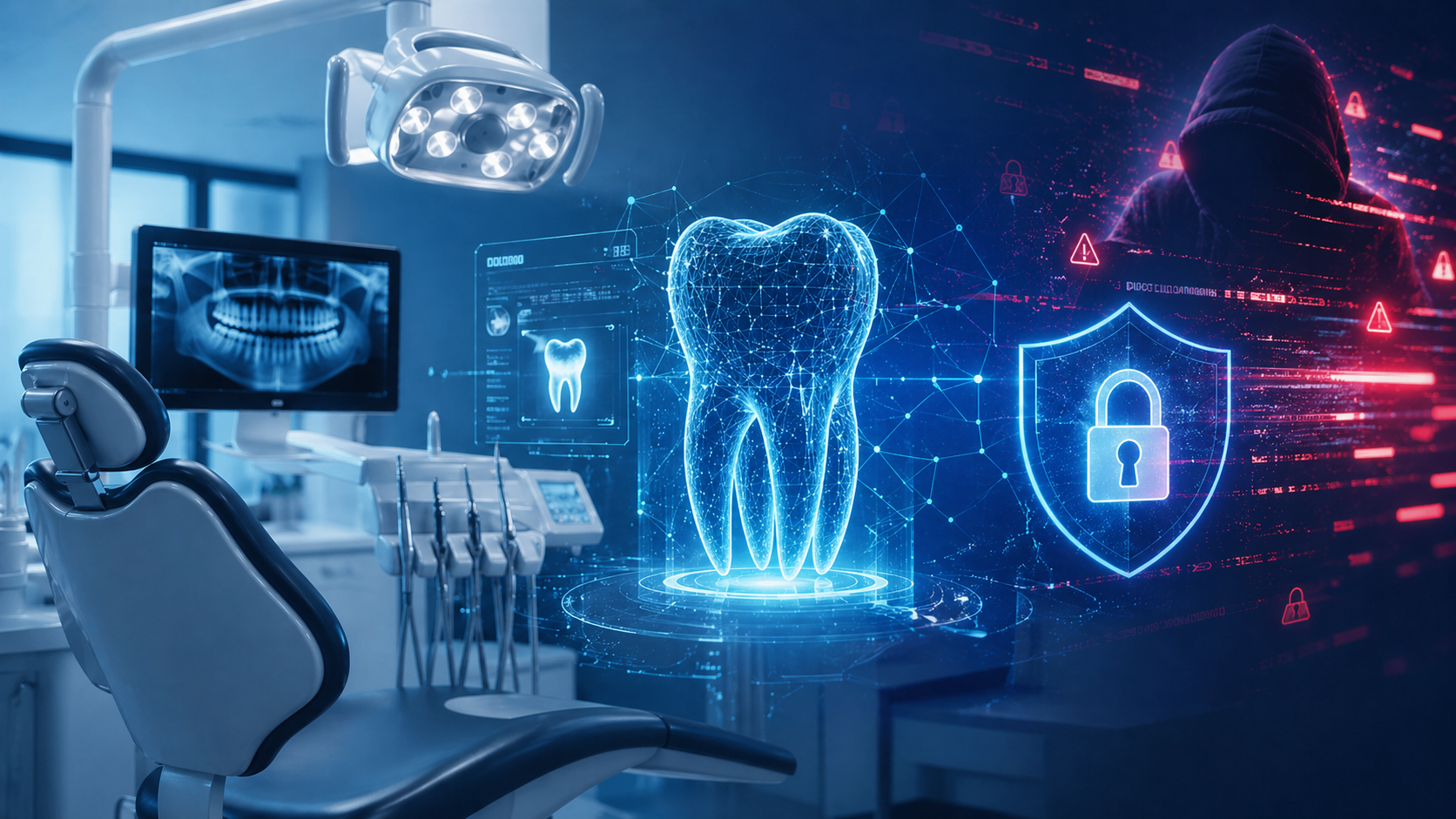
Artificial intelligence is reshaping dentistry at every level, from scheduling and AI-assisted diagnostics to revenue cycle automation. The efficiency gains are real. What gets less attention is the other side of the same shift: AI is fundamentally changing the cybersecurity threat landscape, and most dental practices are not prepared for what is coming.
How AI Is Changing Cyberattacks in Healthcare
Cybercriminals are not operating the way they did even a few years ago. AI has lowered the barrier to entry for attackers while dramatically increasing the sophistication of every attack.
Phishing emails used to be easy to spot. Bad grammar, generic greetings, obvious spoofing. That signal is gone. AI-generated phishing is now personalized, context-aware, and nearly indistinguishable from legitimate communication. Attackers can analyze public information, mimic writing styles, and craft messages that feel authentic to the recipient. In a dental environment, that might look like an email that appears to come from a doctor, a vendor, or even a patient, requesting sensitive information or prompting a login. Success rates on these attacks are climbing because they no longer rely on luck. They rely on precision. We covered several of the most prevalent fraud patterns in our breakdown of common IT scams targeting dental practices.
Why Dental Practices Are a High-Value Target
Dental practices sit in a uniquely vulnerable spot. They manage protected health information, payment data, and operational systems that the entire business depends on every day. At the same time, very few dental organizations operate with enterprise-level cybersecurity maturity. Most still rely on a mix of legacy infrastructure, fragmented systems, and limited internal IT oversight. When AI-powered threats meet that environment, the result is an attack surface that is both easier to penetrate and harder to defend.
Healthcare also remains the most expensive industry in which to suffer a breach. According to IBM’s 2024 Cost of a Data Breach Report, the average healthcare breach now costs $9.77 million, the 14th year in a row healthcare has topped the list.
On-Premise Practice Management Systems Are Easier to Exploit
On-premise practice management software remains one of the largest exposure points in dental IT. These systems have been the backbone of dental operations for decades, but many environments have not evolved to meet modern security standards. It is common to see networks lacking proper segmentation, outdated operating systems, insufficient endpoint protection, and poorly secured remote access tools. In these environments, a single compromised device can quickly lead to full network compromise.
AI-driven attackers are particularly effective here because they can rapidly scan for vulnerabilities, identify weak points, and execute attacks at a speed that outpaces traditional defenses. For practices operating on-premise systems without layered security controls, the risk is not theoretical. It is immediate.
Cloud PMS Does Not Equal Secure
There has been a broad shift toward cloud-based practice management systems, often with the assumption that cloud equals secure. While cloud platforms reduce certain infrastructure risks, they introduce a different set of vulnerabilities that are frequently overlooked. The most common issue is weak identity security, particularly the lack of enforced multi-factor authentication. Without MFA, a stolen password is often all it takes to gain access to critical systems.
AI has made credential theft far more effective by improving the quality and targeting of phishing attacks, meaning that even well-intentioned staff can unknowingly hand over access. Cloud systems are only as secure as the controls surrounding them, and in many dental organizations, those controls are insufficient. For a deeper look at when and how cloud adoption makes sense for dental, see why dental practices should transition to the cloud.
Microsoft 365 Is Often the Front Door, and It Is Usually Unlocked
Microsoft 365 serves as the operational backbone for email, file storage, and collaboration in many practices. While M365 can be highly secure when configured correctly, many dental environments run older or default configurations that lack essential protections. Missing or inconsistent MFA enforcement, absence of conditional access policies, and limited email security hardening create an environment where attackers can easily gain a foothold. Microsoft research shows that turning on MFA blocks more than 99.9% of automated account compromise attacks.
Once inside, attackers can monitor communications, launch internal phishing attacks, and move laterally into connected systems such as cloud PMS platforms or financial tools. For many practices, Microsoft 365 is effectively the front door to the organization, and in its current state, that door is often left unlocked.
Staff Behavior Is Still the Number One Vulnerability
Despite all the technological vulnerabilities, the most consistent point of failure remains human behavior. Staff members are the primary target of modern cyberattacks because they represent the easiest path into a system. AI has made social engineering more convincing than ever, eliminating many of the traditional warning signs that training once focused on. Messages are clean, contextually accurate, and timed in ways that align with real workflows. In some cases, attackers are even using AI-generated voice technology to impersonate leadership or vendors. Yet, most dental practices do not implement ongoing cybersecurity awareness training, nor do they test their teams with simulated phishing campaigns. This gap leaves organizations exposed in a way that technology alone cannot fix. We outlined where most teams fall short in our 3 tips to safeguard your dental practice from cybersecurity threats.
The Rise of Agentic AI and What It Means for Dental Cybersecurity
As AI adoption grows within dental organizations, another layer of risk is emerging that is often misunderstood. There is a tendency to assume that advanced AI tools are inherently safe or self-regulating, but the reality is more complex. Frontier AI systems are becoming capable of identifying, chaining, and in some cases autonomously exploiting software vulnerabilities at a level comparable to skilled human security researchers. CISA and other agencies have begun issuing guidance on AI-enabled attack techniques as the threat landscape shifts.
The risk for dental organizations is not that practices are using these frontier systems directly, but that the same capabilities being studied today will be in the hands of attackers tomorrow. The belief that AI is smart, therefore safe, creates a dangerous blind spot. AI is accelerating both defense and offense, and in many cases the offensive side is moving faster. Without proper governance, security controls, and awareness, integrating AI into workflows can unintentionally expose sensitive data, expand attack surfaces, and create new pathways for compromise. For a closer look at where AI fits inside a dental operation, read how dental practices can use AI.
The Threat Landscape Is Accelerating, Not Stabilizing
Cyberattacks are becoming faster, more automated, and more adaptive. Ransomware groups are increasingly targeting healthcare and dental organizations due to the high value of their data and the operational pressure to restore services quickly, a pattern borne out by the biggest dental data breaches on record. The combination of AI-driven attack methods and historically under-protected environments creates a scenario in which incidents are not only more likely but also more impactful when they occur.
What Dental and DSO Leaders Should Do Now
For dental leaders, this is no longer a theoretical discussion or a future concern. The idea that a practice is too small to be targeted is outdated. The idea that basic IT support is sufficient for cybersecurity is no longer valid. The expectation from regulators, insurers, and patients is shifting toward accountability and resilience. Practices are now expected to understand their risk, implement appropriate controls, and respond effectively when incidents occur.
The reality is straightforward. AI is not creating cybersecurity risk in isolation. It is amplifying existing weaknesses. On-premise systems without modern protections are becoming easier to exploit. Cloud systems without strong identity controls are becoming easier to access. Staff without training are becoming easier to deceive. And organizations that assume they are safe because they have not yet experienced an incident are operating on borrowed time.
The practices that will navigate this shift successfully are not necessarily those that adopt AI the fastest, but those that approach it with a balanced understanding of both opportunity and risk. That means recognizing where vulnerabilities exist, investing in identity and access controls, modernizing legacy environments, and treating staff education as a core component of security rather than an afterthought. It also means approaching AI adoption with intention, ensuring that new tools are integrated into a framework that prioritizes data protection and operational resilience.
The frontier is changing quickly, and the margin for error is shrinking. Ignorance is no longer a defensible position.
Posted in AI in Dentistry