
July 2nd, 2026
Our Dental Cybersecurity Data Report (June 2026)
Industry Research — Dental Cybersecurity, Research

Most articles about dental cybersecurity are written from the outside looking in. They quote the same recycled industry surveys and end with a list of tips. This one is different.
This is our dental cybersecurity data report, built entirely from first-party data inside the dental practices and DSOs that Medix Dental IT protects. For the month of June 2026, our security operations analyzed more than 2.58 billion events across our managed fleet. What follows is what that data actually showed, the themes behind it, and what we did about each one.
We are sharing it for one reason. When you can see the real numbers from a network built specifically for dental practices, you stop guessing about what “good security” means and start measuring it.
A Month of Dental Cybersecurity, by the Numbers
Security is a filtering problem. The vast majority of what crosses a dental network is noise. The work is separating the handful of events that matter from the billions that do not, fast enough to act before anything spreads.
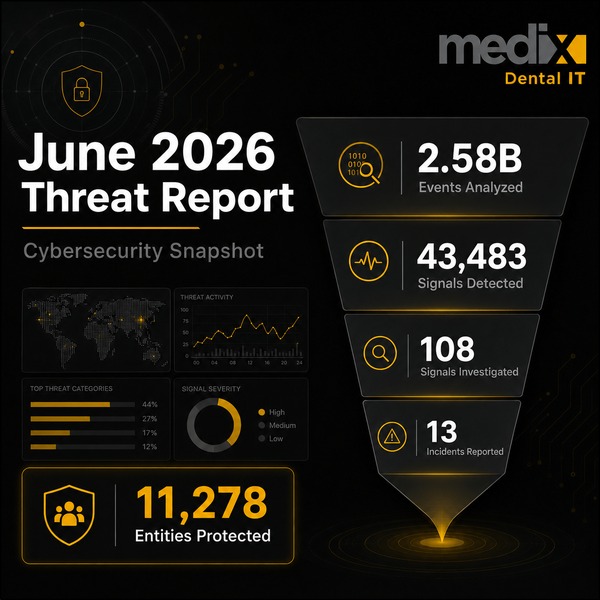
Here is how June 2026 filtered down across the practices we protect:
| Stage | Volume | What it means |
|---|---|---|
| Events analyzed | 2,579,269,005 | Raw activity across the managed fleet |
| Signals detected | 43,483 | Anything worth a closer look |
| Signals investigated by analysts | 108 | Suspicious enough for a human to review |
| Incidents requiring remediation | 13 | Real threats our team shut down |
| Ransomware incidents | 0 | Across 10,795 protected endpoints |
Read that funnel from top to bottom. Roughly 2.58 billion events became 13 confirmed incidents, and not one of them turned into ransomware. That ratio is the entire argument for managed security in one line. No front desk team, no office manager, and no part-time local IT contractor watches 2.58 billion events a month. Software does the filtering, and trained analysts make the judgment calls on the 108 that look wrong.
The rest of this report breaks down the four themes hiding inside those numbers, and what we do about each.
Theme 1: Attackers Want a Quiet Foothold, Not a Loud Break-In
The single most common threat pattern we saw last month was not a dramatic attack. It was attackers trying to quietly move in and stay.
Our platform analyzed 6,222,186 autorun events looking for persistent footholds, the mechanisms attackers use to gain long-term access by hiding inside ordinary auto-starting programs. That produced 16,598 signals, 57 manual investigations, and 12 confirmed foothold incidents that our team remediated. The top global threat behind many of them was the abuse of remote monitoring and management (RMM) tools.
RMM tools are legitimate. They are how IT teams support computers remotely. That is exactly why attackers love them. A rogue remote-access tool looks like normal IT activity, so it slips past defenses that are only watching for obvious malware.
What Medix does about it: we maintain an approved-software inventory for every practice, monitor for unauthorized RMM installations, and flag unexpected remote sessions for review. When a foothold is confirmed, we remediate the endpoint and close the path the attacker used. The goal is simple. We want to find the quiet visitor before they decide what to do next.
Theme 2: Ransomware Is Stopped Early, or Not at All
Zero ransomware incidents across 10,795 endpoints is the headline most practice owners care about. It is also the number most easily misunderstood. Zero is not luck. It is the result of catching the early warning signs before encryption ever starts.
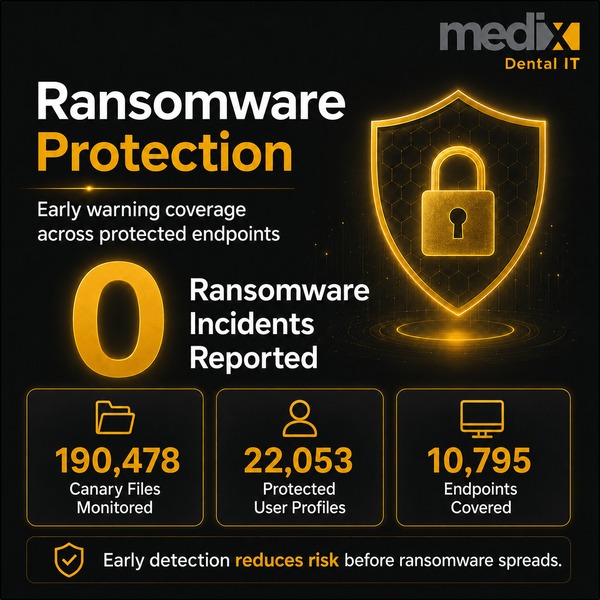
Last month we monitored 190,478 small decoy files, placed quietly across 22,053 protected user profiles. These act like the canary in the coal mine. They sit untouched in the background, and if anything starts modifying them the way ransomware does, an investigation opens immediately. The encryption stage of a ransomware attack is loud and fast. The hours and days before it are where there is still time to act.
The threat is not theoretical. IBM’s 2026 Cost of a Data Breach Report puts the average healthcare data breach at $6.64 million, still the highest of any industry, down 10.5% from $7.42 million the year before. Healthcare also remained the most targeted sector for ransomware, accounting for 35% of publicly disclosed attacks worldwide in July 2026 (BlackFog).
What Medix does about it: early-warning decoy files on every protected endpoint, a security team investigating the moment those files are touched, and tested backup and recovery so that even a worst case does not become a closed practice. For a deeper look at ransomware specifically, see our guide on protecting your practice from ransomware.
Theme 3: Antivirus Is Table Stakes, Not a Strategy
Antivirus did its job last month. Our managed antivirus blocked 1,651 malware files from running on Windows endpoints, and none of those required a deeper investigation. That is antivirus working exactly as designed.
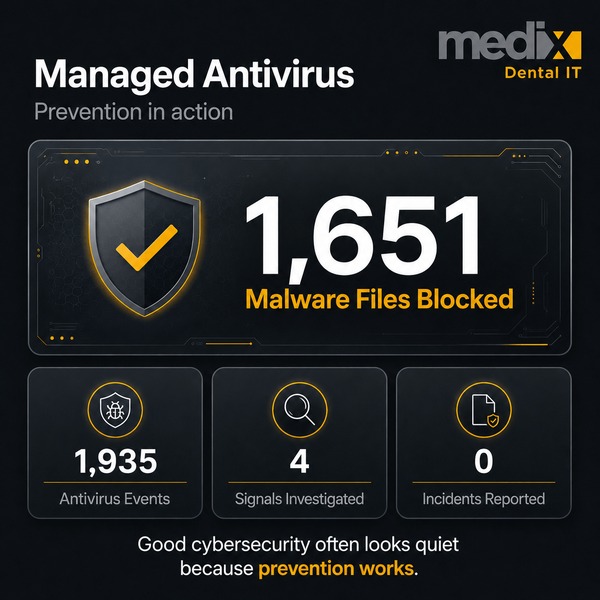
Here is the part that matters. None of the 13 real incidents we remediated came from the files antivirus catches. They came from RMM abuse, persistent footholds, and suspicious processes, the kinds of threats that look like legitimate activity and walk right past a signature-based scanner. As Tom Terronez puts it, antivirus is not a cybersecurity program. It is one layer.
We also watch the antivirus itself. Last month our platform reviewed 92,479 Defender exclusions and found none risky enough to remove. Exclusions tell antivirus to skip certain files or folders. Set too broadly, often by a well-meaning vendor trying to stop a false alarm, they quietly shrink the area antivirus is actually protecting. A clean month here is not the absence of work. It is continuous review making sure no single overly broad exclusion ever becomes a blind spot.
What Medix does about it: managed antivirus is the floor, not the ceiling. On top of it we run process monitoring that analyzed 2,570,622,151 process events last month, surfaced 25,631 signals, and led to 9 confirmed incidents our team shut down. That is the layer that catches what antivirus cannot see.
Theme 4: Identity and Microsoft 365 Are the New Front Door
For most dental groups, the real target is no longer the server in the back office. It is the Microsoft 365 account. Email, files, and logins are where patient data and payroll actually live, and where attackers increasingly aim.
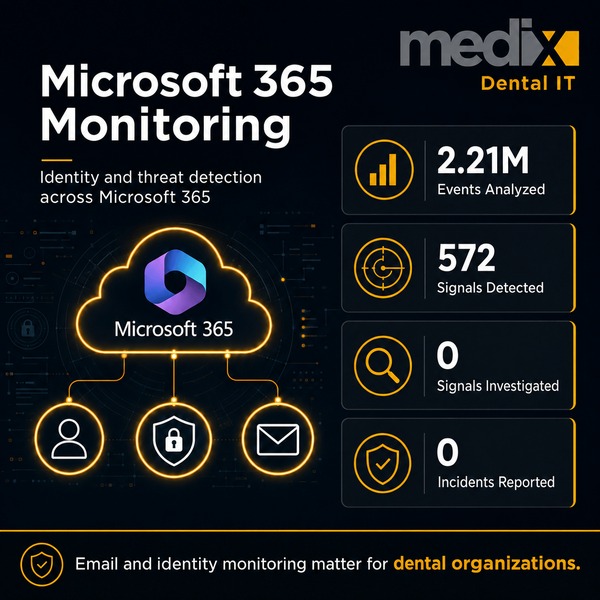
Last month our identity threat detection analyzed 2,210,755 Microsoft 365 events, looking for the signs of an account takeover: a login from an impossible location, a sudden inbox rule quietly forwarding email to an outsider, a permission change no one requested. We also ingested 161,940,934 security logs, filtered down from 1,169,374,929 raw logs, to correlate activity across the whole environment. None rose to the level of a confirmed incident, which is the outcome you want, but the watching never stops.
This is also where the most effective single control lives. Microsoft research found that multi-factor authentication reduces the risk of account compromise by 99.22% across the entire population of accounts studied. It remains optional in far too many practices.
What Medix does about it: identity monitoring on Microsoft 365 for anomalous logins and malicious inbox rules, log correlation across the environment, and MFA as a baseline rather than an upgrade. For the behavioral side that no software can cover, our team also keeps practices current on the social-engineering tactics hitting front desks. See our breakdown of the common IT scams targeting dental practices and these tips to safeguard your practice from cybersecurity threats.
What This Means for a Multi-Location Dental Group
A single practice can sometimes get by on a patchwork of tools and a local IT contact. A DSO cannot. Every location you add multiplies the number of endpoints, accounts, and entry points an attacker can try, and a threat in one office is a threat to the patient data sitting in all of them.
The numbers in this report only exist because the practices behind them run on one security baseline, not fifteen different ones. That is the difference between fragmented per-office IT and a managed platform. One standard, applied everywhere, with results that roll up into a single view leadership can actually read. A group running fifteen separate IT setups cannot produce a report like this, because there is no single place the data lives.
That standardization is also what protects enterprise value. Buyers and partners increasingly look at IT and security maturity during diligence, and a clean, measurable security posture is far easier to defend than a story. If you operate multiple locations, this is the model worth pushing toward. We cover it in more depth on our dental service organization IT page.
The Bottom Line
The takeaway from June 2026 is not that the threats are scary. It is that they are measurable, and that measurement is what turns security from a hope into a result. 2.58 billion events, 13 real threats handled, and zero ransomware is not an accident. It is what monitoring, layered defense, and a dental-specific security team produce month after month.
We will keep publishing this report so practice owners and DSO leaders can see the real picture instead of the marketing version. If you want to gauge where your own practice stands against this baseline, our IT checklist for dental practices walks through the 20 controls worth verifying. If you want a second set of eyes on your current setup, or you are curious how your own numbers would look, we are happy to compare notes. You can also start with a cybersecurity assessment to see where your practice stands today.
Posted in Dental Cybersecurity, Research