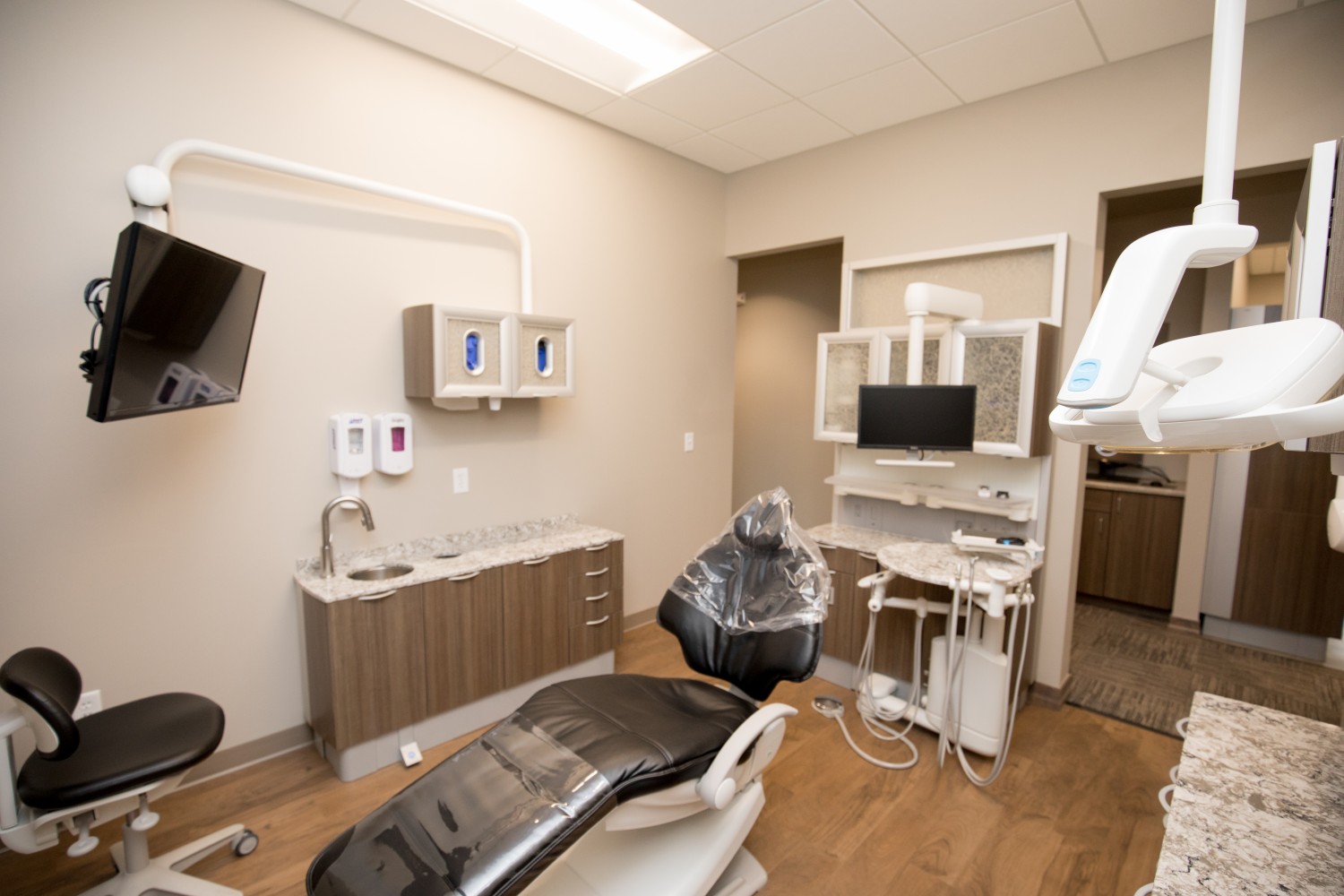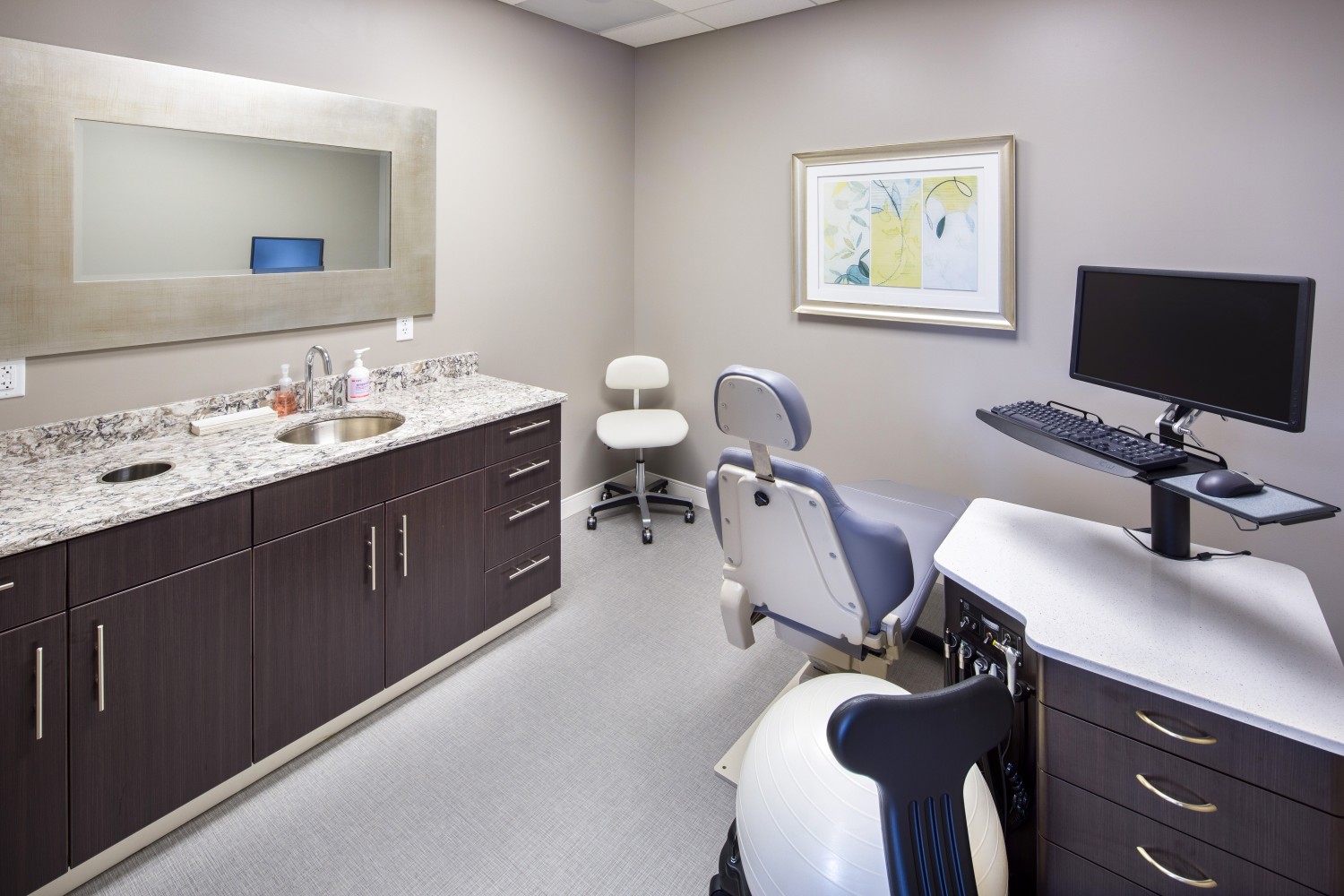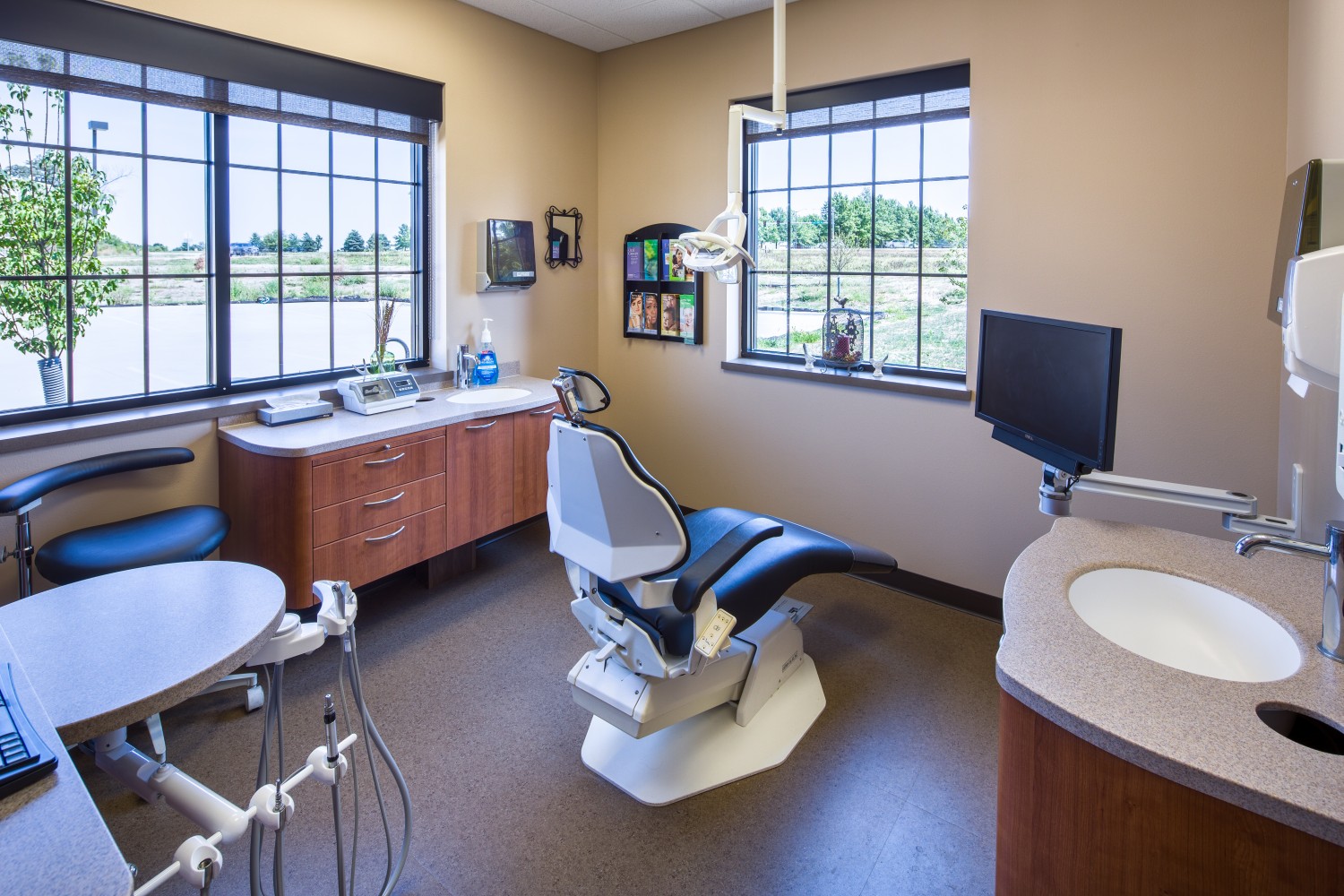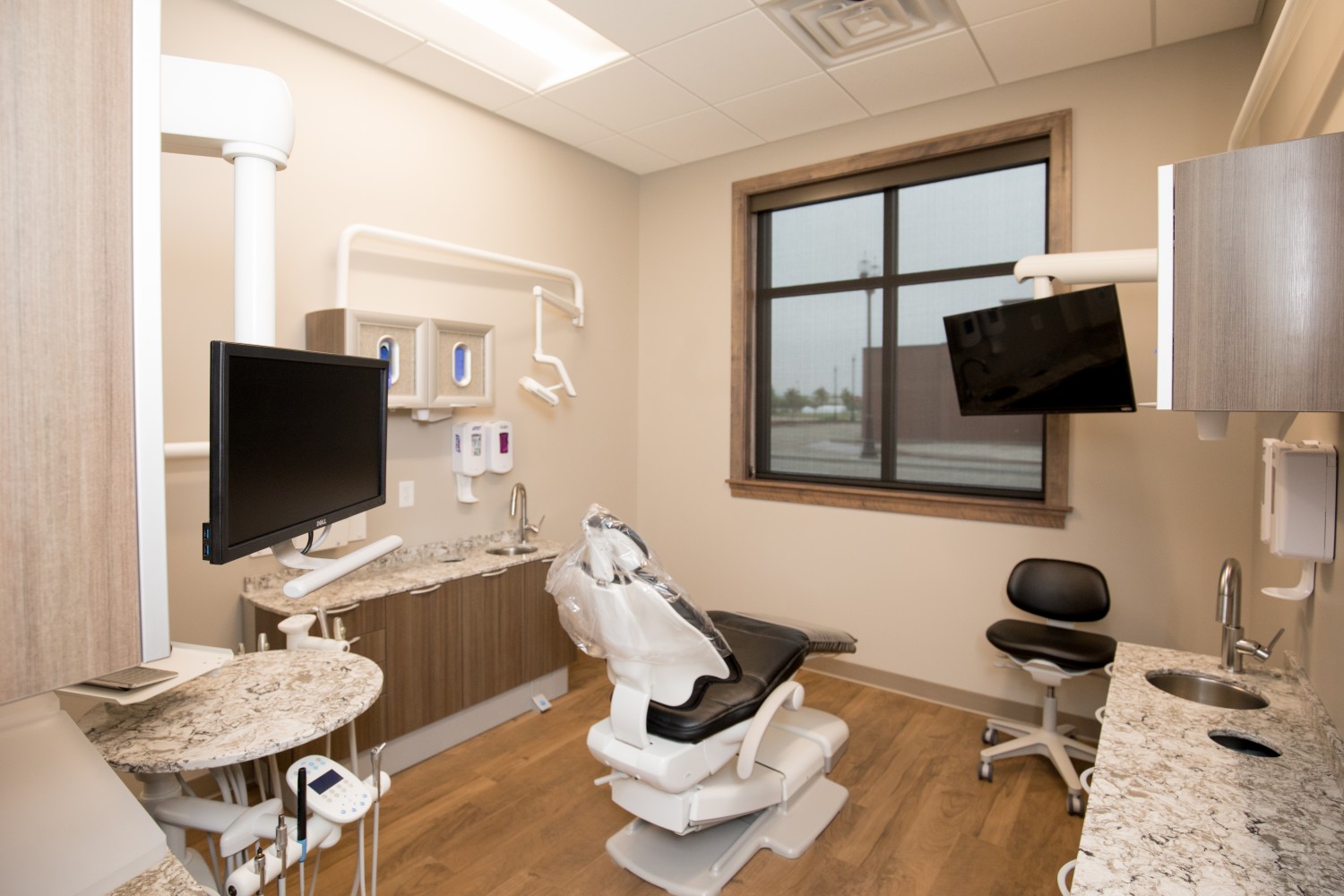

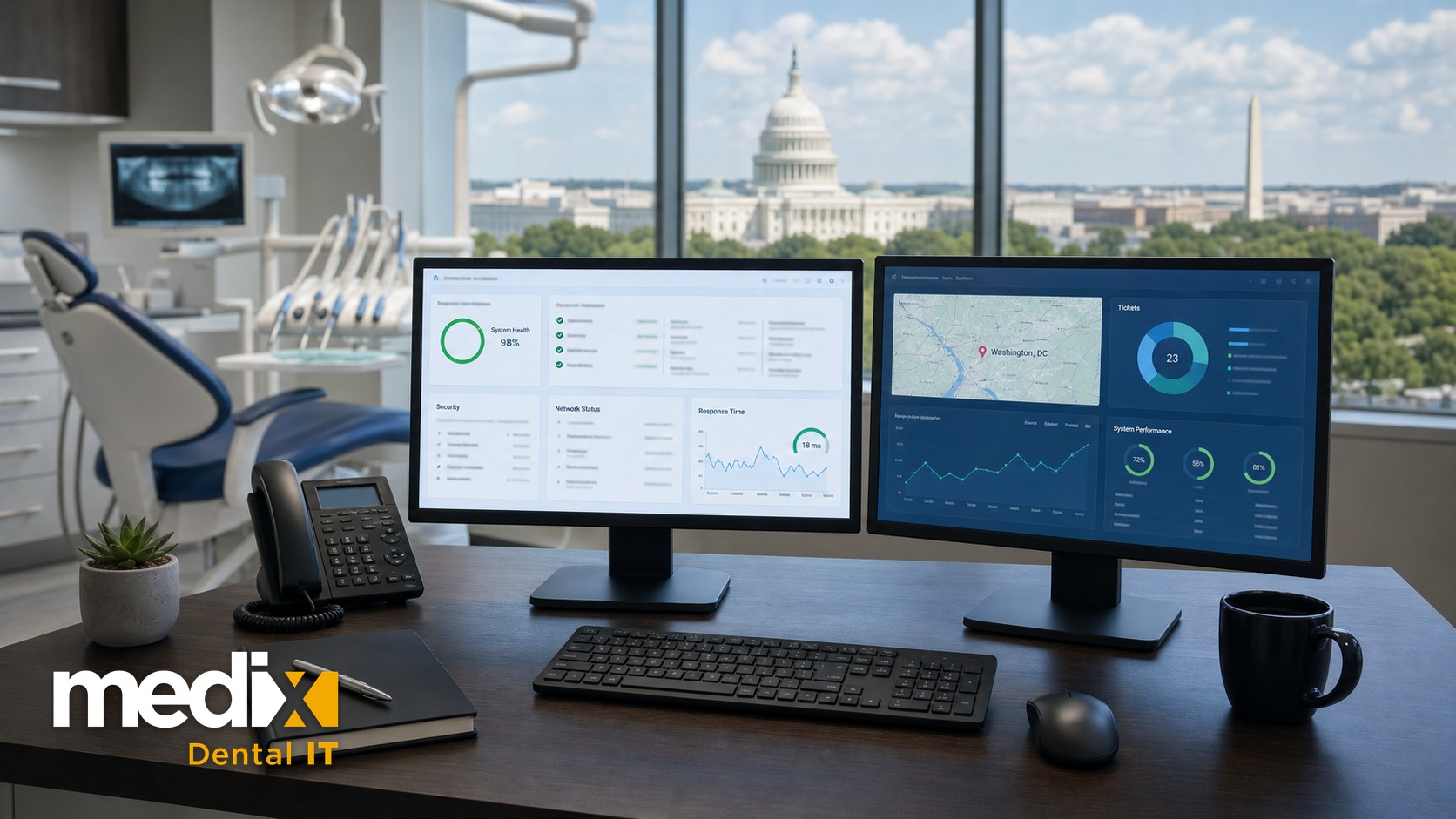
A dental practice in the DMV rarely has patients from just one jurisdiction. Its patient list spans the District, Maryland, and Virginia, and that is exactly what makes its compliance picture harder than any single-state practice’s.
Dental IT support in Washington D.C. has to be built for three breach-notification laws at once, not one. At Medix Dental IT, we work only with dental practices and dental service organizations (DSOs), and the tri-jurisdiction reality of this market is the first thing we plan around.
One Practice, Three Breach Laws
If a DMV practice suffers a breach, the jurisdiction each affected patient lives in decides what you owe. Three different regimes can apply to a single incident, on top of HIPAA.
- District of Columbia (D.C. Code 28-3852): you must promptly notify affected residents, and notify the DC Attorney General when a breach affects 50 or more DC residents. A 2020 amendment also added a reasonable-safeguards duty and free identity-theft protection when Social Security numbers are exposed.
- Maryland (Com. Law 14-3504): you must notify affected individuals within 45 days, and you have to notify the Maryland Attorney General before you notify the individuals.
- Virginia (Va. Code 18.2-186.6): you must notify affected residents and the Virginia Attorney General without unreasonable delay.
Different deadlines, different agencies, different sequencing. A generalist IT contract does not account for any of this. The practices that get it right decide in advance who notifies whom, in what order, for each jurisdiction, before an incident forces the question.
And the risk is local. In 2025, a Virginia dental-sector breach exposed the personal and health information of well over 100,000 people, including Social Security numbers. This is the environment a DMV practice operates in.
Dental IT Support Across the DMV
We support practices throughout the metro and all three jurisdictions. That includes Washington, D.C. proper, the Maryland suburbs of Bethesda, Silver Spring, Rockville, Chevy Chase, and Gaithersburg, and the Virginia suburbs of Arlington, Alexandria, Fairfax, Tysons, Reston, and McLean.
Many DMV practices also serve a heavily federal patient base, employees and contractors who are unusually security-conscious about where their records live. That raises the bar on how a practice handles data, and it is another reason the DMV is a real group and DSO market. National groups like Aspen Dental operate in the Virginia suburbs, and multi-location groups across the region need one security baseline and one backup standard, not a different setup in each jurisdiction.
What We Cover
- HIPAA-aligned security plus a breach-response plan mapped to all three DMV jurisdictions
- Monitored backup and disaster recovery for every location
- Cybersecurity assessments that find the gaps before a regulator or attacker does
- Practice management and imaging support for Open Dental, Dentrix, and Eaglesoft
- Staff training on the phishing and scam tactics aimed at dental front desks
Why Dental-Specific IT Beats a Generalist
A general IT company can keep computers online. It usually cannot tell you why your imaging bridge dropped mid-appointment, how to sequence a cloud PMS migration so the front desk never loses a day, or how three different state breach clocks change your incident response. Dental practices run on a specific stack with failure modes a generalist has never seen.
We have worked only with dental practices for over 20 years. For a DMV group weighing a local break-fix relationship against managed support, the honest comparison is total cost, not the hourly rate. Reactive support looks cheap until the day your schedule is dark and no one was watching to prevent it.
Serving Washington D.C. Practices and DSOs
Whether you run a single office in Georgetown or a growing group spanning DC, Maryland, and Virginia, your technology should be one coordinated, defensible system. If you operate more than one location, standardized IT also protects your valuation when you bring on a partner or sell.
For how we think about multi-location groups, read our guide to the best IT provider for DSOs. When you want a straight read on where your DMV practice stands, reach out.
Frequently Asked Questions
What areas of the DC metro do you support?
We support dental practices across the DMV and all three jurisdictions: Washington, D.C., plus Maryland suburbs like Bethesda, Silver Spring, Rockville, Chevy Chase, and Gaithersburg, and Virginia suburbs like Arlington, Alexandria, Fairfax, Tysons, Reston, and McLean.
Why is breach compliance harder for a DC-area dental practice?
Because a DMV practice usually has patients in the District, Maryland, and Virginia, and each has its own breach-notification law. DC requires notifying its Attorney General when 50 or more DC residents are affected. Maryland requires notice within 45 days and notifying its Attorney General first. Virginia requires notifying residents and its Attorney General without unreasonable delay. All three can apply to one incident, on top of HIPAA.
Do you support multi-location dental groups and DSOs in the DMV?
Yes. The DMV is a real group and DSO market, and multi-location groups are where dental-specific IT matters most. We give a group one security baseline, one backup standard, and centralized visibility across DC, Maryland, and Virginia rather than a separate setup in each jurisdiction.
Which dental practice management systems do you support?
We support the systems DMV practices actually run, including Open Dental, Dentrix, and Eaglesoft, along with the imaging platforms that connect to them. If your group is moving to a cloud-based PMS, we sequence the migration so your front desk does not lose a working day.
Our patients include federal employees. Does that change our IT needs?
It raises the bar. Many DMV practices serve federal employees and contractors who are security-conscious about their records, and the tri-jurisdiction breach rules already demand a strong data posture. A documented, defensible setup is both a compliance protection and a trust signal to that patient base.
Is a dental-specific IT provider really better than our general IT company?
For a dental practice, yes. A generalist can keep machines online but rarely understands the imaging-to-PMS bridge, dental cloud migrations, or the layered HIPAA and DC, Maryland, and Virginia compliance duties tied to patient records. A provider that works only with dental practices has seen your exact failure modes and can prevent them.
Posted in Service Areas