
June 11th, 2026
Dental IT Support Provider in Charlotte, NC (Practices & DSOs)
Industry Research — Service Areas
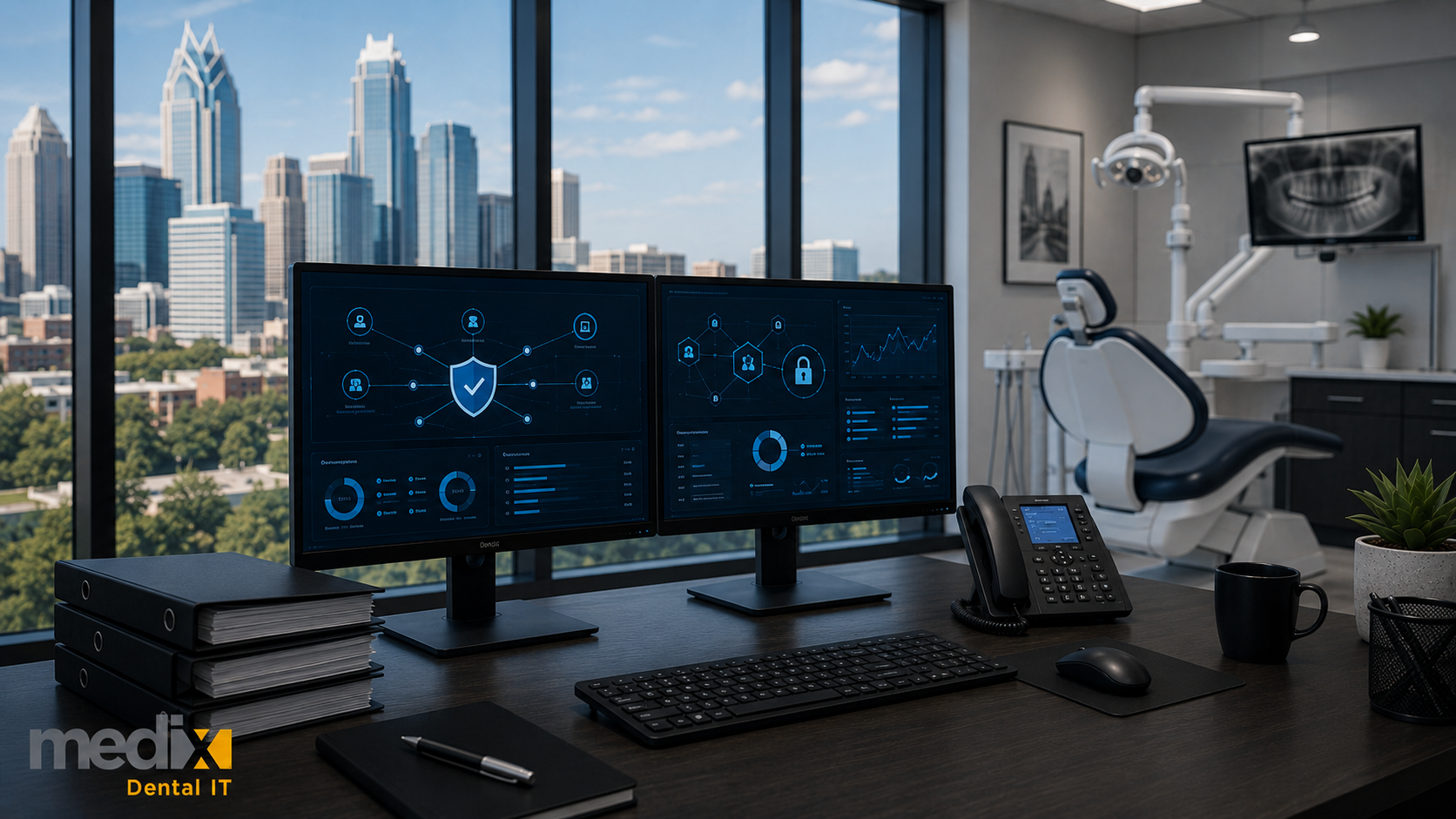
Running a dental practice is hard enough without worrying about whether your technology will hold up on a busy Monday.
Running a dental practice in the Charlotte area means more than skilled clinicians and modern operatories. Strong dental IT support in Charlotte means protecting patient data, meeting HIPAA and North Carolina’s own breach notification rules, planning for the ice storms that knock out power across the Piedmont, and keeping practice management software, imaging, and phones running through every appointment. The metro is now home to roughly 2.88 million people and added more than 61,000 residents in a single year, which means more practices, more acquisitions, and a bigger attack surface for the groups consolidating here. Whether you operate in Ballantyne, University City, Matthews, Mint Hill, Huntersville, Cornelius, Davidson, Concord, Mooresville, Gastonia, Indian Trail, Monroe, or across the line in Rock Hill and Fort Mill, the underlying problem is the same: dental technology is unforgiving when it is run like generic office IT. Medix Dental IT works with practices and DSOs across the Charlotte-Concord-Gastonia metro on exactly that.
Dental IT Support for Charlotte Practices and DSOs
Dental IT is not small-business IT with a dental logo on it. A dental network has to keep Dentrix, Eaglesoft, or Open Dental responsive across every operatory, move large CBCT and intraoral imaging files without choking the network, and hold an identity model that stands up to a HIPAA audit. Carestream, Dolphin, Sidexis, and Planmeca each have their own quirks, and a generalist MSP usually learns them on your time. The details a dental-specific provider treats as routine are the same ones that quietly cost a practice real production hours when they are missed.
Medix has worked exclusively in dental for more than 20 years and supports over 1,000 practices nationwide. We run remote-first from a national operations center with on-call dispatch, so a Charlotte practice gets the same response whether the issue is a frozen imaging sensor at 7 a.m. or a server that did not come back after an overnight power blip. Boring is cheaper than chaos, and a practice that never thinks about its IT is usually the one with a provider who got the boring parts right.
Key Dental IT Services for Charlotte Practices
Every Charlotte practice we support gets the same core program, tuned to how the office actually runs.
Cybersecurity and HIPAA protection. Dental practices hold exactly the data attackers want, and “HIPAA-compliant antivirus” is not a security program. We run enterprise multifactor authentication, endpoint detection and response, identity governance, and regular vulnerability management, then document it so an audit is a non-event. Start with our cybersecurity assessments.
Data protection and disaster recovery. In Charlotte, your continuity plan has to survive a multi-day power outage, not just a deleted file. We build tested, monitored backups with a real recovery path so an ice storm or a ransomware event does not take a practice offline for a week. See our approach to dental data backup and disaster recovery.
24/7 support and monitoring. Issues get watched and resolved around the clock, because the problems that hurt most are the ones that surface before the first patient arrives.
Cloud and Open Dental hosting. For groups moving off aging on-premise servers, we host and manage cloud environments, including Open Dental Cloud, so performance and security are handled centrally instead of office by office.
Lifecycle planning. Hardware gets refreshed on a deliberate five-year cycle, seven years at the outside. That keeps the failures from landing on the busiest day, and keeps a growing Charlotte group’s fleet predictable instead of inheriting a different problem at every acquired office.
The Charlotte DSO Market Is Growing Fast
Charlotte’s growth has made it an active market for dental service organizations, and several of the largest operators already have a real footprint here. Aspen Dental runs multiple offices across the metro, from Northlake to University City to Pineville. PDS Health, through its Smile Generation brand, supports practices like Steele Creek Modern Dentistry and Piper Glen Dental Group. Smile Doctors backs several affiliated orthodontic offices in the city, Affordable Dentures & Implants operates in West Charlotte, and Heartland Dental supports practices including Queens Road Dentistry.
For a group, the IT question is not “does it work in one office.” It is whether the operating environment is repeatable across all of them. A DSO that runs like 15 separate practices gets valued like 15 separate practices, and most of that fragmentation hides in the technology: mismatched security baselines, inconsistent backups, and identity sprawl across acquired offices. We standardize that, run one security baseline and one identity model across every location, and roll the reporting up so leadership can actually see it. That is the difference between a roll-up and a platform, and it is where IT quietly moves EBITDA. Our DSO IT services are built for exactly that.
Ice Storms, Power Outages, and Why Continuity Is Not Optional in Charlotte
Charlotte’s signature operational risk is not the hurricane that makes national news on the coast. It is ice. The Piedmont sits in the part of North Carolina where winter storms arrive as freezing rain, and the result is downed trees, downed lines, and multi-day outages. Duke Energy, headquartered in uptown Charlotte and serving about 4.7 million customers across the Carolinas, puts the mechanism plainly: a quarter inch of ice brings branches onto power lines, and a half inch or more can pull the lines down entirely.
The benchmark is the December 2002 ice storm, still the most severe in Duke’s history, which knocked out power to roughly 1.5 million customers across the Carolinas and caused an estimated $40 million in damage in Mecklenburg County alone. More recently, Winter Storm Elliott forced Duke Energy’s first rolling blackouts in company history on Christmas Eve 2022, cutting power to roughly 500,000 customers across the Carolinas. For a dental practice, every one of those events poses the same question: when the power and the network go down, how long until you can see patients again? Every minute of downtime is revenue walking out the door. A practice with tested backups and cloud-hosted systems answers in hours. A practice relying on a single aging server in a closet answers in days.
North Carolina Dental Cybersecurity and Breach Law
Dental breaches are not hypothetical in the Charlotte metro. In 2024, Valleygate Dental Surgery Centers, which operates locations including Charlotte, reported a network intrusion to federal regulators that exposed the data of 14,589 individuals, including names, Social Security numbers, dates of birth, government IDs, financial account details, and treatment information. That is the full identity-theft payload, and it is exactly what North Carolina law is written to address.
North Carolina’s Identity Theft Protection Act (N.C.G.S. 75-65) requires a business to notify affected residents “without unreasonable delay” after a breach, and to notify the North Carolina Attorney General’s Consumer Protection Division for any breach that triggers consumer notice, with no minimum count threshold. If more than 1,000 people are notified at once, the nationwide consumer reporting agencies have to be notified too. Two things make this stricter than many practices assume. There is no fixed 30 or 60-day clock to hide behind, and North Carolina’s definition of personal information is broader than HIPAA’s protected health information, covering Social Security numbers, driver’s license numbers, financial account credentials, and even biometric data. A practice can trigger North Carolina breach obligations on data that is not PHI at all, which means HIPAA compliance alone does not cover the full exposure.
The defensive baseline is the same regardless of which rule applies first. Enterprise MFA. Endpoint detection and response. Identity governance. Quarterly vulnerability management. A vendor risk register. None of it is exotic, and the payoff is well documented: Microsoft Research found that multifactor authentication blocks over 99.22% of account compromise attacks. In North Carolina, treating that baseline as optional is an expensive position.
Why Charlotte Dental Practices Work With Medix
Dental focus, not a dental side practice. More than 20 years working exclusively in dental, with the practice management and imaging fluency that comes with it.
Enterprise-grade cybersecurity by default. MFA, EDR, identity governance, and vulnerability management are the baseline for every practice, not an upsell.
Real KPI reporting. Uptime, ticket trends, endpoint compliance, MFA adoption, backup health, and hardware age distribution, reported so you can actually act on them.
Built for Charlotte’s growth and Charlotte’s weather. Continuity planning that survives an ice storm and a Duke Energy outage, and standardization that scales as a group acquires its next office.
The Bottom Line for Charlotte Dental Practices
Charlotte practices run specialized software, carry a compliance load that stretches past HIPAA into North Carolina’s own statute, and operate in a metro where a winter storm can take the power down for days. That combination is exactly where generalist IT falls short and where a dental-specific provider earns its keep. The fast-growing groups consolidating here have the most to gain from getting the operating environment repeatable before the next acquisition, not after.
If you are evaluating dental IT support for a Charlotte practice and want a second set of eyes on your current setup, we are happy to compare notes.
Charlotte Dental IT Support FAQs
What areas of the Charlotte metro does Medix Dental IT support?
We support dental practices and DSOs across the Charlotte-Concord-Gastonia metro, including Ballantyne, University City, Matthews, Mint Hill, Pineville, Huntersville, Cornelius, Davidson, Concord, Kannapolis, Mooresville, Gastonia, Belmont, Indian Trail, and Monroe, along with the South Carolina side in Rock Hill, Fort Mill, and Tega Cay.
How should a Charlotte dental practice prepare its IT for ice storms and power outages?
The goal is to make an outage a few-hours problem instead of a few-days problem: tested, monitored backups, a documented recovery path, surge and battery protection on critical hardware, and cloud-hosted practice management where it makes sense, so the practice does not depend on a single on-premise server surviving a Duke Energy outage. We build and test that plan rather than assuming it works.
How does North Carolina breach notification differ from HIPAA?
HIPAA covers protected health information and sets an outer notification limit. North Carolina’s Identity Theft Protection Act (N.C.G.S. 75-65) requires notice to affected residents “without unreasonable delay,” requires notifying the state Attorney General’s Consumer Protection Division for any breach that triggers consumer notice, and defines personal information more broadly than HIPAA, including Social Security numbers, financial account credentials, and biometric data. A practice can owe notice under state law on data that HIPAA does not even cover.
Do you support Charlotte DSOs and multi-location dental groups?
Yes. Multi-location groups are a core part of what we do. We run one security baseline and one identity model across every location, standardize backups and endpoint policy, and roll KPI reporting up to leadership, so a growing group is genuinely scaling instead of photocopying chaos across acquired offices.
Which dental software does Medix support in Charlotte?
We support the full dental stack, including Dentrix, Eaglesoft, Open Dental, Dolphin, Carestream, Sidexis, Ortho2, and Planmeca, along with the imaging hardware that goes with them.
Posted in Service Areas