June 9th, 2026
Dental IT Support Provider in Phoenix, AZ – Secure Your Practice
Industry Research — Service Areas
Running a dental practice is hard enough without wondering whether your technology will hold up through a record-breaking summer.
Running a dental practice in Phoenix dental IT support territory means more than skilled clinicians and modern equipment. It means protecting patient data, meeting HIPAA and Arizona-specific breach notification rules, keeping servers cool through record-setting desert heat, and keeping practice management software, imaging systems, and phones running through every appointment. Medix Dental IT works with dental practices and DSOs across the Valley of the Sun on exactly that.
Phoenix is the fifth-largest city in the country, with about 1.67 million residents inside the city limits and a metro area of roughly 5 million across Maricopa and Pinal counties. For a dental practice or a multi-location group, that growth is the opportunity and the operational pressure at the same time. We provide Phoenix dental IT support from the urban core out through Mesa, Chandler, Gilbert, Glendale, Scottsdale, Tempe, Peoria, Surprise, Goodyear, Buckeye, and Queen Creek, plus the specialty corridors in Paradise Valley, Fountain Hills, and Cave Creek. Arizona’s own breach notification statute, A.R.S. § 18-552, sits on top of HIPAA, and it sets a tighter clock than most practice owners expect.
Dental IT Support for Phoenix Practices and DSOs
Dental IT is not generic small-business IT with a tooth on the logo. A dental practice runs a specific stack: Dentrix, Eaglesoft, or Open Dental for practice management, Dolphin or Ortho2 for orthodontics, and Carestream or Sidexis driving the imaging and CBCT hardware. Those systems carry protected health information and break in ways that stop production cold when the identity model and backups are not built around them. A practice that loses its imaging server at 8 a.m. is not having an IT problem. It is having a revenue problem.
Medix has worked exclusively in dental for more than 20 years and supports over 1,000 practices nationwide, remote-first from a national operations center with on-call dispatch. As Tom Terronez puts it, every minute of downtime is revenue walking out the door.
Key Dental IT Services for Phoenix Practices
Most Phoenix practices come to us for one or two of these and stay for all five.
Cybersecurity and HIPAA protection. Phishing, ransomware, and credential theft are the threats that actually take dental practices offline, and antivirus alone does not stop them. We build enterprise MFA, endpoint detection and response, and identity governance into the practice, then keep them current. Our cybersecurity assessments baseline a practice before anything else.
Data protection and disaster recovery. Backups are only real if they restore. We verify recovery, not just the backup job, so a practice comes back fast after hardware failure, ransomware, or a power event. See our dental data backup and disaster recovery.
24/7 support and monitoring. We watch the systems that matter around the clock and dispatch before a small issue becomes a closed schedule. In Phoenix, that monitoring extends to the physical conditions a server room faces in a triple-digit summer.
Cloud and Open Dental hosting. For practices moving off aging on-site servers, hosted Open Dental cloud removes a single point of failure and a recurring source of summer heat anxiety.
Lifecycle planning. Hardware fails fastest in heat. We plan on a 4 to 5 year refresh for workstations and 5 to 7 years for servers, so a Phoenix practice replaces equipment on a schedule instead of during an emergency in July.
The Phoenix DSO Market
Phoenix is one of the more active DSO markets in the Southwest, and the operators here are not small. Heartland Dental has expanded in the Valley, including a build near 29th Avenue and Dove Valley Road. Aspen Dental runs roughly 21 locations across metro Phoenix, from Metrocenter to Arcadia to Bell Road. Western Dental operates several offices, including on N 35th Ave, N 75th Ave, and W Indian School Rd. Smile Brands, through its Bright Now! Dental offices, has a long-standing Arizona presence, and PDS Health supports affiliated offices statewide from its Henderson, Nevada headquarters.
What separates a DSO that scales from one that does not is whether the IT operating environment is repeatable. Tom Terronez says it plainly: if your DSO operates like 15 separate practices, expect to be valued like 15 separate practices. A roll-up that bolts together 12 acquired offices with 12 backup tools, 12 firewalls, and 12 shared logins is not a platform. It is photocopying chaos. Medix builds a single security baseline, one identity model, and rolled-up reporting across every location, because boring is cheaper than chaos. That standardization is also what makes the valuation story believable to a buyer. More on how we support dental service organizations.
Phoenix Heat Is an IT Risk, Not Just a Comfort Problem
Phoenix does not get weather the way Houston or Chicago do. It gets heat, and the heat is now extreme enough to be an operational hazard for on-site IT. In the summer of 2023, Sky Harbor recorded 31 consecutive days at or above 110°F, from July 1 through July 31, shattering the previous record of 18 straight days set in 1974. That is not a comfort statistic. It is a server-room statistic.
Most dental practices keep their server, network gear, and on-site backup in a closet with a single supply vent. When the building HVAC strains for a month straight, or fails on a Saturday with nobody on site, that closet can climb well past what electronics tolerate, and the imaging server that was fine on Friday is dead on Monday. Monsoon season layers a second risk on top: localized power outages across APS and SRP territory that drop practices without warning.
The fix is design, not heroics: temperature monitoring on the server room, off-site backups that restore fast, and for a growing number of Phoenix practices, moving the practice management database to hosted cloud entirely, so a 115-degree afternoon is the building’s problem and not the practice’s.
Arizona Dental Cybersecurity and Compliance
HIPAA is the floor, not the ceiling. Arizona’s breach notification statute, A.R.S. § 18-552, requires that affected individuals be notified within 45 days of determining a breach occurred. When a breach affects more than 1,000 Arizona residents, the practice must also notify the Arizona Attorney General, the Arizona Department of Homeland Security, and the three nationwide consumer reporting agencies. Arizona’s 2018 amendment widened the definition of personal information past names and Social Security numbers to include medical and mental health information, health insurance identifiers, biometric data, and online account credentials. For a dental practice, that means an imaging archive or a portal login spill is squarely a reportable event. Civil penalties are capped at the lesser of $10,000 per affected individual or actual losses, up to $500,000 per breach series.
There is a federal change worth watching too. In January 2025, the HHS Office for Civil Rights published a proposed update to the HIPAA Security Rule that would convert long-standing “addressable” safeguards, including encryption and multi-factor authentication, into explicit requirements. The rule is still a proposal as of this writing, but the direction is clear, and practices that treat MFA and encryption as optional today are building toward a compliance gap.
The defensive baseline we recommend for every Arizona practice is the same one we hold ourselves to. Enterprise MFA. Endpoint detection and response. Identity governance. Quarterly vulnerability management. A vendor risk register. None of it is exotic, and the payoff is well documented: Microsoft Research found MFA blocks 99.22% of account compromise attacks. Antivirus alone is not a cybersecurity program.
Why Phoenix Dental Practices Work With Medix
Dental focus, not a dental side practice. We have done this and only this for more than 20 years. A generalist MSP can outspend a dental IT company. It usually cannot outperform one, because it does not know what a CBCT failure or a Dentrix migration involves.
Enterprise-grade cybersecurity by default. MFA, EDR, and identity governance are the baseline every practice gets, not upsells.
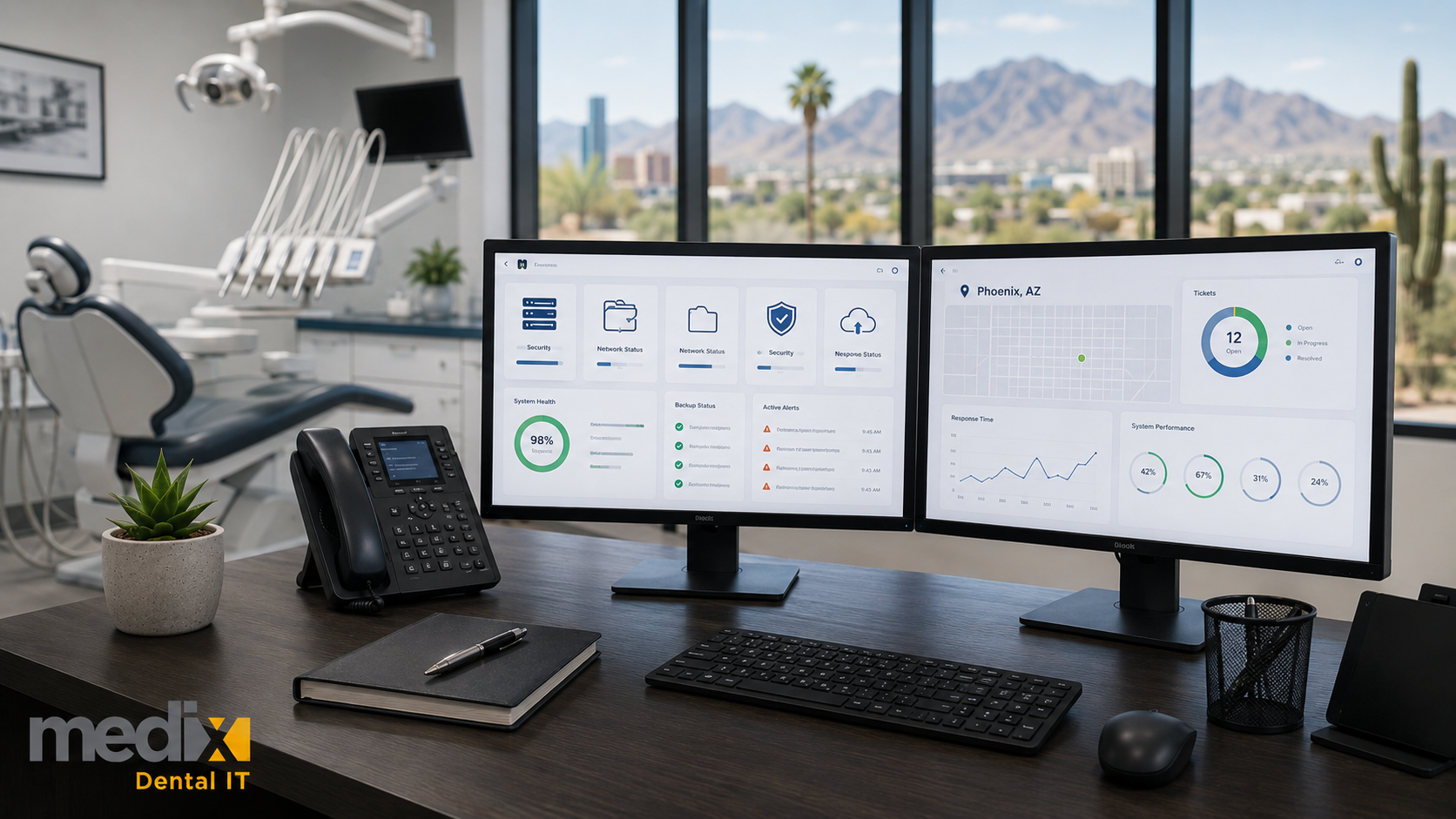
Real KPI reporting. You get a dashboard, not a vibe: uptime, ticket trends, endpoint compliance, MFA adoption, and backup health. If an IT partner cannot show you a dashboard, they are not managing anything.
Built for Phoenix’s growth and Phoenix’s heat. We design for the conditions a desert practice actually faces, from server-room temperature risk to monsoon power events, and scale that design across a single office or a fast-growing DSO.
The Bottom Line for Phoenix Dental Practices
A Phoenix dental practice carries every challenge a practice anywhere does, plus a few the desert adds on top. Specialized software that breaks in specialized ways. A compliance overhead that runs past HIPAA into Arizona’s own 45-day notification clock. A server room that has to survive a month of 110-degree afternoons. A threat surface that grows with every new location and every new login.
None of it requires alarm. It requires a partner who has seen it before and builds for it on purpose. If you are evaluating dental IT support for a Phoenix practice and want a second set of eyes on your current setup, we are happy to compare notes.
Phoenix Dental IT Support FAQs
What areas of metro Phoenix does Medix Dental IT support?
We support dental practices across the full Valley: Phoenix, Mesa, Chandler, Gilbert, Glendale, Scottsdale, Tempe, Peoria, Surprise, Goodyear, Avondale, Buckeye, Queen Creek, and Maricopa, along with the specialty corridors in Paradise Valley, Fountain Hills, Cave Creek, and Carefree. Remote-first support means coverage does not thin out the farther a practice sits from the urban core.
How should a Phoenix dental practice prepare its IT for extreme summer heat?
Start with the server room: temperature and humidity monitoring so you know before hardware does that the closet is overheating, verified off-site backups, and a written recovery runbook. After Phoenix’s 31-day streak of 110-degree highs in 2023, we treat heat as a primary disaster-recovery scenario. For many practices, moving the practice management database to hosted cloud removes the on-site heat risk entirely.
How does Arizona breach notification differ from HIPAA?
Arizona’s A.R.S. § 18-552 requires notifying affected individuals within 45 days, and notifying the Arizona Attorney General, the Arizona Department of Homeland Security, and the three nationwide credit reporting agencies when more than 1,000 residents are affected. Arizona also defines personal information more broadly than HIPAA, covering biometric data, online credentials, and health insurance identifiers, so incidents that might not register federally can still be reportable in-state.
Do you support Phoenix DSOs and multi-location dental groups?
Yes. We build one security baseline, a unified identity model, and rolled-up KPI reporting across every location, so a 3-office group and a 30-office platform run on the same standards. That standardization is what turns a roll-up into a platform a buyer can value, instead of a stack of separate practices.
Which dental software does Medix support in Phoenix?
Dentrix, Eaglesoft, Open Dental, Dolphin, Carestream, Sidexis, Ortho2, and Planmeca, among others. We support the practice management, imaging, and orthodontic systems Phoenix practices actually run, including the CBCT and digital imaging hardware those systems depend on.
Posted in Service Areas