
Most dental group CFOs can tell you the MSP line item, the cyber insurance premium, and the hardware CapEx forecast within a few hundred dollars. Those are the visible costs. They are also not the costs that quietly drain margin every month.
The hidden IT costs at a multi-location dental group live one layer below the obvious line items. They show up as license sprawl, redundant circuits, imaging storage growth, shadow IT purchases, and compliance work absorbed by an operations director who is moonlighting as a helpdesk. None of them break the budget on their own. All of them stack across locations, every month, and the group never gets the leverage from scale that the org chart suggests it should.
This is the CFO-side read on the five hidden IT costs killing DSO margins, the per-location dollar ranges that show up in our audits, and the multi-location math that makes them worth fixing now instead of at the next exit conversation.
Why Hidden Costs Compound at Multi-Location Scale
A solo practice can carry quiet inefficiency for years without any one of them surfacing. A multi-location group cannot. As Tom Terronez has put it, every new location adds cost instead of leverage when the operating environment is not standardized. The acquisition adds revenue on the top line, but it also inherits whatever IT mess came with the deal. Multiply that by location count, and the group ends up paying for IT twice. Once for the inconsistent infrastructure across locations, and again in the form of margin loss the CFO cannot easily trace.
Healthy healthcare organizations spend somewhere between 3 percent and 6 percent of revenue on IT as a working benchmark per industry healthcare IT budgeting benchmarks. DSOs that show up well below 3 percent are not running lean. They are running underinvested, and the hidden costs below are usually where the gap is hiding.
The 5 Hidden IT Costs Hitting DSO P&Ls
1. SaaS and License Sprawl Across Acquired Locations
Every acquired practice arrives with its own software stack. Microsoft 365 tenants nobody consolidated. Duplicate PMS seats for departed staff. Imaging modules nobody uses. AI scribe trials that auto-renewed. Add-on dental software with overlapping functionality across two or three vendors, which is easy to accumulate when add-on modules a base license does not include are priced one at a time. As Tom puts it, the biggest blind spot is the M365 tenant nobody is monitoring, the former employee who still has access, and the shared login six people use because it is easier. License waste is also dollars walking out the door every month.
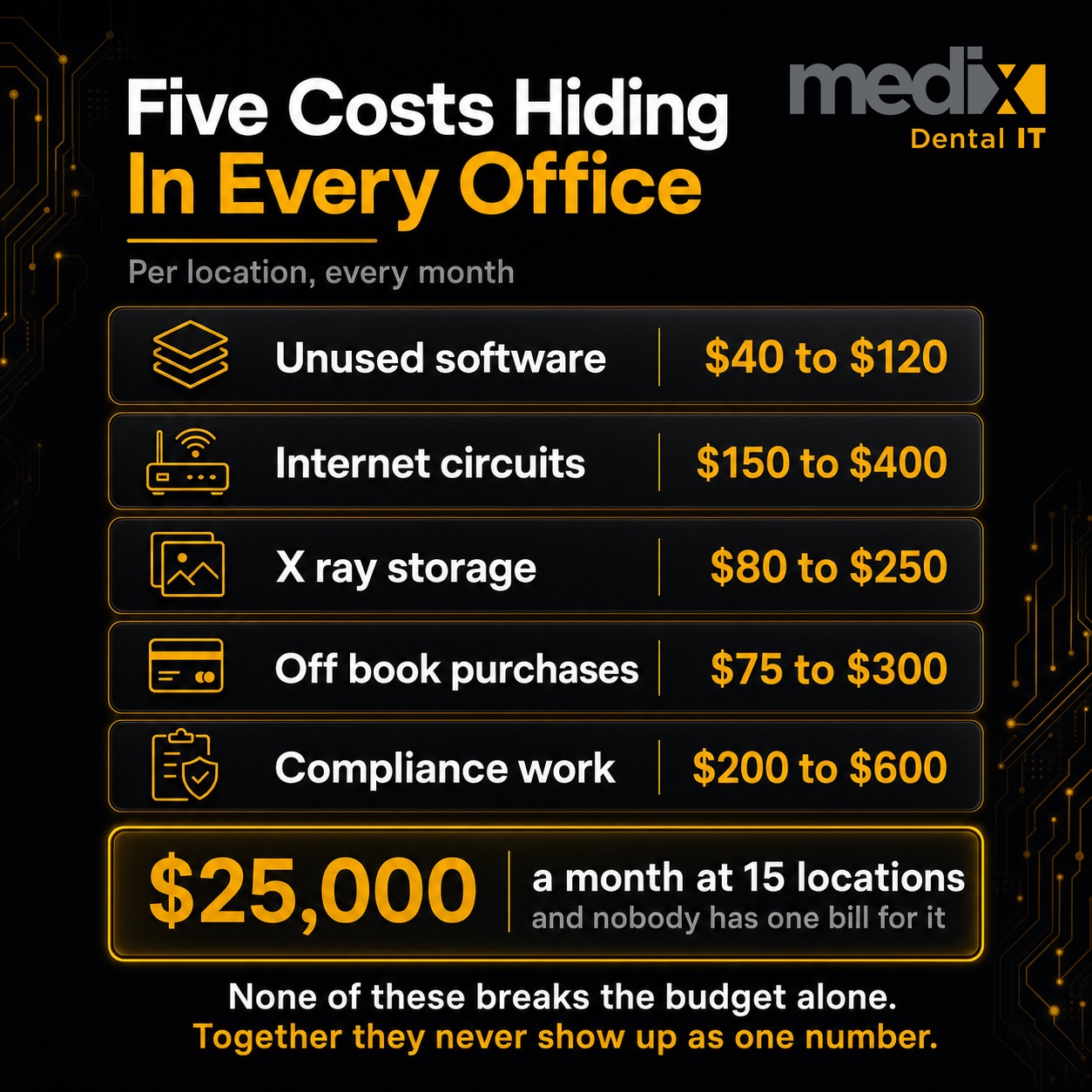
What our audits find: $40 to $120 per location per month in unused or duplicate licenses across acquired practices. At 15 locations, that is $600 to $1,800 per month in pure waste, or $7,200 to $21,600 per year that should never have hit the P&L.
2. Bandwidth and Circuit Redundancy Without a Group Contract
Each location signed its own internet contract with its own ISP at its own retail price, usually years ago, before the group existed. Failover circuits and LTE backup are inconsistent across locations. Some pay for redundancy they do not need. Others pay nothing for redundancy and lose a full production day when the primary circuit goes down.
Group purchasing on bandwidth alone usually recovers material spend. Pact-One’s published dental IT pricing sits at $32 to $68 per device per month with a $499 per month minimum, which works out to roughly $500 to $2,000 per location depending on device count, and circuits sit inside that envelope without a clear line item.
What our audits find: $150 to $400 per location per month in either overspend on redundant circuits or underspend that exposes the practice to single-circuit downtime. At 15 locations, $2,250 to $6,000 per month is on the table either way.
3. Imaging and PACS Storage Growth Nobody Forecasted
CBCT, intraoral scanner data, and imaging archives commonly grow 20 to 30 percent per year per location in our audits as utilization climbs. Cloud storage costs grow with them. Backup egress fees grow with them. And the practice that bought a 4TB on-prem imaging server in 2022 is now staring at a storage refresh that was nobody’s planning agenda.
This cost rarely appears as a budget line. It shows up as a surprise quote from the imaging vendor or the backup vendor when storage thresholds get hit. Our audits find $80 to $250 per location per month in cloud storage and backup egress costs that should have been forecasted but were not. At 15 locations, that is $1,200 to $3,750 per month landing somewhere on the P&L without a named owner.
4. Shadow IT and Office-Manager Swipe Spend
Zapier subscriptions. Calendly. AI scribe tools. SMS appointment confirmation platforms. Patient communication apps. AI photo tools. Office managers and clinical leads at acquired locations swipe corporate cards on tools that solve a real problem in that practice and never make it onto the group’s procurement list. The spend is small per item. The aggregate across 15 to 30 locations is not. Giving locations a vetted list to buy from at the group level costs less than unwinding eight one-off subscriptions later.
Beyond the spend, the bigger issue is that shadow IT also bypasses the BAA review and vendor governance every dental group needs for PHI-handling vendors. A vendor risk register that nobody updates is not vendor governance.
What our audits find: $75 to $300 per location per month in shadow IT spend across 5 to 12 unsanctioned SaaS tools. At 15 locations, $1,125 to $4,500 per month, and that is before the compliance exposure.
5. Compliance and HIPAA Work Absorbed by an Ops Director
The HIPAA Security Rule requires a periodic risk assessment under 45 CFR §164.308(a)(1)(ii)(A), and HHS guidance plus industry best practice treat annual as the working cadence. Most growing DSOs do not have a named compliance officer at sub-25 locations. The work gets absorbed by the operations director, who is also running practice operations, supporting acquisitions, and managing vendor relationships. The cost shows up not as a line item but as ops director hours that could have gone to revenue-positive work, or as outside compliance consulting at $2,000 to $5,000 per location per year when the work finally gets outsourced.
What our audits find: $200 to $600 per location per month in absorbed compliance labor when amortized. At 15 locations, $3,000 to $9,000 per month flowing through the P&L as misallocated operations cost rather than named compliance spend.
The Hidden Monthly Drag, Stacked
Stack the five categories across a typical 15-location DSO and the per-location ranges add up fast. At the low end of every category, the hidden monthly IT drag lands near $8,000 per month. At the high end of every category, it runs to about $25,000 per month. Annualized, that is roughly $96,000 to $300,000 in margin loss the CFO cannot easily reconcile to a named vendor or contract.
The math is the point. None of these line items is a budget-breaker on its own. All of them compound across locations, every month, and the group never sees the leverage from scale that the org chart implies. This is also why one sentence has cost DSOs millions: “We will just keep the local IT guy at each practice.” That is not a knock on him, and Tom made the case in his defense having held the job himself. The local IT guy is not running the SaaS audit, the bandwidth audit, the storage forecast, the shadow IT review, or the compliance risk assessment. Nobody is, and the cost shows up everywhere else.
What This Looks Like Fixed
The fix is not a new IT product. It is a standardized operating layer that catches each of these five categories on a recurring monthly review cycle. License inventory and tenant consolidation. Group bandwidth procurement with documented failover. Imaging storage forecasting tied to utilization. A vendor risk register that includes every SaaS tool with PHI access. A documented annual HIPAA risk assessment with the work scoped to a dental-specialist partner instead of absorbed by the ops director.
The visible MSP fee tends to go up when a DSO standardizes. The hidden $8,000 to $25,000 monthly drag tends to come down by more than the visible spend increase. That is the trade most CFOs are willing to make once the math is on the table. The EBITDA impact of the same standardization at exit is a separate conversation, but the monthly P&L recovery is what makes the case before the exit conversation ever happens.
The Bottom Line
Visible IT costs are the ones every CFO knows. Hidden IT costs are the ones quietly killing margin at multi-location scale. Five categories, $8,000 to $25,000 per month at a typical 15-location DSO, and a fix that lives in operating discipline rather than a new product line item.
If you want a second set of eyes on what your current IT setup is actually costing the group each month, our team runs dental cybersecurity assessments and managed IT support for dental service organizations that include the audit categories above. Happy to compare notes.
Posted in DSO