
July 27th, 2026
DentaQuest Data Breach Hits 15 Million: What It Means for Dental Practices
Industry Research — Dental Cybersecurity, News
Another week, another healthcare data breach in the headlines. This one keeps getting bigger.
The DentaQuest data breach is now one of the largest healthcare data incidents on record, and it is far worse than the early reporting suggested. DentaQuest has begun notifying roughly 15 million people that their personal and health information was stolen, after an extortion group leaked the company’s data online. DentaQuest is not a dental practice. It is the largest Medicaid and CHIP dental benefits administrator in the country, a Sun Life company that handles claims and enrollment data for roughly 33 million members. And that is exactly why every dental practice and DSO leader should pay attention. When a vendor that holds your patients’ data gets breached, your patients get exposed, even if your own network was never touched.
What happened in the DentaQuest breach
In early June 2026, DentaQuest confirmed a cybersecurity incident involving unauthorized access to a portion of its network. The company says it contained the attack, kept its systems operational, and brought in law enforcement and forensic investigators.
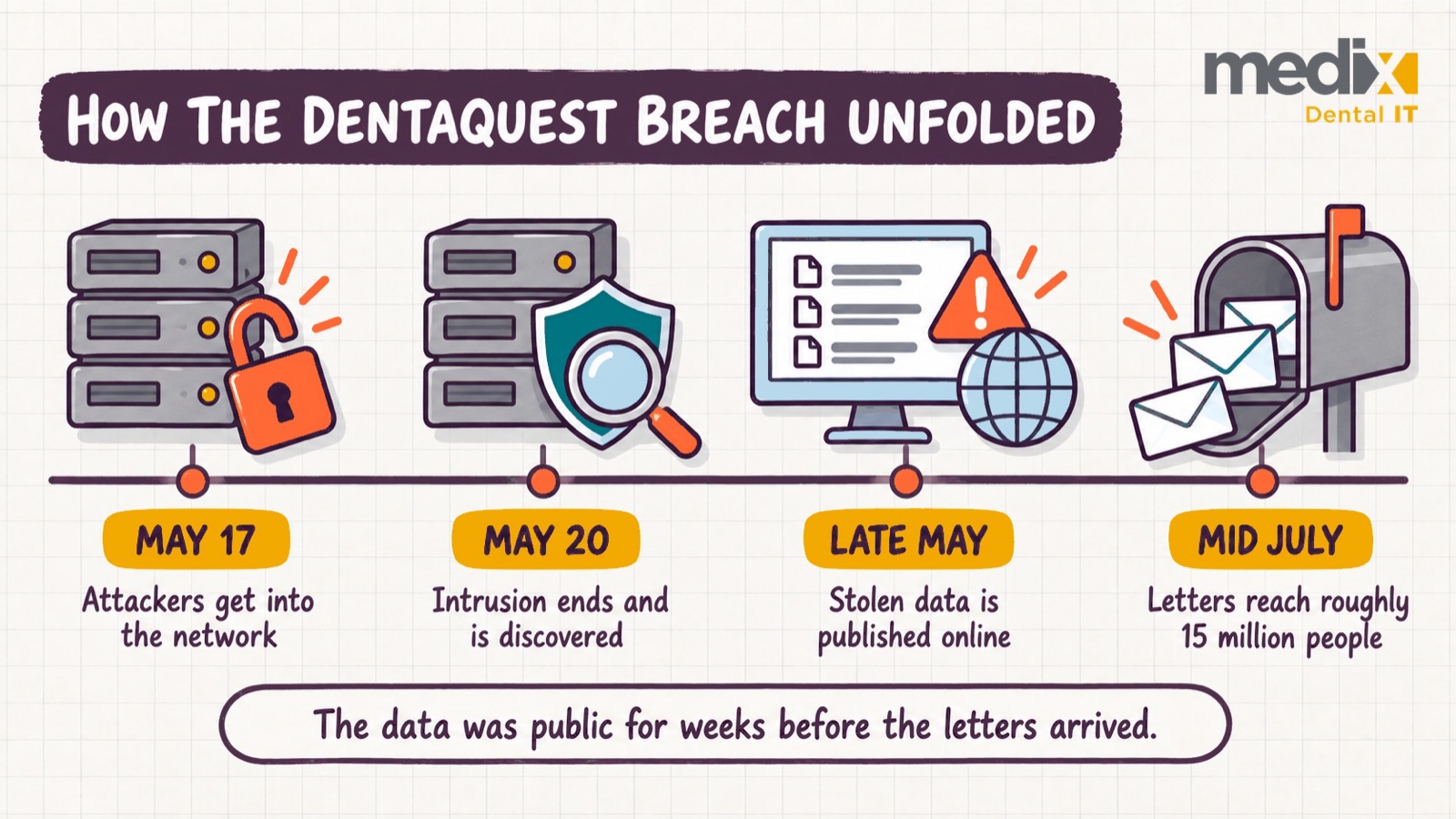
The notification letters that started reaching members in July pin down the timeline. According to the letters DentaQuest filed with the California Attorney General, unauthorized individuals accessed the network on May 17, 2026, the intrusion ended by May 20, 2026, and DentaQuest discovered it that same day. The company then spent roughly two months determining whose data was involved before letters began going out on a rolling basis around July 17.
The stolen information is extensive. Depending on the individual, it includes names, dates of birth, addresses, phone numbers, email addresses, Social Security numbers, government-issued ID numbers, Medicaid and Medicare numbers, member ID numbers, and dental or vision health information such as provider names, diagnoses, treatments, and billing details. Security researchers who analyzed the leaked files reported finding roughly 1.7 million unique Social Security numbers in the data, a large share of them belonging to children.
That combination is the part we would flag for any client. A stolen password gets reset in a minute. A date of birth and a Social Security number are permanent, and the dental and vision claims history attached to them turns a generic identity record into a convincing script for whoever calls your patient next.
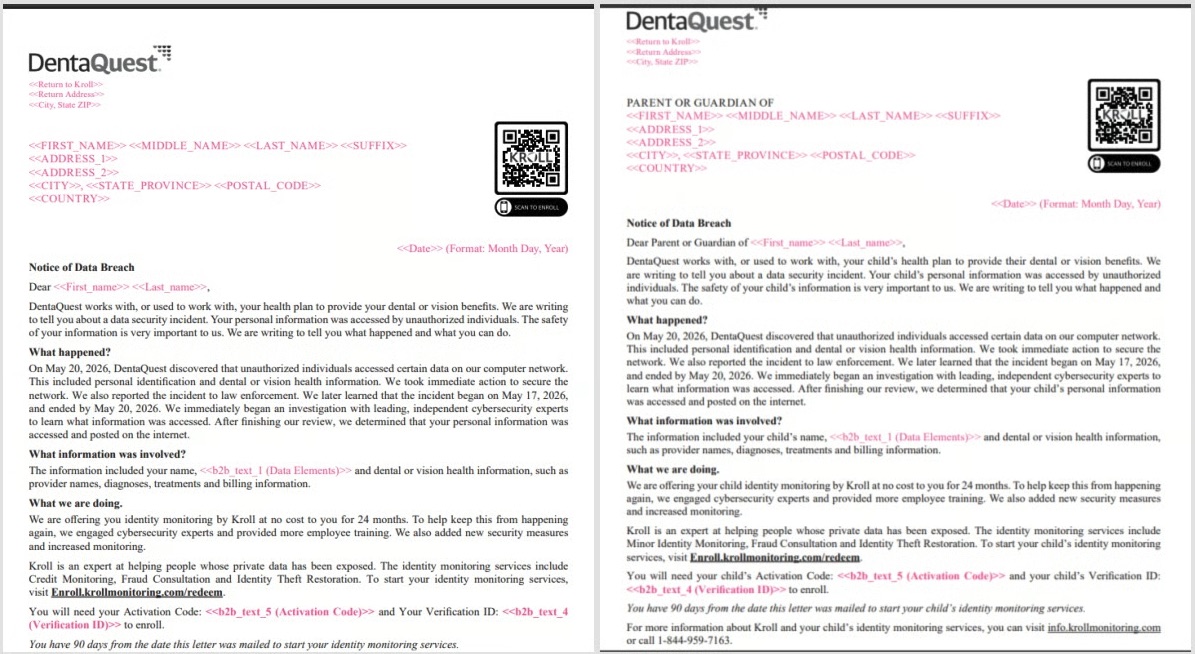
Notice there are two different letters there. DentaQuest filed a standard member letter, a separate letter addressed to the parent or guardian of an affected minor, and a third version for deceased members. That tells you something about who is in this dataset. A Medicaid and CHIP population is heavily made up of children, and children are the most valuable identity theft targets there are, because nobody checks a seven-year-old’s credit report for a decade.
Why the numbers kept climbing
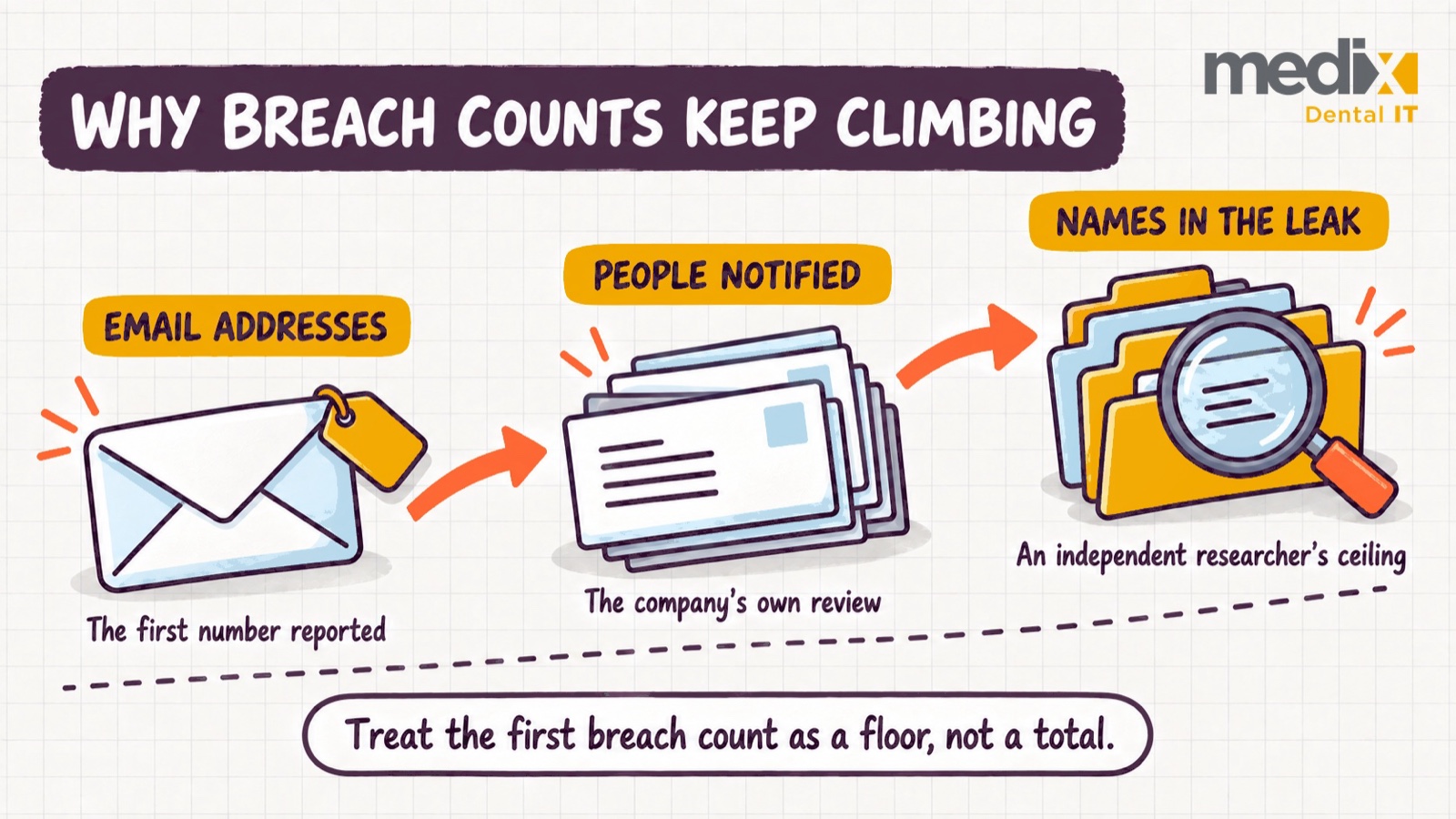
If you followed this story in June, you saw a much smaller figure. Early coverage centered on roughly 2.6 million, which came from Have I Been Pwned’s analysis of the leaked dataset. That number was never the count of victims. It was the count of unique email addresses in the stolen files.
Most Medicaid and CHIP enrollees, especially children, have no email address on file. So the email count captured a fraction of the people involved. Once DentaQuest finished its own review, the notification figure landed near 15 million. HIPAA Journal’s coverage of the breach tracks how those figures evolved, including an independent researcher’s estimate that counted unique name and date-of-birth combinations in the leak and put the ceiling closer to 23 million.
This is the normal shape of a breach disclosure, and it is worth internalizing. The first number you hear is almost always the smallest number anyone can defend at the time. If you made a risk decision in June based on “2.6 million,” that decision was built on a number that was off by roughly six times. We tell the groups we work with to treat early breach counts as a floor and revisit them, because the version of the story that reaches your patients is usually the third one, not the first.
What DentaQuest is offering affected members
Your patients are going to ask you about this, so it helps to know what the letter actually says. DentaQuest is offering 24 months of identity monitoring through Kroll at no cost, and recipients have 90 days from the date the letter was mailed to enroll. The letter includes an activation code and a verification ID, both of which are required to sign up.
One detail worth flagging at your front desk: the services differ by age. Adults get credit monitoring, fraud consultation, and identity theft restoration. Minors get minor identity monitoring, fraud consultation, and identity theft restoration, because a child generally has no credit file to monitor. If a parent asks whether to enroll their child in credit monitoring, the accurate answer is that Kroll’s minor service is the one covered by that letter.
Litigation has already started. A proposed class action was filed in Massachusetts federal court in June, and multiple firms have opened investigations. That is not a surprise at this scale, but it is a reminder of where the real cost of a breach lands, and it lands long after the incident is contained.
This was extortion, not ransomware
Security reporting attributes the attack to the extortion group ShinyHunters, which claimed to have taken 234GB of data from DentaQuest and published it in late May after negotiations went nowhere. That is the sequence worth holding onto: the intrusion ended May 20, the data was public within weeks, and the letters explaining it did not reach mailboxes until mid-July. DentaQuest’s own letters do not name the group, so the attribution comes from researchers and the leak site itself rather than from the company.
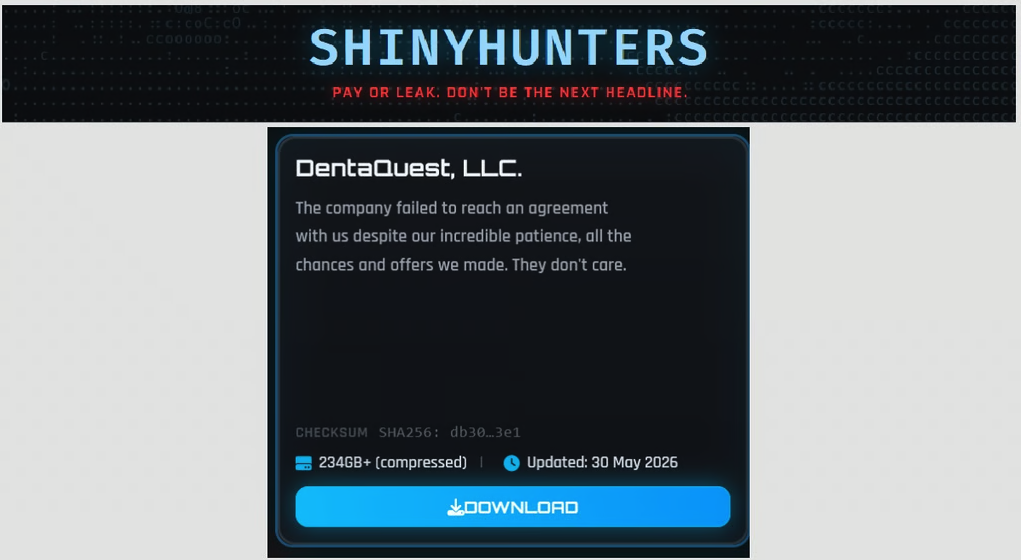
Read the line on that listing: “The company failed to reach an agreement with us despite our incredible patience.” That is the entire business model in one sentence. There is no encryption, no locked workstations, no downed schedule. The only threat they had was publication.
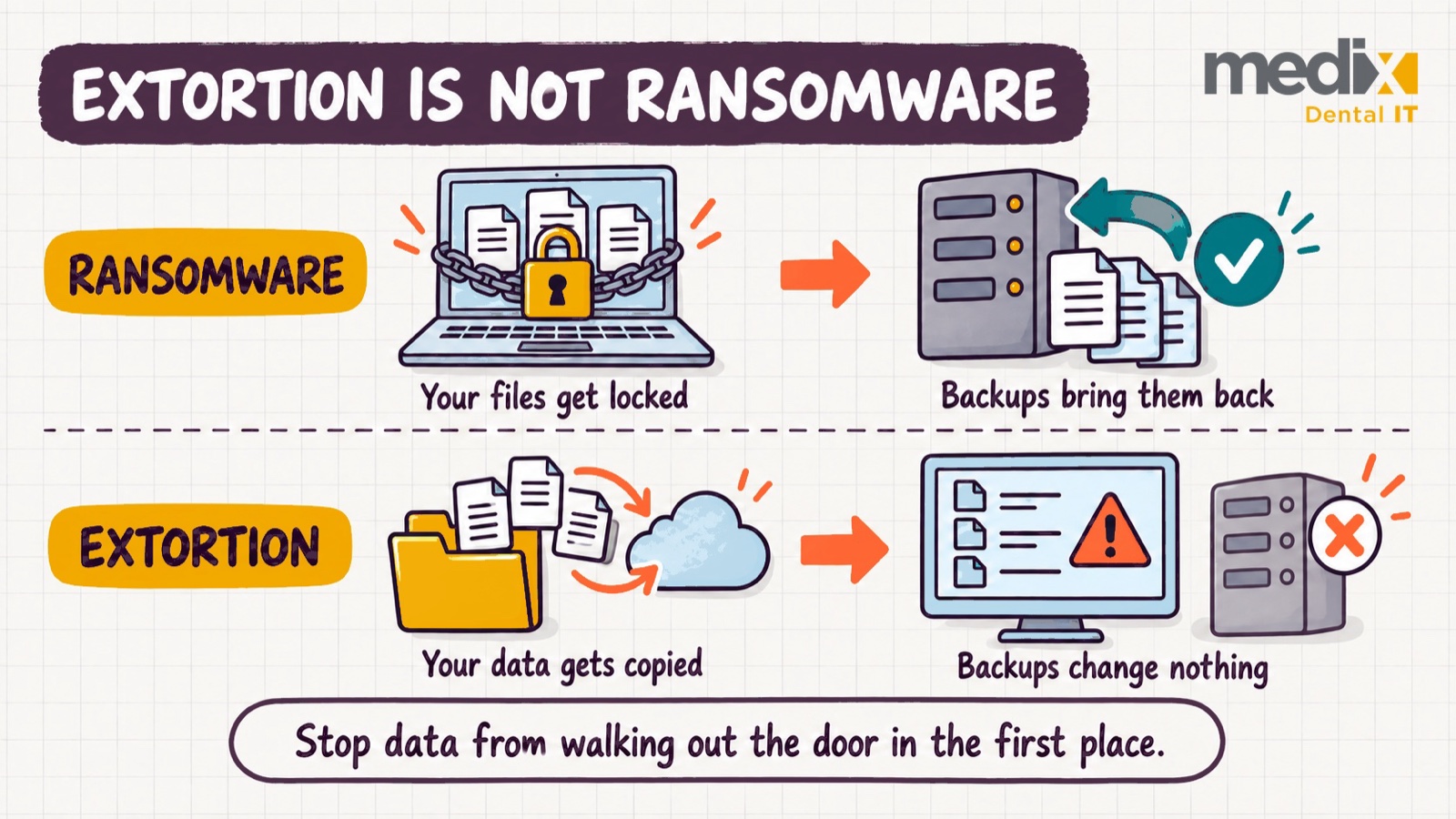
That distinction matters more than most dental leaders realize. Backups do not save you here. You can restore every file you own and the data is still on a leak site. The defenses that actually work against extortion are the ones that stop data from walking out the door in the first place: identity controls, monitoring for unusual data access and exfiltration, and limiting how much data any one account can reach. Most dental organizations are built for neither ransomware nor extortion, but they at least have a backup story. Against this, they have nothing.
Why this is a vendor problem, not just a DentaQuest problem
Here is the part most of the coverage misses. If you run a dental practice or a DSO, you almost certainly do not have a direct security relationship with DentaQuest. You did not choose their firewall and you cannot audit their network. But your patients’ information may have been in that leaked dataset anyway, because that is how the modern dental data supply chain works.
Patient data does not sit in one place. It flows from your practice management system to your clearinghouse, your insurance administrators, your analytics tools, and your communication platforms. Every one of those vendors holds a copy of something, and every copy is a target. A breach at any link in that chain can expose your patients without a single alert firing on your own network. It is the same lesson the Change Healthcare incident taught the industry, and your patients will not call DentaQuest’s front desk about it. They will call yours.
Too many practices assume their vendors have security handled because the sales page says “HIPAA compliant.” That is not validation. It is marketing. If a vendor can see your data, they can expose it. Access equals risk.
What dental practices and DSOs should do now
You cannot patch DentaQuest’s network. But you can change how you manage the vendors who touch your data, and tighten your own posture so the leaked data does not become the opening move in an attack on you. A few things matter more than the rest:
- Treat every vendor as part of your attack surface. List every platform and integration that can access patient data, confirm there is a signed business associate agreement in place, and stop treating “HIPAA compliant” on a sales page as proof of anything. Verifying vendors is basic diligence, and almost nobody does it.
- Warn your front desk and patients about phishing. Leaked names and insurance details make impersonation easy, so expect a wave of calls and emails pretending to be your office or “your insurance.” Expect fake breach-notification emails too, since attackers know 15 million people are waiting on a letter right now. A two-minute heads-up to staff and patients prevents a five-figure cleanup.
- Fix your own identity layer. Enforce multi-factor authentication everywhere, kill shared logins, and remove access for former employees today. Microsoft’s research found MFA blocks more than 99% of automated account-compromise attempts, yet many dental organizations still treat it as optional. The biggest blind spot in dentistry is the Microsoft 365 tenant nobody is watching, not the firewall.
- Watch for data leaving, not just attackers coming in. Extortion crews are judged on what they carry out. If nothing in your environment would notice an account suddenly pulling thousands of patient records, you would not know this happened to you until it showed up on a leak site.
- Have a breach-response plan before you need one. If a patient asks whether their data was caught up in this, you should have an answer ready, not a scramble. Our guide on what to do after a breach walks through it, and the deadlines that apply when the breach is yours are covered in our guide to dental data breach notification.
DentaQuest Breach FAQs
Is there a DentaQuest lawsuit, and where does it stand?
Yes, and it is early. On July 31, 2026 the court consolidated thirteen federal cases into a single action in the US District Court for the District of Massachusetts, In re: DentaQuest Group, Inc. Data Incident Litigation, No. 1:26-cv-12458, before Judge Angel Kelley.
Nothing has been decided, which is the part worth holding onto when you read coverage of it. The court has not yet appointed lead counsel for the plaintiffs, so the consolidated complaint has not been filed. No class has been certified, DentaQuest has not answered the allegations, and no court has found that the company did anything wrong. Everything published about its security so far is an allegation in a filing rather than a finding, and the consolidation order was agreed to by both sides and decided nothing about the merits. The practical read for an operator is that this will be quiet for a long time, and that any patient who is told there is money waiting is being told something that is not true yet.
Is there a DentaQuest settlement, and what do these usually pay?
No settlement exists. No fund, no claims process, no settlement website. So if a patient says they have been asked to file a DentaQuest claim, there is nothing yet for them to file against, and whatever reached them did not come from a court-approved process.
Recent healthcare breach settlements do follow a consistent shape, so the range is worth knowing before a patient asks. A claimant who can document out-of-pocket losses can usually claim up to somewhere between 2,500 and 7,500 dollars. Everyone else takes a flat cash payment, typically advertised between 50 and 100 dollars. That flat figure is an estimate rather than a promise, because it is divided by however many people end up filing.
The gap between the advertised number and the real one can be wide. In the Premera Blue Cross settlement, class members were offered up to 50 dollars, and the checks that went out in June 2020 came to about 13. The reason reported at the time was that roughly four times as many people filed claims as is typical, so the same fund was divided further. Attorneys’ fees also come out of the fund before anyone is paid. And these take years: the litigation over the February 2024 Change Healthcare breach, a far larger incident, is still in pretrial proceedings with no approved settlement for consumers to claim against.
For the front desk, that turns into one instruction. Do not quote a patient a number, because there is not one to quote, and a staff member guessing at a figure is the kind of thing a patient repeats back later as something the practice told them. Point them at the letter they received and at DentaQuest, and leave the payout question alone.
A patient received a DentaQuest letter. How do they know it is real?
Three things travel together on a genuine one: it came by mail, it names Kroll as the monitoring provider, and it carries both an activation code and a verification ID. DentaQuest also sent different versions to adults, to the parent or guardian of an affected child, and to the families of deceased members, so two households can compare letters that do not look alike and both be holding the real thing.
The tells worth giving your front desk are about pressure and payment. No legitimate notice asks for money to enroll in monitoring the company is providing free. Deadline pressure is trickier, because the real letter does carry a deadline: 90 days from the mailing date to enroll with Kroll. That is the detail worth passing along, since a patient who sets the letter aside can lose free monitoring they were entitled to. What a genuine notice does not do is compress that into hours, or tell someone their coverage lapses today unless they click. Unsolicited texts and emails deserve suspicion even though enrollment itself is legitimately done online, so the safe instruction is the same one that works for every impersonation attempt: do not click the link you were sent, go to the enrollment site named in the mailed letter, and use the codes printed there. Kroll’s own enrollment will ask for identifying information, which is normal once you have reached it independently rather than through a link someone sent you.
What does your practice actually owe here?
The answer turns on the relationship, not on whose network was breached, and that distinction is where practices get this wrong. Where DentaQuest is acting as the dental plan administrator, it is a covered entity in its own right and it is the party notifying affected members. Your practice is not the one on the hook, and your patients are being contacted directly.
Where a vendor holds your patient data as your business associate, the analysis is different. Under 45 CFR 164.410 the business associate notifies you, and your own duty to notify individuals under 164.404 does not disappear because the incident happened on their systems. You can agree that the vendor sends the notices, but that is a delegation, not an exemption. So the question to answer is which role the vendor was playing for you, and the place to answer it is the signed agreement rather than the letter your patient received. If your group sent data to DentaQuest under a business associate arrangement, that is a conversation with counsel.
What your practice does owe is a straight answer at the front desk. Patients whose data was exposed somewhere else still call the office they trust, and “we did not send that letter, here is what we know about it” is the difference between a calm conversation and a patient who assumes you are hiding something.
The pattern behind every one of these
DentaQuest is a big name, but the story is the same one that plays out across dentistry every month. We saw it with the Aspen Dental incident, it now sits near the top of the biggest dental data breaches on record, and we saw it again when a ransomware group posted a claim against the dental billing vendor eAssist, which left practices deciding what to do while the vendor would only confirm that it was investigating. We see smaller versions of it constantly in the practices we protect. The common thread is not bad luck. It is underinvestment, blind trust in vendors, and the assumption that someone else is handling security. For DSOs the stakes are higher, because the exposure multiplies across every location and every vendor relationship you have not standardized, and a buyer doing diligence will price that risk straight into your valuation.
The shift that matters is moving from “do we have security tools” to “do we have a security posture.” Antivirus is not a security program, and a signed BAA is not a security audit. Real protection comes from knowing exactly who can touch your patient data, watching for the early signs of an attack, and locking down identity before a leaked record ever turns into a breach of your own.
That is the work we do for the dental groups and DSOs we protect at Medix Dental IT. We map every vendor and integration that can reach your patient data, monitor for the lateral movement and credential abuse that follows breaches like this one, and build the layered defense that keeps a third-party leak from becoming your incident. If you want a second set of eyes on how exposed your vendor chain actually makes you, a cybersecurity assessment is a good place to start. Prevention is always cheaper than panic.
Posted in Dental Cybersecurity, News