
September 21st, 2026
Why You Should Never Buy Dental Technology at a Conference
Industry Research — DSO

Conference season runs most of the year in dentistry, and the exhibit hall is where a lot of technology decisions get made.
Buying dental technology at a conference is how a good idea becomes a problem your team inherits. The decision happens at a booth. The consequences land later, on people who were never asked.
I used to speak in front of D4 students at dental schools. I would talk about technology and business leadership, and I always ended the same way: for the rest of your life, you are going to be professional sales targets, and you are going to have really good salespeople selling to you all the time.
That was not a warning about bad vendors. Most of them are good at what they do. It is a warning about where the decision gets made.
I talked through this with Brandi Marzolino on her show, The Real Talk of Dental, and the clip below picks up right at the conference question. Fair disclosure: Medix sponsors that podcast, so treat it as a conversation between people who know each other rather than an independent review.
The Booth Is Built to Compress a Decision
An exhibit hall is a room built to compress a decision. The demo runs on clean data. The rep is the best one they have. The pricing expires Sunday. Everyone around you is nodding.
That environment works on experienced operators too. It is designed to.
None of that is dishonest. It is just a selling environment, and it is very good at its job.
What the booth cannot show you is your own environment.
It cannot show you the aging workstations in your busiest operatories. Or the practice management platform that will not hand over its data cleanly. Or the person at the front desk who already has a workaround for the problem you are about to solve.
I can’t tell you how many times we had a dentist reach out and say, “I was at Midwinter and I bought this.” And we would say, okay, now you have to upgrade several computers, you have to do this. The answer comes back: “I didn’t know.”
That is why you don’t buy at a conference. Not because the product was wrong. Because the bill was only partly written.
The Bill You Did Not See
A signature at a booth is rarely the whole purchase. It is the trigger for a second purchase nobody quoted.
New software often lands on hardware that cannot carry it. Microsoft’s lifecycle documentation confirms Windows 10 reached end of support on October 14, 2025, which means any workstation still sitting on it is already past the line, and a new clinical application is frequently the thing that finally exposes it. We wrote about how that deadline sits inside a hardware order in our new dental office technology setup sequence, and the same arithmetic applies to an existing office.
Then there is the data. Moving records between systems is a project, not a setting, and it is the line item most likely to be missing from what you signed. If the purchase is a practice management platform, the migration and training load is most of the real cost, which is why we broke out what dental practice management software actually costs separately from the license price.
And if the product touches patient information, you have a regulatory obligation attached to the purchase whether anyone mentioned it or not. Under 45 CFR 164.502(e), a covered entity has to have satisfactory assurances from a business associate, and those assurances must be documented in a written contract. Almost nobody asks for that at a booth.
None of these costs are hidden, exactly. They are just somewhere other than the room where you decided.
What To Do at the Booth Instead
Go. Walk the hall. See the demos. Conferences are genuinely useful for finding out what exists and meeting the people behind it.
Just move the decision somewhere else. Brandi Marzolino, who coaches dental teams and hosts The Real Talk of Dental, tells her clients to get the info, get the person, start building a relationship, and not hand anyone a credit card at the event. I would go further than that. Take the decision home and put it through a process.
If you want the conversation to be worth something, the questions below are the ones that change what you sign. They are also the ones a good vendor will answer happily, which is its own signal.
What does this run on, specifically?
Ask for the current system requirements in writing, not a verbal “it works with everything.” Then ask what happens on hardware that is four or five years old, because that is what is actually in your operatories.
What does the data migration cost, and who does the work?
Ask whether migration is included, quoted separately, or handled by a third party you will be managing yourself. Ask how long the last comparable migration took in real weeks.
Will you sign our business associate agreement?
If the product touches patient data, this is not optional. Ask for their standard agreement and check whether it commits them to return or destroy protected health information at termination, which is what 45 CFR 164.504(e) contemplates where feasible.
While you are in that document, ask the commercial questions the regulation does not cover. What format does your data come back in, who pays for the export, and how much notice does termination require. Those answers decide how hard it is to leave.
Who on my team has to change how they work?
Name the roles. If the answer is front desk and nobody from the front desk has seen the product, you have found the gap before it costs you.
What does onboarding actually include, and when does it end?
Get the number of sessions, the format, and the date support shifts from implementation to a ticket queue.
What does the conference price look like in three weeks?
Ask directly. A vendor who will hold terms for a buyer doing real diligence is behaving like a partner. A vendor who will not hold them for three weeks is telling you the discount was doing the persuading, and that is worth knowing before you commit.
There is one honest exception to all of this. If you have already done the technical, legal, and staffing work on a product, and the event is just where the paperwork happens to land, then signing there is fine. The rule is not about the building. It is about whether the decision was made before you walked in.
For Groups, Sequence Beats Shopping
Everything above applies to a single practice. For a group it compounds, because you are not buying one deployment, you are buying one deployment times every location.
My technical answer for DSOs is always the same. Get a strong technological foundation, standardize, and then start looking at new technology.
What has been common in the industry is the opposite order. In the early stages of consolidation people bundle practices together, and they could have five or seven different practice management systems across the group. Then somebody wants to put one new technology across all the practices, and the lift required is much larger than it looks from the outside. Sometimes it is not possible at all.
The agreement still gets signed, because nothing in the buying process is designed to surface that.
Standardization is not about control. It is about leverage.
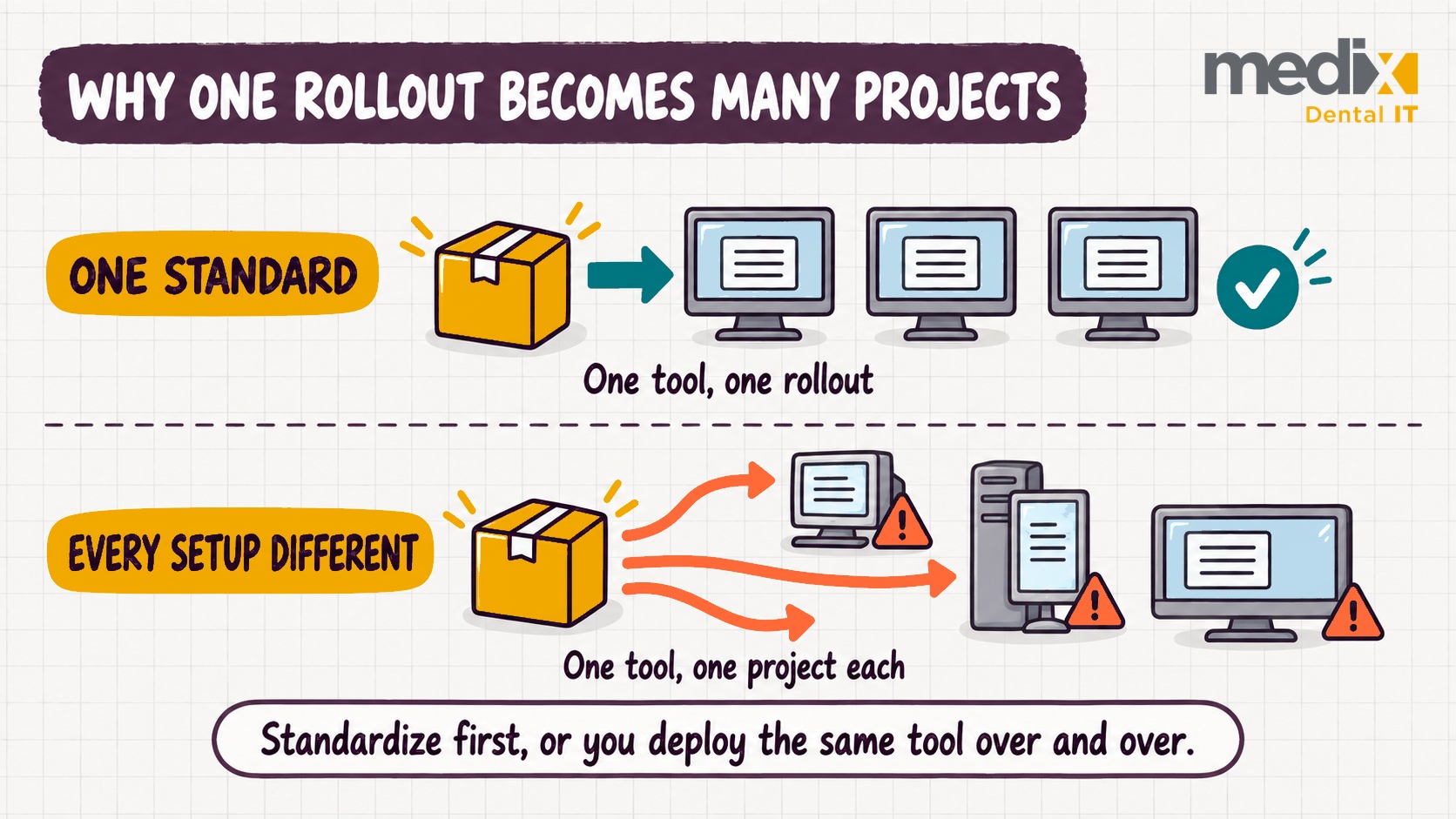
A new tool deployed across a standardized environment is a rollout. The same tool deployed across a group still running that many different systems is not one project. It is one project per environment, wearing a single invoice. If you are still working out that foundation, our DSO technology playbook covers the order we recommend.
Who Should Have Been in the Room
Here is the part that gets skipped, and it is the part that decides whether the purchase works.
Leadership in a doctor-owned group tends to be more clinical. They see something that looks like a great solution for the front office or the back office, but they do not do that job day to day, so they do not see the impacts or the repercussions.
Ask your team. Ask questions. Have them involved and have them hold a stake in it. If you make a change and just thrust it in front of them and say make it work, the uptake and the success rate are much lower. If they are part of the decision, they will have the buy-in organically.
If you are a big DSO, build a committee of people in different roles. If something is going to touch front desk operations, have a committee of front desk people involved in making the decision. Do not just sign them up and say, here you go. They are going to have input and an understanding that leadership is not going to have.
Where I see a lot of friction is when the technology is chosen, implementation starts, and only then does the front office get brought in. That is when somebody says, well, that is not going to work with how we do this. All of it could have been prevented if they had been part of the decision.
There is a structural gap underneath all of this, and it is not anyone’s fault. Vendor onboarding is finite, and it is not practical for a vendor to run an immersive program inside individual practices with your staff. In groups and DSOs there is usually no dedicated internal resource to pick it up either, so the work of making a tool part of how people actually operate lands in the space between the two, where nobody owns it.
Assume that gap is yours until you have confirmed otherwise. Practically, that means naming one person who owns adoption before you sign, giving them time that is actually budgeted rather than absorbed on top of their existing job, and agreeing what usage should look like ninety days in. If nobody can be named, that is worth knowing before the contract starts rather than after.
The Real Cost of Moving Fast
The case for signing at the booth is speed. Move now, get the discount, start sooner.
There may be a dollar cost up front that is a little higher when you slow down. The long-term cost is lower, because you are not absorbing the staff turnover. You are building a foundation with your team instead of eroding trust.
Trust is the expensive part. When a practice partners or joins or is sold, there is already distrust in the building. Sometimes the buyer’s approach is to rip everything out and then make the changes. To somebody who has been in that same seat for fifteen years, that is a hard thing to absorb.
I have been through a lot of these scenarios where tribal knowledge just disappears when enough people turn over. That knowledge is not written down anywhere, and it does not come back with the replacement hire. It could have been prevented with a little more attention to the people.
So put it in the process. In every decision, technology or otherwise, have a segment in your decision-making that specifically addresses who this is going to impact and how. Then plan around that answer: who gets told before it happens, who gets trained first, and what the first two weeks look like for the people whose day changes.
Technology is only scalable if people will actually use it. You cannot deploy your way out of a culture problem, and no purchase order has ever solved one.
What This Means for Your Group
I sell dental IT, so weigh this accordingly. The arithmetic does not care who is doing the math.
The move is not to avoid the exhibit hall. If you want to know which events are worth the travel in the first place, we broke down the four circuits in our guide to dental conferences and DSO events. Go to the right ones. Walk them with a rule: nothing gets decided in the building.
If you are sitting on a purchase you already made and your team is not using it, most of that is recoverable. Adoption problems usually are. Contract terms and hardware you did not plan for are harder, and the sooner you look at them the cheaper they get. Happy to compare notes on how other groups worked through it.
A booth is a good place to learn what exists. It is a poor place to learn what it will cost you.
Posted in DSO