
September 2nd, 2026
New Dental Office Technology Setup: The Pre-Opening Sequence
Industry Research — Dental Cybersecurity, DSO, Tech News
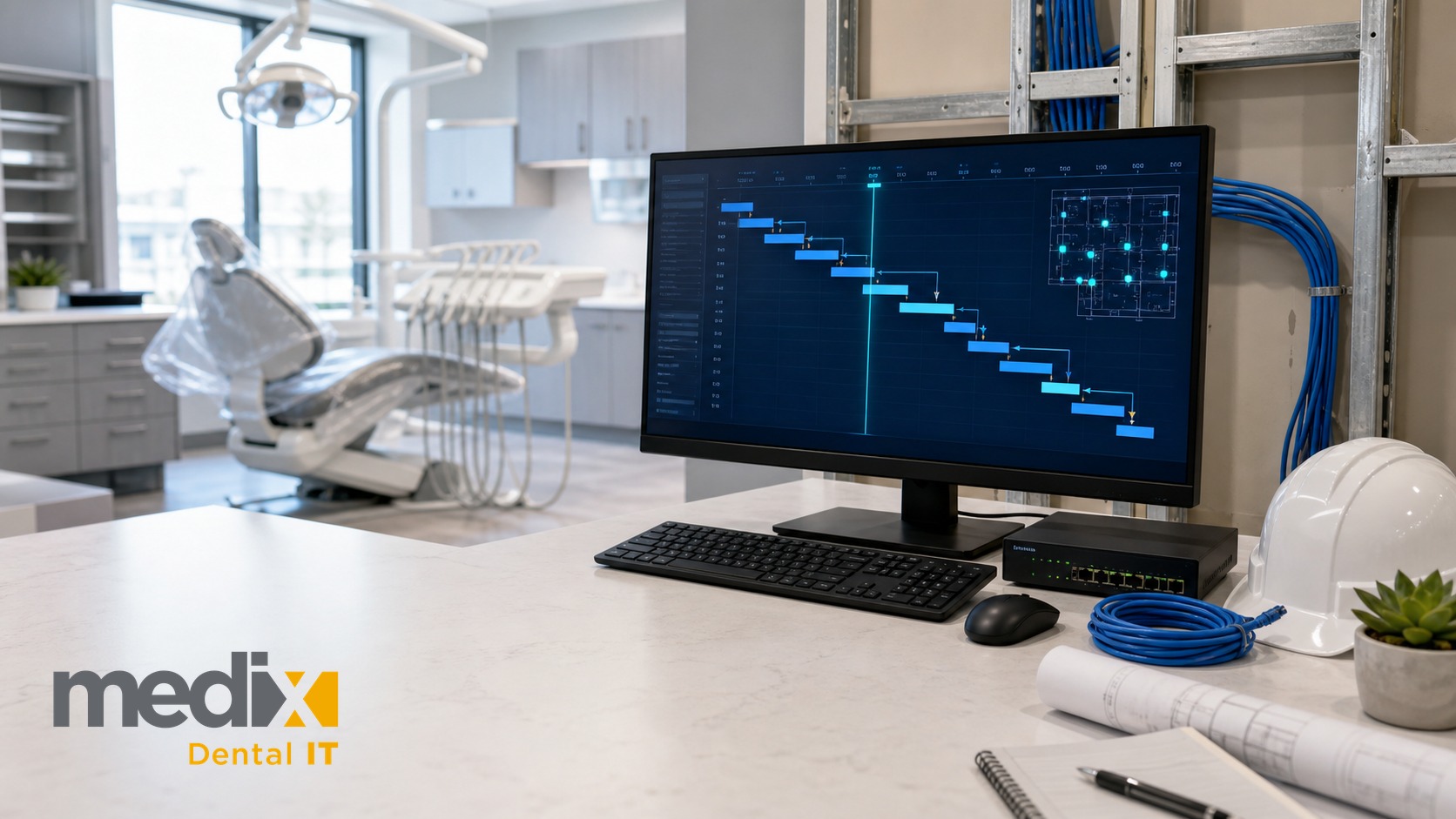
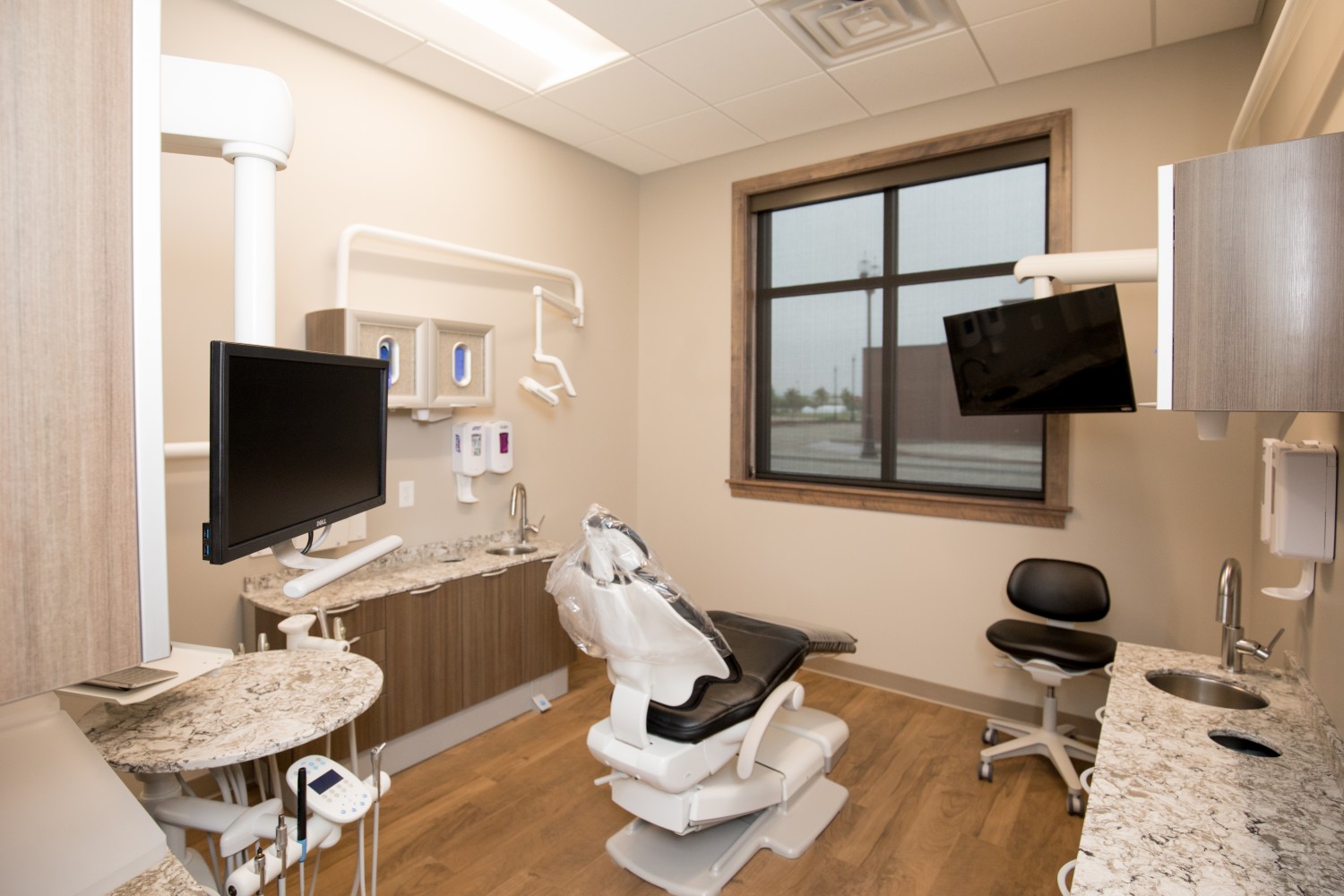
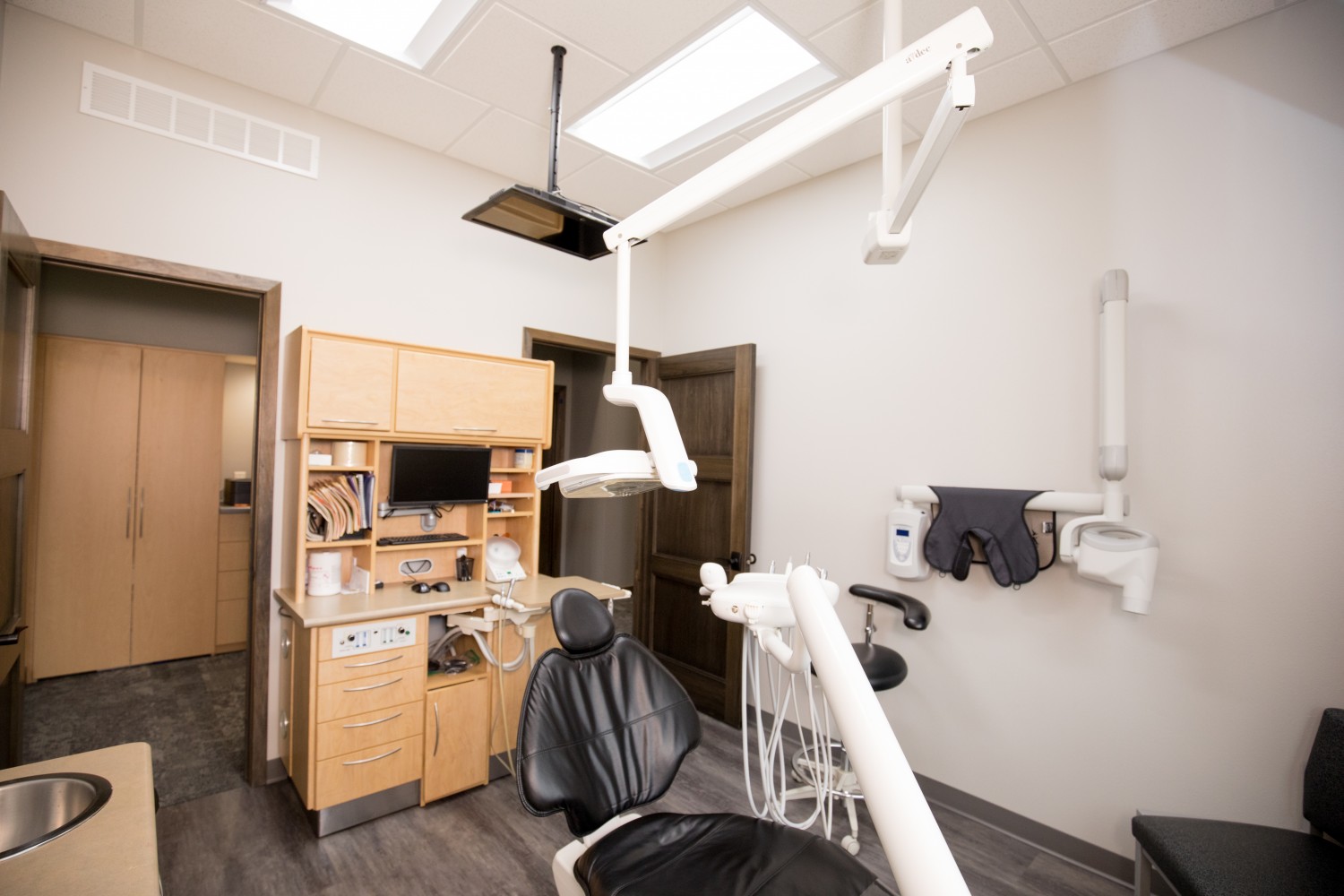
Opening a practice is one of the few times in dentistry when you get to build the technology environment from nothing, with no legacy decisions to work around.
Most guides to new dental office technology setup give you a six-month countdown and a list of things to buy. The countdown is roughly right as a duration, and it still leaves out the part that decides your opening date. Your sequence gets fixed by a small set of constraints published by your software vendors, your carrier, and federal regulation, and almost none of them appear on the pages that rank for this topic. A practice that reads those documents early builds in the right order. A practice that does not ends up retrofitting.
This is a pre-opening guide, and the sequence is the same whether this is your first location or your ninth. If you already see patients and want to audit what you have, our IT checklist for dental practices is built for that job instead. What follows is the order of operations for a space that is still under construction.
The Constraint That Sets Your Real Deadline
Ask five dental IT companies when to start and you will hear six months. Ask them why six months, and the answer gets thin.
Here is the more useful way to think about it. Your opening date belongs to the longest task you do not control, plus the decisions that become expensive to reverse once drywall goes up. Cabling is the obvious one. Two others matter just as much and get noticed much later.
The first is your internet circuit. One of the most specific installation figures published by a national carrier comes from AT&T, and the scope matters: the company says you can “get up and running in as little as ten days at 3 million nationwide fiber-ready business locations.” That is the best case, at a building that already has fiber to it. A new dental office in new construction may or may not be, and that is the question to settle first.
For a building without suitable facilities already in place, the carrier’s own terms describe a different process. CenturyLink’s published local terms of service for special construction state that special construction can be required “when suitable facilities are not available to meet a customer’s order for service” and one or more further conditions the document lists are met, and on timing the document says this:
“Based on available information and the type of service ordered, CenturyLink will establish an objective date for the installation of necessary facilities. The date will be established on an individual case basis and provided to the customer. CenturyLink will make every reasonable effort to assure that the date is met. However, shortage of components, personnel or other factors may lengthen the installation interval.”
That is a carrier saying in its own terms of service that the date is individual to your site and can stretch.
Comcast is more direct still. Its dedicated internet product schedule defines the “Estimated Availability Date” as “the target date for delivery of Service,” then says the company “shall use commercially reasonable efforts to provision the Service on or before the Estimated Availability Date; provided, however, that Comcast’s failure to provision by said date shall not constitute a breach of the Agreement.” Lumen’s internet services schedule adds the other end of the same process: “Construction charges apply if special construction is required to extend Service to the demarcation point. If Customer does not approve of the Construction charges after Lumen notifies Customer of the charges, the Service ordered will be deemed cancelled.”
Note that CenturyLink and Lumen are the same company under two brands on the business side, so treat those as one carrier rather than two. Even so, the pattern holds: Comcast, CenturyLink and Lumen all decline to guarantee a completion date in their own terms, and where facilities are not already in place, CenturyLink and Lumen both spell out a survey-and-quote process you have to approve before work starts. That gap is a common reason a technically ready practice opens without working internet, and while a good IT provider can chase serviceability checks and escalate, none of them can pour conduit faster.
The second is the practice management software decision, because it silently sets the specification for everything else you are about to buy.
Why the Software Choice Has to Come First
The PMS choice specifies four things you are about to buy: whether you need a server, what your workstations have to be, how much bandwidth to order, and whether your cabling plan is adequate. The first and last of those get locked in by construction. All four are cheaper to decide once.
Bandwidth is not one number. Dentrix Ascend’s published system requirements call for 50 Mbps download and 10 Mbps upload, noted as assuming ten logon IDs in use at one time at one location. Curve Dental publishes a very different figure for its cloud product, stating that “the minimum recommended connectivity for the average practice (1-10 users) is 10 Mbps download and 5 Mbps upload.” Both are cloud platforms. One asks for five times the download of the other. If you order a circuit before you pick a platform, you are guessing.
Server-based platforms bring their own rules. Patterson’s Eaglesoft hardware and network requirements document (Rev 035, dated 03.27.2026) states plainly that “the use of a virtual machine to run any Patterson Companies software is not supported,” and that “a dedicated Eaglesoft Server is recommended for 6 or more workstations.” On cabling, the same document says “network cabling should be at 5e or higher, allowing for full use of Gigabit network speeds,” and advises you to “use cabled connections whenever possible and avoid wireless when using Eaglesoft.”
Dentrix has a comparable constraint that surprises people who planned around thin clients. Its 2026 system requirements state that “thin client setups, such as Terminal Services and Citrix, are currently not supported and should not be used with Dentrix.”
The lines in those documents do not all carry the same force, and the difference tells you which items are negotiable in a buildout. "Not supported" is the vendor telling you what it will decline to help with if you call at eight in the morning with a waiting room full of patients, and both the virtual machine line and the thin client line are that kind of statement. "Recommended" and "whenever possible" are softer, which is where Eaglesoft’s dedicated server and cabling guidance sit. Patterson’s document is absolute about the Eaglesoft server itself, which must be wired to the network, and states that Eaglesoft is not supported with any WAN solution. In practice we build to the recommendations anyway, since the cost of doing so during construction is small and the cost of arguing about it during a support call is not.
The Windows 10 Deadline Sitting Inside Your Hardware Order
Microsoft’s lifecycle documentation confirms Windows 10 reached end of support on October 14, 2025. That much has been widely covered. What has not is what Henry Schein One published in response. The Dentrix 2026 System Requirements, publication date April 2026, carry this footnote:
“Microsoft’s support for Windows 10 ended in October 2025. After June 30, 2026, Henry Schein One will no longer support installing Dentrix on Windows 10.”
Read the scope carefully, because it is narrower than it first appears and still decisive. The sentence is about installing Dentrix on Windows 10, and that window closed on June 30, 2026. If you are equipping a practice now and running Dentrix, a discounted Windows 10 workstation is a machine the vendor no longer supports you installing onto. That is the whole purchase, since a new practice is doing nothing but new installs.
The same logic applies to the server if you need one. Dentrix lists Windows Server 2016 among supported server operating systems while noting in its own footnote that “Windows Server 2016 support ended in 2022; extended support continues until 1/12/2027.” Microsoft’s 2027 end-of-support list gives the same date, January 12, 2027. A server bought new in 2026 on that operating system starts life with about a year or less of support left, which is not what anyone intends when they capitalize a server.
Imaging Decides Electrical, and Electrical Is Not an IT Decision
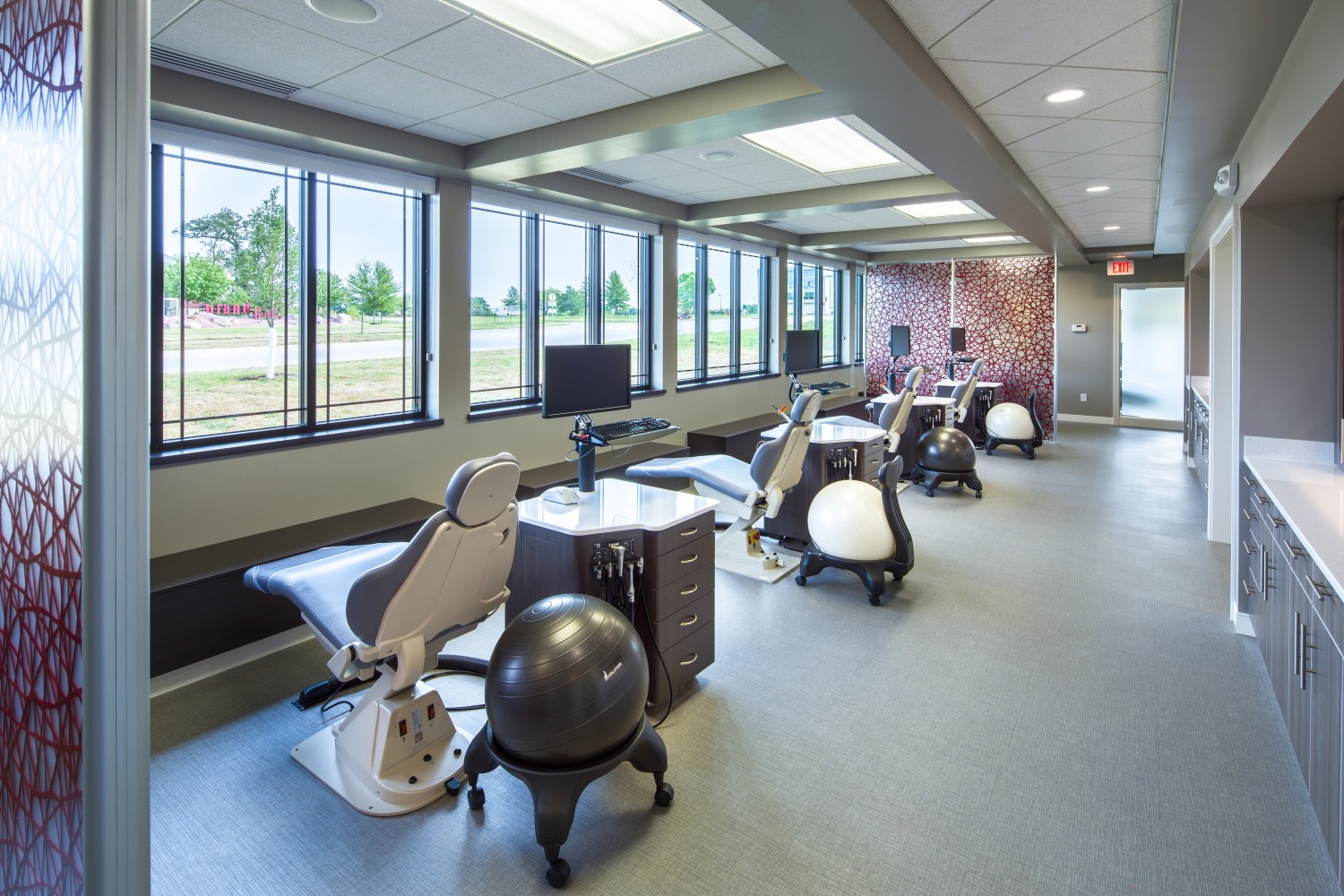
Imaging equipment carries site requirements that are architectural. They belong to the electrician and the general contractor, they have to be satisfied before drywall, and they vary by the specific unit you buy. The vendors publish these requirements, and the useful detail is that they do not all state them with the same force.
Planmeca’s ProOne installation instructions list, under power, “110V, 20A dedicated circuit.” Vatech America publishes the same shape of requirement on its power specifications page, calling for a “110Vac – Dedicated outlet” and a “20 AMP Dedicated Breaker,” and adds that the company “will not be liable for damages” resulting from non-dedicated power connections.
Carestream words it as a strong recommendation rather than a requirement, and publishes the protection spec alongside it. Its CS 8100 3D family installation guide (SM843, Ed10) explains that “if other systems are installed on the same line, interference and voltage fluctuations can cause the radiological system to operate abnormally,” then states: “We strongly recommend that a separate electrical line be dedicated to supply power to the unit. This line must be protected by a differential circuit breaker of 30 mA and a circuit breaker with a maximum current of: 15 A, 16 A, or 20 A at 200-240 V, 20 A at 100-130 V.”
The instruction is the same in every case, which is that the unit gets its own line. What differs is the exact amperage and protection spec, and that is the part an electrician needs in writing rather than in summary.
The requirements are not only electrical. The same Planmeca ProOne document notes that “the pan creates a pull-out force of 608 pounds” and specifies wall bracket and mounting requirements. That is structural blocking inside a wall. There is no version of that decision that can be made after the wall is closed.
The Pre-Opening Sequence, and Who Actually Owns Each Step
The reason a buildout goes sideways is rarely that someone forgot a task. It is that a task belonged to a party nobody assigned it to. The general contractor is not going to specify your network drops. Your equipment representative is not going to order your circuit. Your IT provider cannot install cable in a wall that is already closed.
The table below is the sequence, keyed to what blocks what and to who owns each step.
| Phase | What has to happen | Why the timing is fixed | What it blocks if it slips | Who owns it |
|---|---|---|---|---|
| Before construction documents are final | Select the practice management and imaging platforms | Published requirements differ by platform: Dentrix Ascend asks 50/10 Mbps, Curve Hero 10/5, and Eaglesoft states that “multiple locations (or offices) running on a single Eaglesoft database is not supported over a wide area network” | Everything downstream, because the specification is unknown | The owner, with the IT provider reviewing requirements |
| Before construction documents are final | Order the internet circuit and confirm whether the building already has fiber | Carrier terms set the date “on an individual case basis” where facilities are not already present | Opening day. This is the longest task nobody controls | The owner places it. Ask the carrier rep for a written serviceability answer for the address |
| Before construction documents are final | Get written site-prep requirements from every imaging and equipment vendor | Imaging vendors publish their own electrical spec (Planmeca ProOne: “110V, 20A dedicated circuit”), and it is an electrician’s item, not an IT one | Electrical rough-in and operatory layout | The equipment representative, delivered to the architect and GC |
| During framing, before drywall | Structured cabling to every operatory, front desk, imaging room and the network closet | Cable in a closed wall cannot be added without opening it, and Planmeca also specs wall blocking for a pan with “a pull-out force of 608 pounds” | Every device that needs a wired connection | Low-voltage contractor, to the IT provider’s drop plan |
| During framing, before drywall | Network closet location, power, cooling and rack space | It is a room, and rooms are built once. Eaglesoft recommends a dedicated server at “6 or more workstations,” which sets the space | Server, switching, firewall and battery backup | General contractor, coordinated with the IT provider |
| Before any vendor touches patient data | Signed business associate agreements with every vendor that will handle ePHI | 45 CFR 164.308(b)(1) permits a business associate to handle ePHI “only if” the practice first obtains satisfactory assurances | Lawful use of any vendor that stores or transmits ePHI | The owner signs, as the covered entity. Request each agreement from the vendor’s compliance or legal contact |
| Four to six weeks out | Install and configure software, workstations, imaging bridges and phones | Needs cabling live, circuit installed and hardware delivered on a supported OS. Dentrix no longer supports new Windows 10 installs (Henry Schein One, effective June 30, 2026) | Training and the practice-day test | IT provider, with the software vendor’s implementation team |
| Before go-live | Documented security risk analysis and the day-one security baseline | 45 CFR 164.308(a)(1)(ii)(A) makes the risk analysis a required specification, and it attaches to the environment holding ePHI | Compliance posture, and the documentation a cyber insurance application asks for | The owner owns the obligation. The IT provider or a security assessor does the assessment work |
| One to two weeks out | Full simulated patient day across every system | Problems need time to fix, and a port request is only guaranteed a one-business-day turn under 47 CFR 52.35(a) when it is a simple port | Nothing. This is the buffer, and it is the first thing sacrificed | The whole team, run by the practice |
Two rows in that table are the ones that get skipped, and both are owned by the practice rather than by a contractor. The circuit order and the business associate agreements are easy to defer because nobody is standing in the space asking about them the way a contractor asks about finishes.
The Compliance Work That Starts Before Your First Patient
A new practice sometimes treats HIPAA as something to sort out after opening, on the theory that there is no patient data yet. The rule does not read that way, and the sequencing consequence is real.
On vendor agreements, the Security Rule at 45 CFR 164.308(b)(1) states that a covered entity “may permit a business associate to create, receive, maintain, or transmit electronic protected health information on the covered entity’s behalf only if the covered entity obtains satisfactory assurances” that the business associate will appropriately safeguard the information. The agreement comes before the data, so the sequencing question for each vendor is simple: will this company create, receive, maintain or transmit ePHI for us? Where the answer is yes, and it typically is for the PMS host, the imaging platform that stores images, and an IT provider with administrative access to systems holding ePHI, the agreement belongs in place before that access begins. A vendor that never touches ePHI is a different conversation, so the useful exercise is listing which vendors need a signed agreement before they get access.
On the risk analysis, 45 CFR 164.308(a)(1)(ii)(A) makes it a required implementation specification, defined as an obligation to “conduct an accurate and thorough assessment of the potential risks and vulnerabilities to the confidentiality, integrity, and availability of electronic protected health information held by the covered entity or business associate.” The duty attaches to the environment that holds ePHI, so it lands the day your live system holds patient data rather than at some later compliance milestone. There is no grace period in the text for a practice that recently opened, and a group opening a location extends its existing analysis to the new site rather than starting a separate one.
Worth knowing: the government publishes a free tool for exactly this. The Security Risk Assessment Tool from the Office of the National Coordinator, developed with the HHS Office for Civil Rights, is a downloadable desktop application that walks a practice through the assessment, and HHS states it “does not collect, view, store, or transmit any information entered into the SRA Tool.” It is not a substitute for competent security work, but a startup practice with no documentation at all is better served starting there than starting nowhere.
One more piece of sequencing that catches people: retention. Under 45 CFR 164.316(b)(2)(i), documentation must be retained “for 6 years from the date of its creation or the date when it last was in effect, whichever is later.” The habits you set in month one are the ones you will be evidencing years later.
What to Get in Writing Before Drywall Goes Up
Most of what goes wrong in a buildout traces back to something everyone assumed and nobody documented. These are the items worth having on paper.
1. The carrier’s install date, and what happens if facilities are not there
Ask specifically whether the building is already served, and get the answer in writing. If special construction is required, ask for the engineering review and the construction quote in writing, and ask what the interval becomes.
2. The drop count per room, not just “cabling”
A drop plan should name every location and how many runs each gets. Operatories need more than people expect once you account for the chair-side workstation, the imaging sensor, a monitor feed, and often a phone. Spare capacity is cheap while the wall is open and expensive afterward.
3. Site-prep documents from every equipment vendor
Imaging equipment carries power, space, and sometimes structural requirements that belong to the architect and the electrician, not to your IT provider. Ask each vendor for its installation requirements document by name and version, and hand it to the general contractor. Do not let it arrive as a verbal summary from a sales representative.
4. Your software vendor’s published requirements, by document
Ask for the requirements document itself rather than a salesperson’s summary, and check its publication date rather than its file name. The current Dentrix requirements are a useful example, since the file is served under a name reading 2025 while the document inside is the 2026 edition published in April 2026. Confirm that whoever specified your hardware worked from the current one.
5. Who is responsible for the network closet environment
Power, cooling, and physical security for that room are construction items. Confirm in writing whether the general contractor or the IT provider owns each, because it is an easy item to fall between the two scopes.
6. The number porting plan and its dependencies
Phone numbers are usually the least of your problems, and it helps to know why. Federal rule at 47 CFR 52.35(a) requires carriers to complete a simple wireline-to-wireline or simple intermodal port request “within one business day unless a longer period is requested by the new provider or by the customer.” Ports still get rejected over mismatched account details, so accuracy on the paperwork matters more than lead time here. The circuit the phone system rides on is the piece with the real lead time.
Where a Group Opening a De Novo Location Differs
Most of this applies whether you are opening your first practice or your twelfth. Two things change when the new location joins an existing group.
The first is that a de novo is the only time you get to build a location that already matches your standard. Every acquired practice arrives with someone else’s decisions in it, and reconciling those is the expensive part of integration. A ground-up location has no legacy to unwind, which makes standardizing it far cheaper than retrofitting an acquisition, if you build it to the standard deliberately rather than letting the local contractor and the equipment rep decide.
The second is a real constraint worth knowing before you assume a shared database. Patterson’s Eaglesoft requirements state that “multiple locations (or offices) running on a single Eaglesoft database is not supported over a wide area network,” and direct groups intending to run Eaglesoft across multiple locations to contact a software technology specialist. Groups that assume a new location can simply join the existing database find this out late, usually after the architecture is already committed. In group dentistry, “we will figure integrations out later” tends to be one of the most expensive sentences anyone says out loud.
If you are weighing how the new location should be supported once it opens, our comparison of outsourced IT, in-house, and break-fix models covers the cost side of that decision, and the platform question itself is worth reading through the lens of where the group is going rather than where it is today, which we cover in our guide to dental practice management software.
Building in the Right Order
The six-month rule of thumb survives because it is roughly right. It is just the wrong thing to plan against, because it describes duration rather than dependency.
The practices that open cleanly do three things early. They pick the software first, because it specifies everything else. They order the circuit before they need it, because it is the one task where a carrier’s own terms say the date depends on the individual case. And they get cabling into the walls while the walls are open, because that decision has no second chance.
Everything after those three is schedulable work. A fiber build that has not started, a wall that is already closed, and a workstation bought onto an unsupported operating system are not, and those are what turn an opening day into a troubleshooting day.
If you are planning a buildout and want a second set of eyes on the sequence before construction documents are final, we do this regularly and are happy to compare notes. It costs nothing to check the order, and it is far cheaper than opening a wall twice. For practices further along, our guide to dental IT disaster recovery planning covers what to put in place once the doors are open.
New Dental Office Technology Setup Questions
What should we do if the internet circuit will not be ready by opening day?
Decide early whether you can open on a temporary connection, because that answer changes what you order. A cellular or fixed-wireless backup can carry a cloud PMS and card processing for a short period at reduced performance, and it is worth pricing before you need it rather than during opening week. What it will not carry gracefully is large imaging transfers or a full backup schedule. The related question to settle in the same conversation is whether your practice can see patients at all with the connection down, since a cloud platform makes internet a clinical dependency rather than an office convenience.
Can workstations be bought on Windows 10 to save money on the build?
For a Dentrix practice, that window has closed. The Dentrix 2026 System Requirements state that after June 30, 2026, Henry Schein One “will no longer support installing Dentrix on Windows 10,” and Microsoft ended Windows 10 support on October 14, 2025. The restriction is specifically about new installations, which is the only kind a new practice does. Note the requirement travels with the software rather than the hardware, so the question to ask a hardware vendor is which operating system the machines ship with, not whether the machines are new.
If we go serverless, does that remove the network closet from the plan?
No, and this is a common misread of what cloud removes. A serverless practice still needs a place for the internet handoff, the firewall, the switch that every cabled drop terminates into, and battery backup for that equipment. What changes is the size and cooling load of that space, not its existence. Treat it as a smaller closet rather than no closet, and keep it in the construction drawings, because a practice that deletes the room and later needs a rack has no good place to put one.
What happens if we change practice management platforms after construction starts?
It depends which decisions the change touches. Switching between two cloud platforms late is survivable, since the main consequences are bandwidth sizing and workstation specification, and a circuit can usually be upgraded after the fact. Switching from a cloud platform to a server-based one after the walls are closed is the expensive version, because it introduces a server, a place to put it, power and cooling for that space, and a cabling assumption that may no longer hold. If a platform decision is genuinely still open, tell your general contractor to build for the more demanding of the two options rather than picking the cheaper one and hoping.
Does imaging equipment need a dedicated electrical circuit?
Plan on it, and take the exact specification from the unit’s own manufacturer rather than from a general rule. Planmeca’s ProOne installation instructions specify a “110V, 20A dedicated circuit.” Vatech publishes a “110Vac – Dedicated outlet” with a “20 AMP Dedicated Breaker” and warns it will not be liable for damage from non-dedicated power connections. Carestream states it as a strong recommendation instead, advising in its CS 8100 3D installation guide that “a separate electrical line be dedicated to supply power to the unit,” protected by a 30 mA differential circuit breaker and a breaker rated 20 A at 100-130 V. The instruction converges, the amperage and protection details do not, which is why the equipment has to be chosen early enough for its own document to reach the electrician before rough-in.
How many network drops should each operatory get?
More than the device count you can name today, because the marginal cost while the wall is open is a fraction of the cost afterward. Count the chairside workstation, the imaging sensor or camera, a monitor feed, and a phone if it is not on the workstation, then add spare capacity for the intraoral scanner or chairside device you have not bought yet. Ask your low-voltage contractor to label and certify every run and to hand you the test results, since an uncertified drop that fails later is indistinguishable from a device problem and gets diagnosed the expensive way.
Do we need a second internet connection on day one?
Decide it deliberately rather than by default, and let the platform answer drive it. A practice running a cloud PMS cannot see patients without a connection, which turns a single circuit into a single point of failure for clinical operations rather than for email. A second connection from a different provider, or a cellular failover, is the usual answer, and the detail worth confirming is that the backup path does not ride the same physical route into the building as the primary. Two circuits sharing one conduit fail together, which defeats the purpose of buying two.
Posted in Dental Cybersecurity, DSO, Tech News