
September 23rd, 2026
Eaglesoft vs Dentrix: Which is Better for Multi-Location Groups?
Industry Research — PMS
Every dental group evaluating this pair starts in the same place, which is a search for what each one costs.
We put the same question to four AI assistants on the same day, in the same words, and read what Google’s AI Overview returned for Eaglesoft vs Dentrix alongside them. The answers ran from $100 a month at the low end to $1,200 per location at the high end, with one quoting $1,500 for ten users and another putting a six-location group at $4,000, and they did not even quote in the same units. None of those figures came from a current vendor price list, because neither company publishes a license price for either product.
Worth knowing before you budget. It is not the decision, though.
The decision is architectural, and Patterson’s own requirements document settles most of it. We support practices on both platforms and sell neither, so the answer up front: for a group past one location the Dentrix side wins, but only as Dentrix Ascend or Dentrix Enterprise, never classic Dentrix.
Eaglesoft vs Dentrix vs Open Dental at a Glance
Three platforms, lined up on what a multi-location operator has to live with afterward. The quoted language below is the vendors’ own. The rest is our reading of what those documents mean for a group.
| Decision factor | Eaglesoft (Patterson) | Dentrix (Henry Schein One) | Open Dental |
|---|---|---|---|
| Deployment | On-premise only. Patterson: “Eaglesoft is currently a server-based practice management solution” | Three products: classic Dentrix installed locally, Dentrix Ascend cloud-native, Dentrix Enterprise for multilocation | Self-hosted by default, vendor-hosted Open Dental Cloud optional |
| Server required | Yes. Patterson: “an on-premise solution that requires a physical server” | Yes for classic Dentrix, no for Ascend | Yes, unless you buy Open Dental Cloud |
| Supported across locations | Not on one shared database. Patterson: “Multiple locations (or offices) running on a single Eaglesoft database is not supported over a wide area network” | Yes, via Ascend or Enterprise. Henry Schein One rates classic Dentrix “Limited multi-location support” | Yes. Open Dental documents a single central database across locations |
| Runs on a virtual machine | Not supported. Patterson: “The use of a virtual machine to run any Patterson Companies software is not supported” | Not applicable to Ascend, which runs in a browser | Yes, customer-managed |
| Published license pricing | None. Quote through a Patterson representative | None, for any of the three products | Full fee schedule published |
| Vendor’s own cloud answer | Fuse, which is a separate product, not Eaglesoft | Dentrix Ascend | Open Dental Cloud, or self-directed cloud hosting |
| Integration route | Local API installed with each server, through Patterson’s authorized vendor program | API Exchange, priced per product. Classic: $5,000 read plus $5,000 write, plus royalties. Ascend: $5,000 plus $47 per location per month | Direct read access to the database, documented. Writes go through the Open Dental API |
Rows three and six carry the argument. Both vendors sell group products, but Henry Schein One’s wear the Dentrix name while Patterson’s is called Fuse, so a group shopping Eaglesoft may never be shown it.
If you want the Open Dental column argued properly rather than summarized, we did that separately in our Dentrix vs Open Dental comparison for dental groups.
What Patterson Supports, and What It Does Not
Eaglesoft has been in the market more than three decades and Patterson reports nearly 30,000 users. It is mature, widely installed, and the front-office affection for it is real and earned.
Patterson positions Eaglesoft as “the essential practice management system for private practices.” That is a market rather than an architecture, and a private practice can certainly own several locations. The architecture question gets answered in the technical documentation underneath, and it gets answered precisely.
Two answers from Patterson’s own Eaglesoft FAQ do most of the work here. Asked whether Eaglesoft is cloud-based, Patterson answers that it “is currently a server-based practice management solution.” Asked whether you need a server, the answer is “Yes, Eaglesoft is an on-premise solution that requires a physical server, which stores and manages the practice’s database.”
What Patterson’s Requirements Document Actually Says About Multiple Locations
The hardware requirements document Patterson publishes for Eaglesoft is a detailed technical file that Patterson revises regularly. A handful of lines in it decide whether Eaglesoft can serve as a group platform.
The first is the one nobody quotes. Under Network Recommendations the document states flatly that “Eaglesoft is not supported with any WAN solution.” Further down the same page, a section headed Multi-Site Locations says it more precisely: “Multiple locations (or offices) running on a single Eaglesoft database is not supported over a wide area network.”
Read the precise version, because it is the one a Patterson representative will quote back. Patterson is not saying you cannot run Eaglesoft in more than one office. Plenty of groups do. It is saying those offices cannot share one database over a wide area network, and the same section tells anyone planning multiple locations to call a Software Technology Specialist.
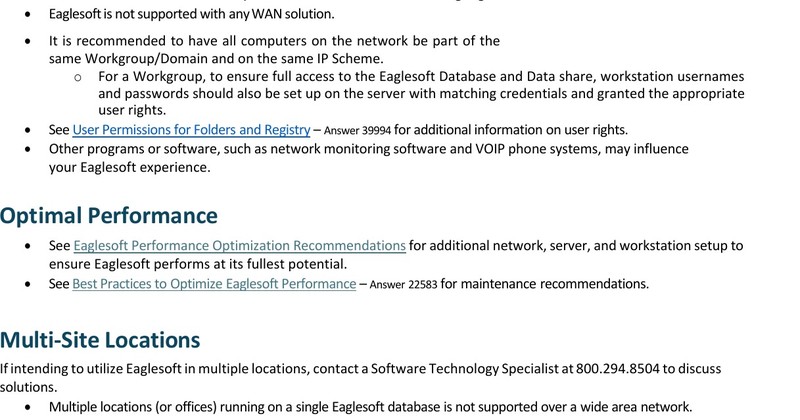
The second appears twice, once for servers and once for workstations: “The use of a virtual machine to run any Patterson Companies software is not supported.” Virtualization is how most groups consolidate infrastructure and how nearly every hosting arrangement works underneath, so running Eaglesoft that way puts you outside support.
The third is quieter. Servers on a Windows Server operating system “must be wired to the network, cannot use a wireless connection,” and Patterson recommends that “all computers on the network be part of the same Workgroup/Domain and on the same IP Scheme.” None of that is impossible across sites. It is describing a single local network rather than a group estate.
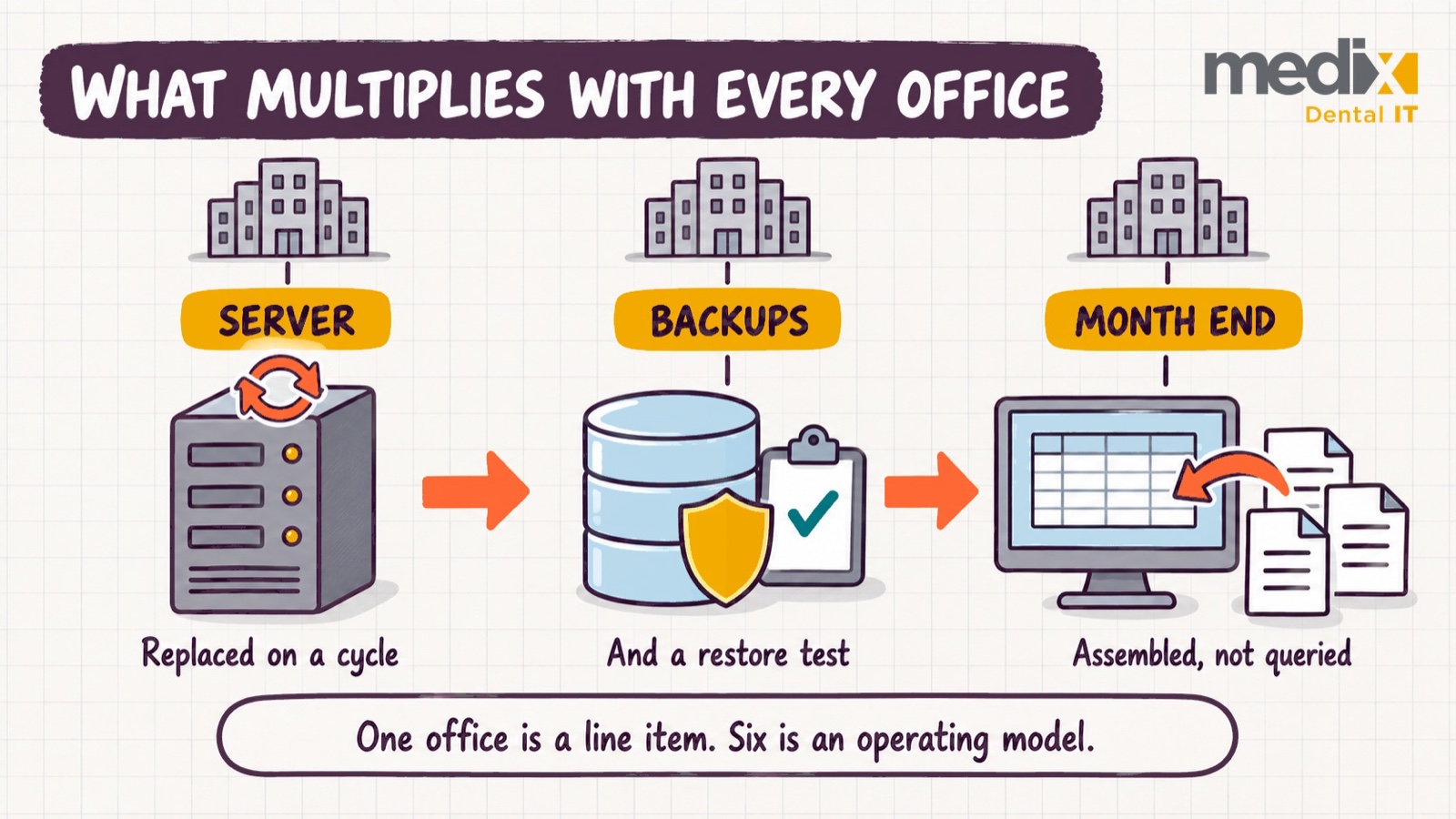
Stack those lines together and the consequence follows. Because the offices cannot share one database, six offices on Eaglesoft means six databases. What that costs you in hardware is ours to estimate rather than Patterson’s to state, but in the deployments we see it means a server, a backup routine and a restore test per office, and a month-end number that has to be consolidated rather than queried. No one overlooked a clever workaround here. That follows from the supported design, and groups rarely discover it at the decision. They discover it when month-end starts taking a week.
Patterson also specifies the server for each location: an Intel i5 of eighth generation or newer with 16 GB of RAM and mirrored 1 TB drives for offices with nine or fewer workstations, a Xeon processor at ten or more, and it recommends battery backup on every server. Reasonable specs, multiplied by your location count and a five-year refresh cycle, and a capital line most groups never put in the software comparison.
Patterson Does Sell a Group Platform, and It Is Not Called Eaglesoft
Patterson’s cloud-based practice management product is Fuse. Its page carries a feature section headed “Multi-locations & Groups,” and the page’s language is exactly what a group is shopping for: “consolidate multi-location practice data and processes in one place and add locations easily.” A customer story on the same page describes staff who “can access a centralized database from any office.”
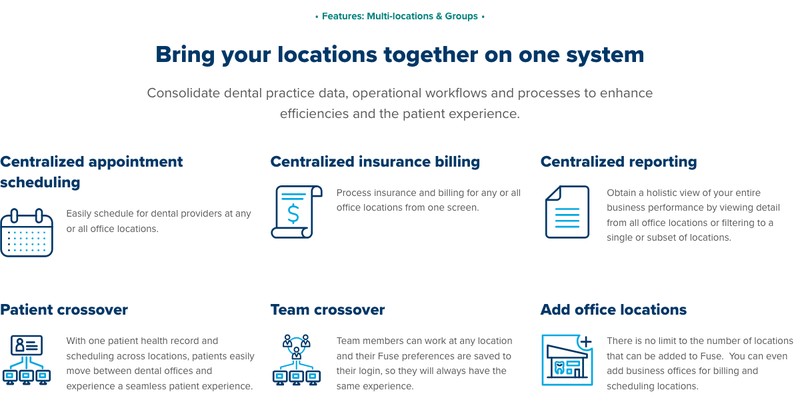
None of that is Eaglesoft. So a group weighing Eaglesoft against Dentrix is usually comparing Patterson’s per-office product against a Henry Schein One family containing two products built for groups. That is not the comparison anyone meant to run, and if you want to stay with Patterson while you grow, Fuse is the conversation to have.
Dentrix Is Three Products, So Ask Which One
Dentrix belongs to Henry Schein One, formed in 2018 as a joint venture between Henry Schein and Internet Brands. One brand name, three separate products underneath it, which is why a Dentrix quote means very little until you know which one it is for.
The local install is classic Dentrix. The browser-based version is Dentrix Ascend, now sold in tiers, so choosing it means choosing a tier too. Dentrix Enterprise is a third thing entirely, marketed on its own site to large groups, public health providers and integrated health centers.
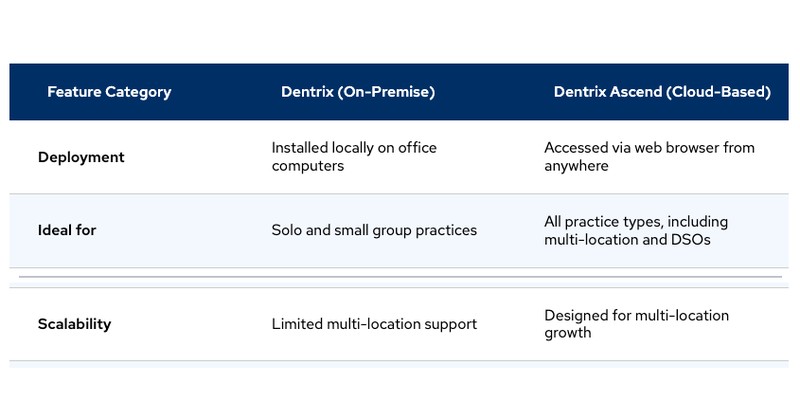
Henry Schein One grades them against each other in public, which saves everyone an argument. Its scalability row reads “Limited multi-location support” for classic Dentrix and “Designed for multi-location growth” for Ascend. Earlier in the same table the intended buyer is spelled out: classic Dentrix suits “Solo and small group practices,” while Ascend is for “All practice types, including multi-location and DSOs.”
The same page answers the remote access question that comes up in every evaluation, and its answer is about the classic product specifically: “Not natively. Dentrix requires local installation and remote access setups.” Ascend, being browser-based, is the opposite case.
So classic Dentrix and Eaglesoft are closer to each other than either is to a group platform. Both are local and server-bound, from large vendors with long histories, and both are sold to the single practice first. If your comparison is genuinely classic Dentrix against Eaglesoft for one office, the architecture argument mostly goes away and you are choosing on workflow, imaging bridges and which vendor relationship you would rather have.
Why Neither Vendor Publishes a License Price
Patterson sells Eaglesoft through Service Club plans in five named tiers, with the license included in the plan rather than priced separately, and directs you to “talk to a Patterson Software Sales Representative” for the number. Its own promotional disclaimer adds a term worth knowing before you ask: the plans “require a 24-month enrollment.” Henry Schein One publishes no license pricing for classic Dentrix, Ascend or Enterprise either.
That is why the public numbers contradict each other so badly. Here is what each surface returned on the same day.
| Where the number came from | Eaglesoft figure quoted | Dentrix figure quoted | What it cited |
|---|---|---|---|
| Google AI Overview | $400 to $900 per month | $400 to $900 per month | Two comparison sites, a Facebook group thread, a YouTube video and a Reddit post |
| ChatGPT with live search | $350 to $1,000 per location per month | $400 to $1,200 per location per month | Four comparison and review sites, plus an old white paper on the Dentrix Enterprise site |
| Claude with live search | Starts at $200, separately $400 to $900, and $1,500 for ten users | $500 to $1,000, and separately $500 to $700 and up | Six comparison and review sites |
| Perplexity | $150 to $250 per month, and $450 to $750 per provider | $100 to $300 per month, with Ascend at $550 to $900 per provider | Seventeen comparison and review sites |
| Gemini | About $200, and $1,800 to $4,000 for six locations | About $500, with Ascend at $500 to $800 per location | Six comparison and review sites |
| Patterson and Henry Schein One | No license price published | No license price published | The vendors themselves |
Read the bottom row first. Every figure above it is an estimate, and almost all circulate between comparison sites. Google’s AI Overview was the only one leaning on a Facebook group thread, a YouTube video and a Reddit post. Three of the four assistants drew on an overlapping set of the same comparison articles. The fourth shared none of the sources we logged for the other three. ChatGPT also cited one vendor-hosted document, an old white paper on the Dentrix Enterprise site, and conceded in the same answer that it “is old and should not be treated as current pricing.”
Notice that the estimates do not even share a unit. Some price per month, some per location, some per provider, one per ten users and one per six-location group. A spread that wide, in five different units, tells you no real price is on the table.
The budgetable part sits outside the subscription line, and that part you can pin down: conversion, imaging, a server per office, training. Get those quoted in writing alongside the license. Our full breakdown of dental practice management software pricing works through it vendor by vendor.
Two Eaglesoft figures Patterson does publish are worth having. A conversion “takes approximately 4-6 weeks,” and on images, “Most imaging software systems do not support image conversion. In those cases, images remain accessible in the original software.” That second one means budgeting to keep an old system running, per location, for records retention.
The Integration Difference Compounds With Every Location
Eaglesoft exposes a local API that, in Patterson’s words, “will automatically install with the installation of the Eaglesoft Server.” Third-party access runs through Patterson’s authorized vendor program, and Patterson is direct about why: some vendors “have built integrations and interfaces to Eaglesoft without authorization or communication with Patterson.” Reasonable security posture, and it also means the API lives with each server, so an integration is a per-location install.
Dentrix splits the same way its products do. Henry Schein One describes classic Dentrix as “an on-premise application, and the Dentrix API is designed for on-premise integrations,” priced at $5,000 for read access and $5,000 for write, plus monthly royalties. Ascend runs on cloud endpoints at $5,000 once plus $47 per location per month, including 30,000 calls and 3 GB of data, and Henry Schein One states the consequence plainly: “One integration can support multiple locations without per-office installs.”
That sentence is the difference. On one architecture, connecting a new practice to your analytics stack is a deployment at that practice. On the other it is a configuration change. At two locations that gap is easy to absorb. At twelve, with an acquisition pipeline behind it, it decides whether onboarding is repeatable or a standing project.
One more distinction matters if you are planning a data warehouse or sharing records with medical partners. Neither the classic Dentrix API nor the Ascend API supports HL7, and Henry Schein One says so on both. Dentrix Enterprise is the exception, and it is the reason that product keeps appearing on public health shortlists. Its clinical interoperability page says Enterprise “works with more than 40 medical software solutions such as athenahealth, Allscripts, Centricity, Cerner, eClinicalWorks, Epic, NextGen, SuccessEHS and more,” sharing “scheduling; billing; demographics; orders; clinical notes; C-CDA (Clinical Context Document Architecture) files for continuity of care; and FHIR Services.” Note also that Dentrix API access is granted rather than owned, through an application and a signed agreement before a key is issued.
How a Group Should Actually Decide This
Strip out the preference argument and four questions settle it.
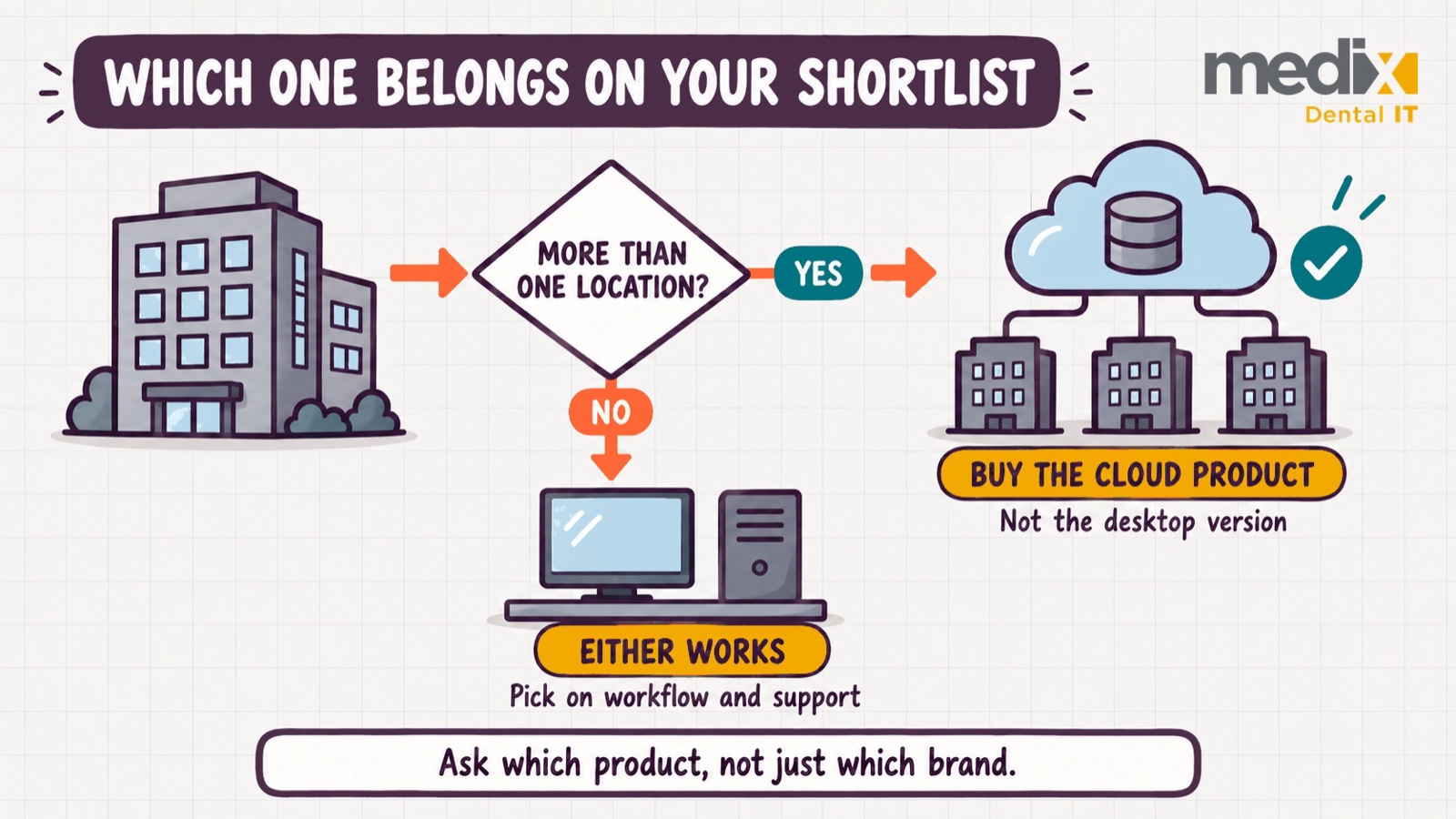
How many locations will you run in three years?
At one location this is a workflow and support choice, and both platforms are credible. At two or more, Eaglesoft is answering a question Patterson’s own documentation says it was not built for. If growth is the plan, compare the group products: Ascend, Enterprise or Fuse.
Who runs the infrastructure once the contract is signed?
A server-bound platform hands you the infrastructure once per location: the box, the backup jobs, restore tests you have genuinely run rather than assumed, and the slow-system call at eight on a Monday. Groups with real IT capacity absorb that. Groups without it are better off buying cloud-native than buying local software and hoping the gap closes.
What does your reporting need to do?
If leadership wants one number across every location without somebody assembling it in a spreadsheet, you need either one database or a funded integration path into a warehouse. Separate databases do not make that impossible, they make it a project you have to pay for, and that cost never appears on the software quote.
What does leaving this platform actually involve?
Get the exit terms in writing while you are still a prospect, because that is the only moment you have leverage. Pin down the format, whether the export is complete, whether images travel with it, and the price.
Where We Land on Eaglesoft vs Dentrix
For a multi-location group, Dentrix Ascend or Dentrix Enterprise is the stronger answer of these two. That rests on vendor documentation rather than preference: Henry Schein One sells two products designed for groups and says so on its own comparison page, while Patterson rules out the shared-database-over-a-WAN design on Eaglesoft and points multi-location buyers to a specialist, or to Fuse.
The condition is the one that applies to any Dentrix evaluation: buy the right Dentrix, and with Ascend you are picking a tier as much as a product. Sign for “Dentrix” without specifying which one and you can end up with separate databases per office, the exact problem you were trying to avoid.
For a single practice the picture changes, and we would not talk anyone out of Eaglesoft. More than three decades in the market, nearly 30,000 users, more than 55 authorized integrations and a front office that likes using it are real assets. You still buy and maintain the server, but at one location none of the multi-site constraints bind. If you want to stay with Patterson while you grow, evaluate Fuse. If you want a platform where you control the hosting and hold direct access to your own database, that is why we point most groups toward Open Dental in our roundup of dental practice management software.
One last thing, because it is the failure we get called in to unwind. A lot of groups never make this decision at all. Nobody chooses to run three systems. It just piles up, one reasonable decision at a time. Then somebody asks why reporting takes weeks, and by then you are not choosing software. You are paying for a data migration, a retraining program, and a long stretch of reporting you cannot trust. If you are acquiring, the cheapest week to move a practice onto your standard is usually the one right after close.
We do not sell a PMS, so we have no stake in which of these you pick. The only argument we have is that these questions get asked before a signature rather than after. Groups working through this decision with an IT and data lens are who we sit down with most weeks.
Eaglesoft vs Dentrix FAQs
Is Eaglesoft hard to learn?
Front office staff generally find Eaglesoft approachable, which is one reason practices stay on it for decades, and Patterson offers on-site and virtual training plus free webinars. The harder part of a rollout is the data conversion rather than the interface: Patterson says a typical conversion takes four to six weeks, and that most imaging systems do not support image conversion, so the images often stay behind in the old software.
How much does Eaglesoft cost per month?
Patterson does not publish a license price. Eaglesoft is sold through Service Club plans in five tiers, with the license included rather than billed separately, and the number comes from a Patterson representative. The estimates circulating online are not even quoted in the same units: roughly $150 to $1,000 a month in some, $1,500 for ten users in another, $1,800 to $4,000 for a six-location group in another. None of them traces to Patterson. Budget instead from what you can pin down: conversion, imaging, the per-location server, and training.
How much does Dentrix cost per month?
Henry Schein One publishes no license pricing for any of the three Dentrix products, so whatever number you have seen came from a dealer, a forum, a review site or an outdated document. One cost it does publish is the API Exchange program: for classic Dentrix, $5,000 for read and $5,000 for write access plus a monthly royalty, and for Ascend a one-time $5,000 fee plus $47 per location per month including 30,000 API calls and 3 GB of data.
Can Eaglesoft run across multiple locations?
Yes, but not on a shared database. Patterson’s hardware requirements document states that “Multiple locations (or offices) running on a single Eaglesoft database is not supported over a wide area network,” and that virtual machines are not supported for any Patterson software. In practice each office runs its own server and database, with consolidated reporting assembled rather than queried. Patterson’s cloud product for multi-location groups is Fuse, a separate product from Eaglesoft.
How many dental offices use Eaglesoft?
Patterson reports “nearly 30,000 users,” which counts users rather than offices, and it is self-reported. That is the only kind of figure available here. No credible independent data on dental software adoption exists, and the market share percentages circulating for these platforms trace back to content marketing pages with no disclosed methodology.
What practice management software do most dental practices use?
We could not find reliable data to answer this. We found no independent body that measures dental practice management software market share, and the circulating percentages trace to no survey or panel. Dentrix, Eaglesoft and Open Dental are all widely deployed on self-reported counts, but “most” is not a claim anyone can currently support. We set out what is measured and what is not in our dental PMS market data breakdown.
Is Open Dental better than Eaglesoft for a multi-location group?
On the architecture question, yes. Open Dental publishes a full fee schedule, documents a single central database shared across locations, and gives you direct read access to that database, with writes going through its API, none of which Eaglesoft offers a group. The trade is that on the default self-hosted setup you own the infrastructure underneath it, unless you pay for Open Dental Cloud, so it only holds if you have real IT capability in house or contracted. Note that Open Dental is no longer open source: its license changed to proprietary at version 24.4, though database access was unchanged. We compared it directly against the Dentrix family in our Dentrix vs Open Dental breakdown.
Is Dentrix or Eaglesoft better for a dental group?
Dentrix, provided you buy Dentrix Ascend or Dentrix Enterprise rather than classic Dentrix. Henry Schein One rates classic Dentrix “Limited multi-location support” on its own comparison page and Ascend “Designed for multi-location growth.” Eaglesoft cannot share one database across offices over a wide area network, and Patterson’s own group answer is Fuse. For a single practice the comparison is much closer and comes down to workflow, imaging bridges and vendor relationship.
Posted in PMS