
September 4th, 2026
Dentrix vs Open Dental: Which PMS is Better for Dental Groups?
Industry Research — PMS
Ask this question in a dental forum and you will get thirty confident answers, most of them about which software people like using.
That is a fair question and it is not this one. The Dentrix vs Open Dental choice is an architecture decision rather than a software preference. Dentrix is a Henry Schein One product family spanning local, cloud and enterprise editions, with no published license pricing. Open Dental is a self-hosted platform with a published fee schedule and direct database access. The decision gets made by whoever has to run the thing across every location afterward. It turns on where the database lives, who is accountable when it is slow, what it costs to add practice eleven, and what happens to your data if you leave. We support both and we are not paid by either, which is why we will give you the answer up front instead of burying it. Open Dental is where we point most groups, for reasons that come down to who owns the data and who controls the architecture. The honest caveat is that it only holds if your group can actually run the infrastructure underneath it.
First, Dentrix Is Not One Product
This is where most comparisons go wrong before they start. Henry Schein One sells more than one thing under that name, and a comparison that does not say which one is not telling you much.
Classic Dentrix is installed locally on office computers. Dentrix Ascend is cloud-native, reached through a browser, and now sells in tiers, so with Ascend the question becomes which tier rather than which product. Dentrix Enterprise is a separate product on its own site, built for multilocation groups and public health organizations.
You do not have to take our word for the difference. On its own comparison page, Henry Schein One puts classic Dentrix in the scalability row as “Limited multi-location support” and Ascend as “Designed for multi-location growth.” That is the vendor’s own published wording, and it is worth more than any outside opinion on the same question.
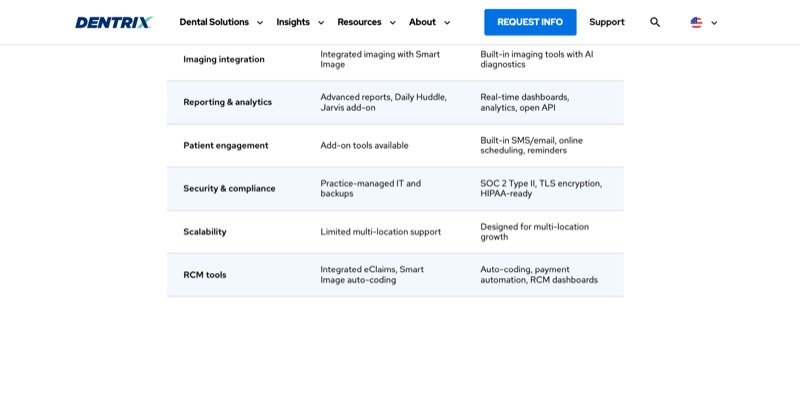
So if someone tells you their group runs Dentrix, the useful follow-up is which one.
Where the Database Lives
This is the decision underneath the decision, and it drives most of what follows.
Classic Dentrix is installed locally, so in the normal deployment each office runs its own database. Ten locations that way means ten databases, ten backup jobs, ten things to patch, and consolidated reporting that has to be assembled rather than queried. Ascend centralizes it, which is the entire point of the product.
Open Dental’s default is self-hosted. Its published fee page describes it as the customer hosting the program locally or managing hosting it remotely. That word “managing” is where groups get into trouble and where they also get their leverage, because a single central Open Dental database serving every location is entirely achievable, and Open Dental’s own documentation walks through exactly that design.
Open Dental also sells a hosted option, Open Dental Cloud, priced in hosting packages by concurrent sessions, from $250 a month for 7 sessions to $2,370 for 75, with a custom quote above that. Hosting is billed on top of the support fee, and the vendor provides an official quote before signup. Read the product page before you plan around it: it is US only, it is in limited release, they accept a limited number of customers, and they note some limitations on interoperability with third-party solutions. For a group already running imaging bridges and an RCM stack, that last line deserves a real conversation before it becomes a migration plan.
What Each One Actually Costs
Open Dental publishes its fees. Henry Schein One does not publish software pricing for any of its three products, so any Dentrix license figure you have seen came from a reseller or a forum rather than the vendor.
It does publish its API program fees, and the Ascend line is worth knowing if you plan to integrate. The Dentrix Ascend API program lists a one-time $5,000 registration and set-up fee plus $47 per month per Ascend location, including 30,000 calls and 3GB of data, with overages beyond that. For a group planning to move data between systems, that is a real line item and it is easy to miss.
That asymmetry is itself worth something during budgeting. Here is what Open Dental publishes, and it is more nuanced than the headline number suggests.
| Open Dental fee | Published amount | The detail that matters |
|---|---|---|
| Initial rate | $199/month per location | 12-month contract. Covers all computers at that location for up to 3 providers |
| Current reduced rate | $149/month per location | After 12 consecutive months. Defined as the fee published on the day you reach month 13, so it is not a locked number |
| Additional providers | $20/month per provider | Beyond 3 per location. Hygienists are not counted |
| Volume, 4 to 9 offices | $169/month per office | Drops to $149 after an office is on support 12 consecutive months |
| Volume, 10+ offices | Not published | Their fee page says to call and ask for Management |
| Open Dental Cloud | $250 to $2,370/month by package | Hosting priced by concurrent sessions (7 to 75) and storage, billed on top of the support fee. Custom quote above 75 sessions |
Two traps in that table. The reduced rate is defined as whatever is published when you get there, not what is published today, so a multi-year model built on $149 is a forecast rather than a quote. The vendor’s own fee table below states that definition in writing. And the fee page ties the volume rate to your office count as of the current month, so crossing from three offices to four moves every location onto the volume rate, not only the new one.
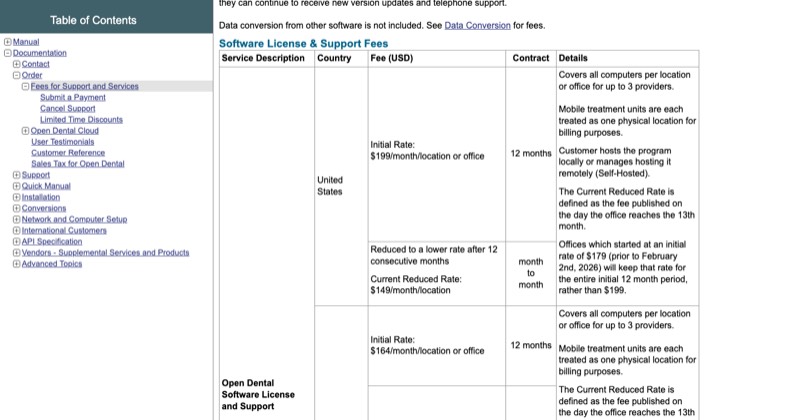
Neither vendor’s license fee is the real number anyway. Conversion, imaging bridges, hardware and the migration project itself can easily exceed the difference in license fees, and we broke that out separately in what dental practice management software actually costs.
Dentrix vs Open Dental at a Glance
Four products, side by side, on the dimensions a group actually decides on. Everything here comes from the vendors’ own published pages.
| Classic Dentrix | Dentrix Ascend | Dentrix Enterprise | Open Dental | |
|---|---|---|---|---|
| Deployment | Installed locally | Cloud-native, browser | Enterprise, separate product | Self-hosted by default, vendor cloud optional |
| Database across locations | One per office in the normal deployment | Centralized by the vendor | Built for multilocation | Your choice: per-location or one central database |
| Vendor’s own scalability wording | “Limited multi-location support” | “Designed for multi-location growth” | Aimed at groups and public health | Documents both designs, does not rank them |
| Published license pricing | None | None | None | Full fee schedule published |
| Data access route | API Exchange, application and signed agreement | API Exchange, plus API program fees | API Exchange | Direct database access, documented |
| Who runs the infrastructure | You, per office | The vendor | The vendor | You, unless you buy Open Dental Cloud |
| Network setup support | Through Henry Schein One | Not applicable | Through Henry Schein One | “Open Dental Support cannot assist with network setup” |
Read the last two rows together and you have the trade. Open Dental hands you the data access and the architectural control, and in exchange you own the network underneath it. That is a good trade for a group with IT capability and a bad one without, which is the whole decision in two rows.
Data Ownership, and the Open Source Question
Here is a thing a lot of published comparisons still get wrong, and it matters because it is usually stated as a reason to pick Open Dental.
Open Dental is not open source anymore. Its own license page states that in version 24.4 the license changed from open source GPL to proprietary. Version 24.4 shipped in March 2025. If a consultant or a comparison article tells you Open Dental is open source, they are working from information that is more than a year old.
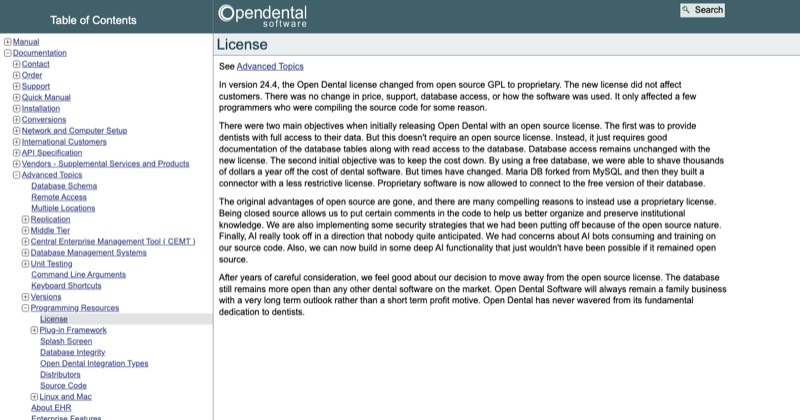
What did not change is the part groups actually care about. The same page is explicit that database access remains unchanged, and Open Dental’s argument is that full access to your data never required an open source license in the first place, only good documentation and read access to the database. On that specific point they are right. Direct database access is the single biggest reason we point groups toward Open Dental, because it is the difference between owning your reporting layer and asking permission for it.
For Dentrix the sanctioned route is the API Exchange, and by Henry Schein One’s own developer FAQ, access runs through an application, a signed API agreement and an issued key. That is a normal vendor posture and not a criticism. The difference that matters is who controls the access: with Open Dental it is you, and with Dentrix it is granted. For a group building a data warehouse, that is the question that decides the platform.
Who Is Accountable When It Breaks
This is the line item groups underprice, and Open Dental is unusually direct about it in its own documentation.
Open Dental’s multiple locations guidance says plainly that Open Dental Support cannot assist with network setup, and recommends having capable IT set up and maintain any network settings. That is not a gap in their product. It is a clear statement of where their responsibility ends and yours begins.
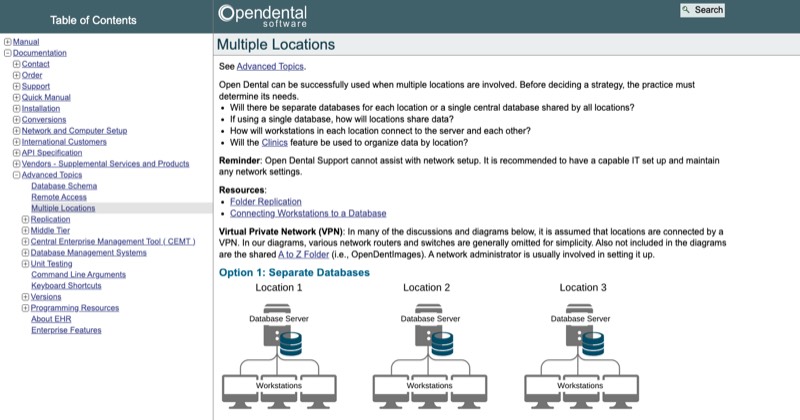
Self-hosting Open Dental across a group means you own the database server, the backups, the restore testing, the VPN or the network path between locations, and the performance conversation at 8am on a Monday. With a capable IT team that is leverage, because you can architect it for how your group actually operates. Without one it is a liability that compounds with every acquisition, which is the same staffing question behind what multi-location groups actually need from IT support.
A cloud-native platform like Ascend moves a meaningful share of that to the vendor, and for a group with no IT function that is worth real money. What you hand over with it is the architecture and the direct data access, which is the part you cannot buy back later. That is the trade, and the mistake we see is pricing only one side of it.
How This Actually Gets Decided
Strip away the preference argument and it comes down to four questions.
Do you have real IT capability, in-house or contracted?
If yes, self-hosted Open Dental gives you architectural control that a cloud platform will not, including a single central database across every location. If no, buying a cloud-native platform is the more honest answer than buying self-hosted software and hoping.
What is your acquisition pace?
Groups acquiring several practices a year should weigh onboarding above almost everything else. A repeatable pattern for bringing a new location onto the platform matters more than any feature comparison, and it is the thing that stalls integrations. We wrote about where that goes wrong in IT pitfalls in dental practice acquisitions.
What does your analytics roadmap need?
If leadership wants a warehouse pulling clinical, operational and marketing data together, direct database access changes what is possible. If PMS-native dashboards are enough, this question does not decide anything.
What happens if you leave?
Ask both vendors, in writing, what an export looks like: format, completeness, images included or not, and what it costs. Ask before you sign, because your leverage is strongest then.
Where We Land
Open Dental is our pick for a group that wants to own its platform, and it is not close. Tom’s shorthand for it is to put it in the cloud, add Clinics, and you have a centrally managed platform. That is Open Dental’s own documented design: Clinics organizes multiple locations inside one database while keeping them separate for reporting, and the vendor documents self-directed cloud hosting on your own infrastructure. You get transparent published pricing, direct access to your own data, and an architecture you control rather than rent. That combination is what makes centralized reporting and a real data warehouse possible later, and no other platform on this page offers it.
The one condition on that pick is real IT capability, in-house or contracted. Open Dental is explicit that it does not support self-hosted setup and recommends working with an IT professional, so the database server, the backups and the network path between locations are yours to own. For a group without that capability and no plan to build it, Dentrix Ascend is a reasonable answer. Dentrix Enterprise belongs on the shortlist too, particularly for larger groups and for organizations with a public health or integrated health center footprint, which is the audience its own site addresses. Classic Dentrix past a handful of locations is the one to rule out, and Henry Schein One’s own scalability row says so before we do.
None of that is a verdict on which software your team will prefer using. It is a read on which one your IT reality can actually carry. If you are weighing this for a group and want a second set of eyes, happy to compare notes. We looked at the wider field in our roundup of the best dental practice management software for groups.
Dentrix vs Open Dental FAQs
Which Dentrix product should a group actually be comparing?
Ask which one before anything else. Classic Dentrix is installed locally, Dentrix Ascend is cloud-native, and Dentrix Enterprise is a separate product on its own site aimed at multilocation groups and integrated health centers. Henry Schein One’s own comparison page puts classic Dentrix in the scalability row as “Limited multi-location support,” so for most groups the real comparison is Ascend or Enterprise against Open Dental.
Why can we not find a price for Dentrix?
Because Henry Schein One does not publish one for any of its three products. Any Dentrix license figure you find came from a reseller, a forum or a comparison site rather than the vendor. Open Dental publishes its full fee schedule, which makes the two genuinely hard to compare on paper and means a Dentrix number has to come from a quote you request directly.
Can Open Dental run in the cloud for a multi-location group?
Yes, in two different ways that people confuse. Open Dental Cloud is the vendor-hosted product, sold in hosting packages from $250 to $2,370 a month by concurrent sessions on top of the support fee, currently US only and in limited release. Separately, a group can run self-hosted Open Dental on its own cloud infrastructure with one central database. That second path is the one that gives a group architectural control, and it is also the one that makes the group responsible for the infrastructure.
Does Open Dental support multiple locations on one database?
Yes. Open Dental’s own multiple-locations documentation walks through both separate databases per location and a single central database shared across locations, and notes that Open Dental Support cannot assist with network setup. The design decision is yours, and so is the network behind it.
We are a five-location group. Which should we shortlist?
Open Dental first, on a single central database, provided you have IT capability in-house or contracted. At five locations its volume tier applies at $169 per month per office, dropping to $149 per office after twelve consecutive months on support, and you get direct access to your own data across all five. Shortlist Dentrix Ascend as the alternative if that IT capability is not there. Classic Dentrix is the one we would leave off the list, on the vendor’s own multi-location language.
Posted in PMS