November 17th, 2026
Access Dental Data Breach: What It Means for Dental Practices
Industry Research — Dental Cybersecurity, News

A Texas dental group has filed breach notices with at least two state regulators, and the total it reported is well above the roughly 340,000 in early headlines.
On November 13, 2026, the Texas attorney general published a report from Access Dental Management LLC, the company behind the Access Dental clinics, listing 455,888 people affected, including 341,039 Texans. The company has reported the Access Dental data breach to state regulators after information may have been viewed and copied from its network in early May 2026.
The short answer: Access Dental Management reported 455,888 affected people to Texas. Its notice says the information may include names, addresses, birth dates, Social Security numbers, insurance and medical information, varying by person. A WorldLeaks leak-site listing named Access Dental on June 5, which the company’s notice does not mention. Law firms are investigating. The pages we reviewed identified no filed complaint. For other dental groups, five things are worth doing now: assign who documents discovery, map what one management login can reach, count the old records you hold, watch for data leaving, and get notice roles in writing.
What is actually known about the Access Dental data breach
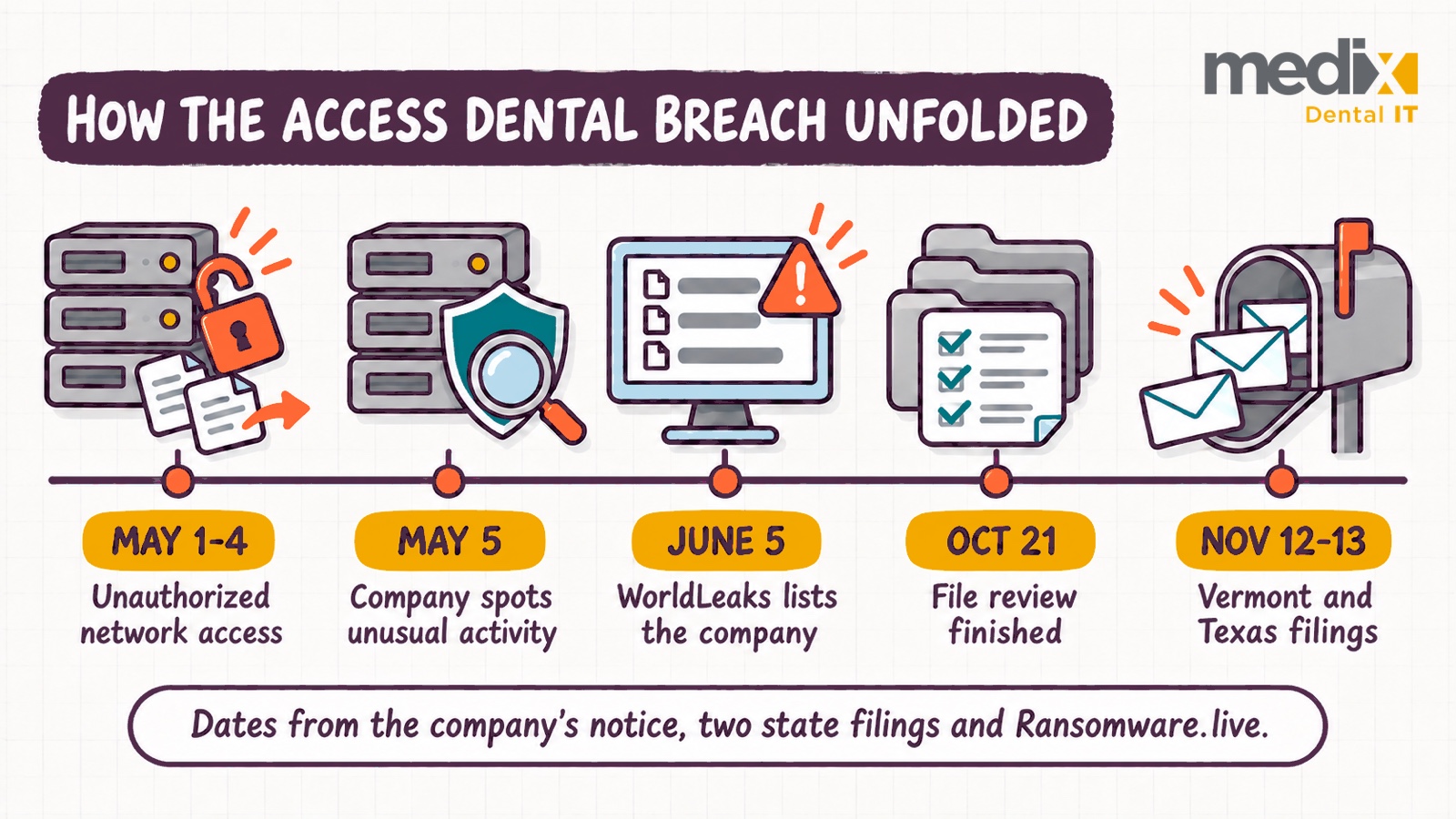
The company has disclosed it. Its website notice says it “became aware of unusual activity in its network environment” on or about May 5, and that information “may have been viewed and copied by an unauthorized individual” between May 1 and May 4. It does not say how the intruder got in or name an attacker.
The state filings. The Texas attorney general’s breach report, the source of the total, lists an Irving, Texas, address and notice by mail. The Vermont attorney general’s list shows 10 Vermont residents.
What we have not found: an entry under the company’s name on the federal HHS breach portal, or on the California, Oregon or Washington attorney general lists, as of November 17.
Its website says it runs offices across Texas and in Illinois, Indiana and New Mexico. SecurityWeek reports its parent platform is Surge Private Equity.
Three claims being repeated, checked
“341,049 were affected, and it could surpass 455,000.” 341,049 combines the Texas and Vermont resident counts, and some AI answers treat a total above 455,000 as only a possibility. But 455,888 is the total the company itself reported to Texas, not a projection.
“It was a ransomware attack.” That wording comes from law firm pages such as Claim Depot’s. The company’s notice never uses it, or mentions encryption or a ransom.
“The attack happened June 5.” That is when WorldLeaks listed the company. The Texas form also lists October 21, when the file review ended, as the “discovered” date, while the notice dates awareness to about May 5. Hood River Dental’s filings split the same way.
What the WorldLeaks listing shows
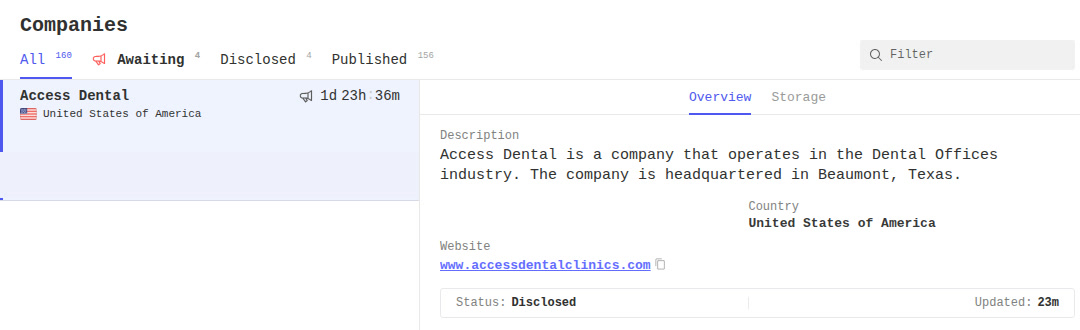
Ransomware.live recorded the WorldLeaks listing at 13:54 UTC on June 5, with a countdown of about two days and the status “Disclosed.” It gives no data inventory or size, and we could not confirm whether any data was later published. In every case our dental leak-site study could match, the listing came before the HHS report. The tracker’s automated summary calls Access Dental a dental insurer focused on California. The listing itself says Beaumont, Texas, the dateline on the company’s notice.
| Source | What it says | What it leaves out |
|---|---|---|
| Company notice (Nov) | Access May 1 to 4, activity noticed about May 5, review done October 21 | A count, the entry point, the attacker, credit monitoring |
| Texas AG report (Nov 13) | 455,888 total, 341,039 Texans | Which practices’ patients are included |
| Vermont AG list (Nov 12) | 10 residents, Social Security numbers and health records | Dates and the total |
| WorldLeaks listing (Jun 5) | Company named, countdown, “Disclosed” | Any data inventory or size |
Why a management company breach can reach many locations
In many DSO arrangements, the management company runs billing, IT and back-office work for dentist-owned practices, which can make it a business associate of each one. Access Dental has not described its structure, so I won’t guess who owes which duty. What the structure changes is reach: when shared systems hold records for many offices, one intrusion can affect all of them. Access Dental’s website says its practices care for more than 150,000 people a year. The total reported to Texas is about three times that, and the notice does not say whose records the files held.
For a breach of unsecured protected health information, HIPAA treats it as discovered on the first day it is known, or would have been with reasonable diligence, under 45 CFR 164.404, and requires notice without unreasonable delay and no later than 60 calendar days after discovery. A business associate must notify the covered entity on the same terms under 164.410. The public dates here do not establish when HIPAA discovery occurred or whether notice was late.
What should a dental practice or group do now?
1. Assign who documents discovery
The stretch between noticing activity and finishing a file review is the part to rehearse. Assign now who documents when a breach was known, or reasonably should have been. Our dental data breach notification guide walks through the clock.
2. Map what one management login can reach
Can one compromised account open every location’s files? Scope admin rights by role and location, and require multi-factor authentication on every remote and administrative login.
3. Count the old records you still hold
Affected-person totals can include former patients. Ask where old patient data, exports and retired servers live, and what retention rules and legal holds allow you to delete.
4. Watch for data leaving
Groups like WorldLeaks steal data instead of encrypting it, so theft can happen without disrupting appointments. Ask your IT provider whether a large overnight transfer from a server would raise an alert, and who reads it.
5. Get notice roles in writing
If a DSO, management company or IT vendor runs your systems, the business associate agreement should say how fast that partner must tell you about an incident, who sends patient letters, and who reports to HHS.
For multi-location groups: one platform, one blast radius
I wrote on LinkedIn last month that what almost nobody looks up is which groups operate as one platform instead of a shared logo. That is still what a buyer pays for. Incidents like this show the other side: the shared systems that make a group one platform can also give one intrusion reach across many offices. That argues for walls inside the platform as you standardize across locations.
Any group in a deal should expect diligence to ask for the incident timeline and the discovery-date reasoning. Our Park Dental Partners breakdown covers those questions.
Access Dental Data Breach FAQs
How many people were affected by the Access Dental data breach?
Access Dental Management reported 455,888 affected people to the Texas attorney general, including 341,039 Texans, in a report Texas published November 13, 2026. A Vermont filing listed 10 residents. As of November 17, we found no federal HHS breach portal entry under the company’s name.
What information was exposed in the Access Dental breach?
The company’s notice lists name, address, date of birth, Social Security number, health insurance information and medical information, varying by person. It points people to credit reports, fraud alerts, freezes and an assistance line at 1-844-770-7442. The website notice does not mention credit monitoring.
When did the Access Dental breach happen?
The company says the unauthorized activity occurred between May 1 and May 4, 2026, and that it noticed unusual activity on or about May 5. It finished reviewing the files on October 21. Vermont recorded its report November 12, and Texas published one November 13.
Was the Access Dental breach ransomware, and who is WorldLeaks?
The company has not said. Its notice does not mention ransomware, encryption, a ransom demand or an attacker. A WorldLeaks leak-site listing named Access Dental on June 5, 2026. Ransomware.live describes the group as a 2025 rebrand of Hunters International that steals data and threatens to leak it rather than encrypting systems.
Is there an Access Dental class action lawsuit?
Law firms including Edelson Lechtzin and Shamis & Gentile have announced investigations. As of November 17, 2026, the pages we reviewed did not identify a filed complaint. An investigation is not a lawsuit or a finding of fault. Our review of settled dental data breach lawsuits shows how earlier cases ended.
Do dental practices have to notify patients because of this breach?
A practice’s duty turns on discovering a breach of unsecured protected health information it is responsible for, including one at its own business associates. Practices supported by Access Dental Management should confirm in writing whose patients were in the affected files and who is sending notices. Other practices have no duty from the news alone.
The question to ask your leadership team
If your IT provider reported unusual activity tomorrow, who would decide when the clock started, and where would that be written down? If the answer depends on who takes the call, start there. If you want a second set of eyes on how your group would handle it, the team at Medix Dental IT is happy to compare notes.
Posted in Dental Cybersecurity, News