
Most dental groups treat standardization as something you do once, during an acquisition. That is the mistake.
IT standardization across DSO locations is not a one-time integration task you finish and forget. It is a standing, never-finished discipline that fights drift across every office, and its real payoff is overhead you stop paying every single month. As ADA Health Policy Institute data shows, more dentists are joining DSO-affiliated groups every year, but a roll-up only becomes a platform when its operating environment is repeatable. Until then, you do not own a group. You own a collection of offices that happen to share a logo, each carrying its own quiet IT tax.
Standardization Is a Doctrine, Not a Project
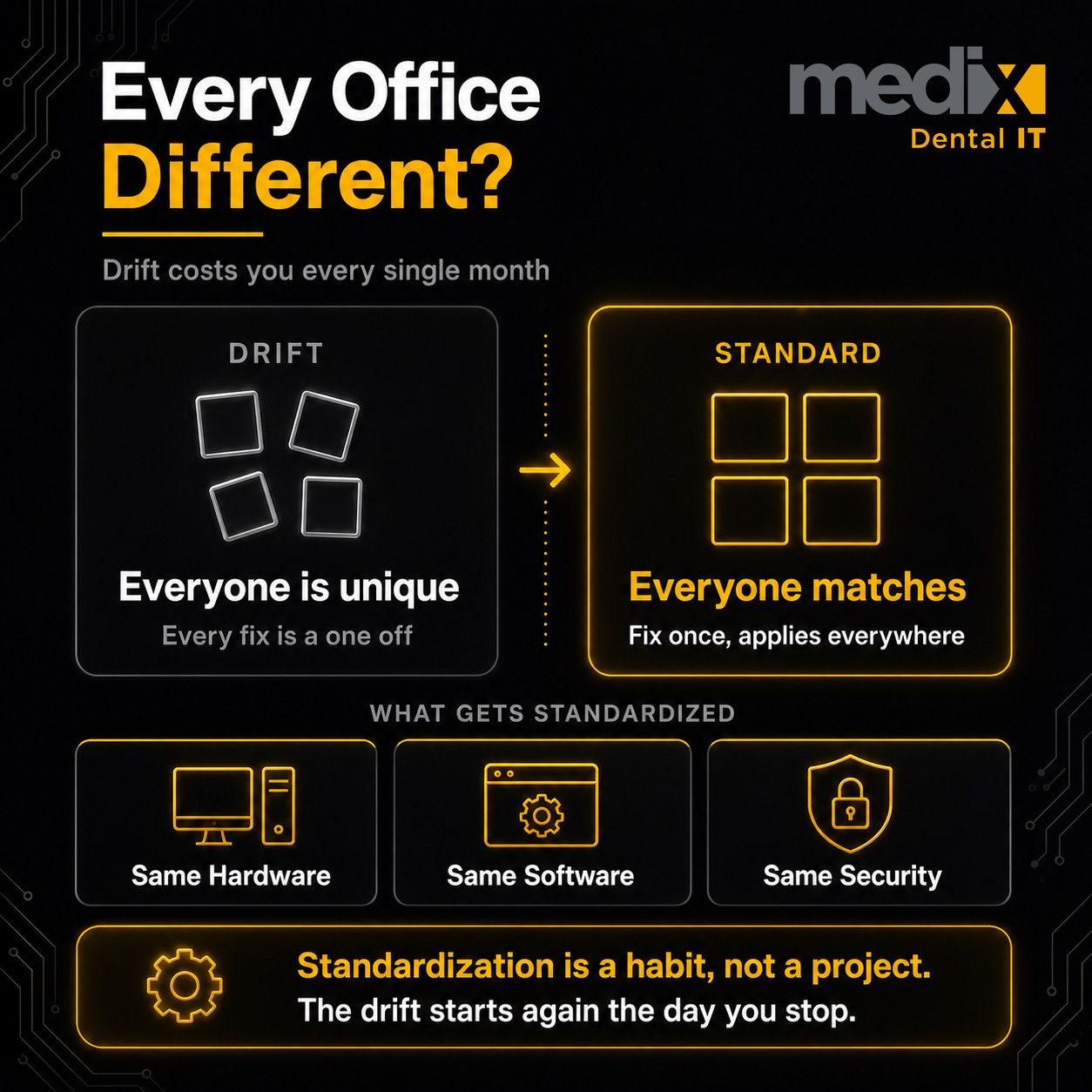
There is a difference between standardizing an office when you buy it and running a group that stays standardized. The first is a project with an end date. The second is a discipline that never stops, because entropy never stops. Software drifts. A location adds a tool nobody approved. An acquired practice quietly keeps its old server because migrating it felt like too much work that quarter.
That drift is where overhead lives. Every nonstandard location costs you more to support, more to secure, and more to report on, forever. Standardization is not about control. It is about leverage. The groups that internalize that early build a fundamentally different kind of organization than the ones that standardize once and let it erode.
The Repeatable Platform Framework
Here is the framework I use with groups that want standardization to be a permanent state, not a periodic cleanup. Four parts, each aimed at the overhead a nonstandard portfolio quietly generates.
1. One Golden Image Per Location Type
Define a standard build for each kind of office you run, such as a general practice, a surgical site, and a hygiene satellite. New workstations and new locations get deployed from that image, not assembled by hand. This is the single biggest overhead reducer, because it turns every future buildout from a custom project into a repeatable deployment. We cover sequencing a ground-up buildout separately, including the vendor constraints that have to be settled before construction documents are final.
2. One Security and HIPAA Posture
Every location runs the same controls: the same multi-factor authentication, the same patching cadence, the same access model. You are not managing ten security postures. You are managing one, applied ten times. This is also what keeps compliance defensible, because you can prove a single standard across the group instead of auditing each office as its own snowflake.
3. Vendor and Tool Consolidation
Multi-location groups accumulate a patchwork of separate IT vendors and overlapping tools as they grow, usually without ever deciding to. Consolidating to one stack and one accountable partner removes duplicated cost and the finger-pointing that happens when three vendors each own a piece of a problem. Fewer moving parts is not just cleaner. It is cheaper.
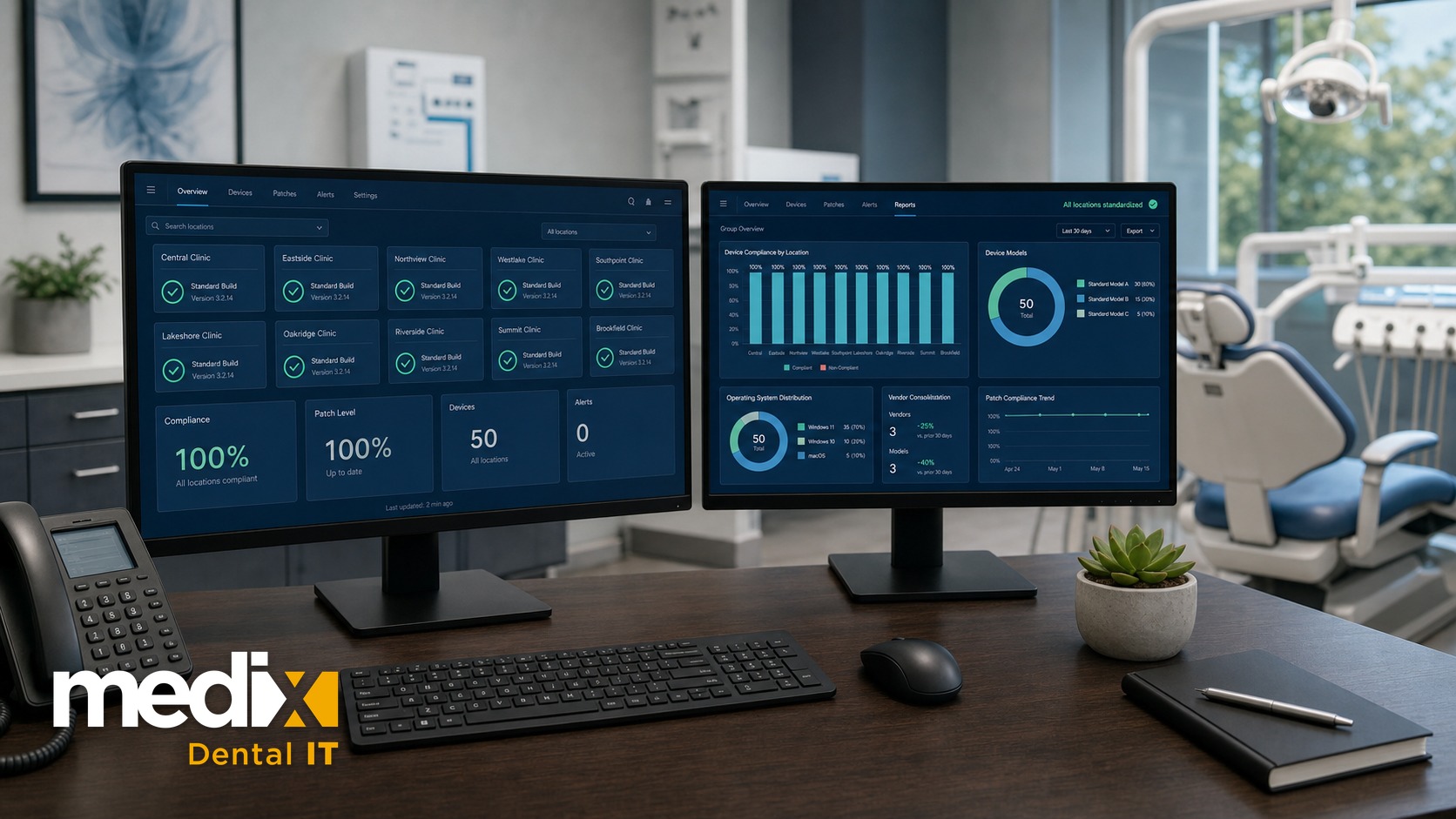
4. Group-Level Reporting as the Control Layer
Standardization you cannot see does not stay standardized. Group-level reporting is how you catch drift early, the location that fell behind on patches or the office still running a tool you retired. Without it, you find out a location drifted only when it causes a problem. With it, standardization becomes something you manage on purpose rather than rediscover during a crisis.
The Overhead You Pay for Drift
The cost of drift is not a one-time hit. It is a monthly one. Every nonstandard location is a line item you keep paying to support, secure, and report on, and it hides in plain sight among the hidden IT costs draining DSO margins. That recurring drag compounds. It also shows up the day you go to sell, because nonstandard IT reads as unbudgeted future cost during diligence, which is part of how inconsistent IT erodes EBITDA. But you do not have to wait for an exit to feel it. You are paying for drift every month you let it run. Standardization is how you stop.
Where the Framework Meets the Deal
This framework is the standing state you maintain across the whole portfolio. The moment you acquire a new practice is its own event, with its own sequence for level-setting a seller’s IT and folding it onto the platform. That deal-time work is covered in the DSO technology playbook for standardizing during an acquisition. The playbook gets a new office onto the platform. This framework keeps the whole platform from drifting once it is there.
The harder question for most groups is not whether standardization is worth it. It is whether they are running it as a permanent doctrine or treating it as a cleanup they do every couple of years and quietly lose in between.
IT Standardization for DSOs FAQs
What does IT standardization across DSO locations actually mean?
It means every location runs the same core technology stack, the same security and HIPAA posture, a consolidated set of vendors, and shared group-level reporting. The goal is a repeatable operating environment, so supporting, securing, and reporting on the tenth office costs no more effort than the first. It is a standing discipline, not a one-time setup.
How does standardization reduce IT overhead in a DSO?
Every nonstandard location costs more to support, secure, and report on, every month. Standardizing removes duplicated tools and vendors, turns new buildouts into repeatable deployments from a golden image, and lets you manage one security posture instead of many. The savings recur every month, not once, which is what makes standardization a margin lever rather than a project.
Is standardization the same as integrating an acquired practice?
No. Integrating an acquired practice is a deal-time event with an end date, focused on getting one new office onto your platform. Standardization is the standing framework that keeps the entire portfolio from drifting afterward. The two work together. Integration gets a location onto the platform, and the framework keeps the whole platform consistent over time.
Why does standardized IT affect DSO valuation?
Buyers pay more for a platform than for a collection of offices. Standardized IT signals a repeatable, lower-risk operation, while nonstandard IT reads as unbudgeted future cost during diligence. Full integration can increase a DSO’s valuation by 2-4x EBITDA, and consistent IT is a visible, verifiable part of what a buyer is assessing.
Posted in DSO