
September 30th, 2026
Best Dental Office Phone Systems and VoIP Providers in 2026
Industry Research — PMS
Most phone system comparisons never tell you the one thing that decides whether it works.
A dental office phone system is a VoIP platform that connects to your practice management software so patient records surface on incoming calls. For most cloud providers, call quality is table stakes. What separates one system from another is the depth of that connection, and whether your PMS vendor recognizes it at all.
That second question is worth five minutes of your time, because the answer is not what the marketing implies. Henry Schein One publishes an authorized vendor directory for Dentrix and Dentrix Ascend. A query of the live directory in September 2026 returned 176 authorized vendors, of which 37 carry a Voice capability. Open Dental publishes its own directory with a category specifically for phone integrations, and that one contains two companies. Run the phone vendors most often pitched to dental practices against those lists and they do not land in one tidy category. Some are listed for the phone capability specifically, some are listed for other things, some appear on a flagged list, and several are not in either directory at all. That spread is the useful part.
What we commonly see is a practice buying on the strength of a demo, then learning later that the connection runs through a third party, or costs extra, or reads data without ever writing anything back. None of that shows up in a feature list.
Why the Phone System Is a Practice Management Software Decision
The front desk does not experience your phone system as a phone system. They experience it as whether the patient’s chart is on screen when they pick up.
That single behavior, usually called a screen pop or call pop, is the primary dental-specific value proposition being sold in this category. It depends completely on a working connection between the phone platform and your practice management system. No connection, no pop. A shallow connection, and you get a name but no balance, no next appointment, no family members.
Which means the phone decision inherits whatever constraints your practice management system already carries. If you are still weighing that layer, our breakdown of the best dental practice management software is the better starting point, because the PMS shapes what any phone vendor can connect to, and how easily.
Here is the part that surprises people. Read the integration directories that Dentrix and Open Dental publish themselves and the phone vendors sort into groups that do not match their marketing.
Open Dental publishes a vendor directory organized by category, including one explicitly labeled Phone Integrations, described as “these companies have a phone integrations (e.g., VOIP, etc).” That category lists two vendors: DentalPaas and VoiceStack. Several of the best known dental phone brands appear elsewhere on that same page under patient communications, but not under phone integrations.
Henry Schein One runs the API Exchange, the authorized integration program for Dentrix and Dentrix Ascend. We queried its published vendor directory in September 2026. It returned 176 authorized vendors, of which 37 carry the Voice capability. Treat these counts as a snapshot of a directory that grows. Alongside that, Henry Schein One maintains a separate list of companies it says “may be utilizing an unauthorized connection,” with a note that the list is not complete.
Here is what nobody tells you when you are shortlisting phone systems. Sort the vendors against those two lists and five patterns show up, and none of them match the marketing neatly.
Authorized for Voice: Mango Voice, RevenueWell, Practice By Numbers, and VoiceStack all appear on the authorized directory with the Voice capability attached, though Mango’s listing covers Dentrix Ascend only.
Listed, with Voice not among the displayed capabilities: Weave is on the directory, and this one is worth being precise about, because it teaches you how to read the whole list. Weave announced in August 2025 that it is an authorized integration vendor in the Henry Schein One API Exchange, and its release enumerates the features that integrate with Dentrix and Dentrix Ascend. One of them is Patient Profile and Call Pop, which it describes as staff viewing household name, demographics and patient photos while serving someone over the phone. That is the phone behavior this entire category sells. Yet the capabilities displayed against Weave’s directory listing when we checked were Patient Experience, Forms, Marketing, Patient Relationship Management, Patient Communications, and Reputation Management, with no Voice tag.
So the tags are not a capability map. An authorized integration can cover the phone experience without carrying the Voice label, which means you should use the directory to confirm that a vendor is authorized, and use the vendor’s own documentation to learn what the integration actually does.
On the possible-unauthorized list: Adit appears there. So does NexHealth. That second one matters more than it looks, because NexHealth is the bridge Ooma uses to reach practice management data. A practice buying Ooma for its Dentrix integration is buying a connection that runs through a company Henry Schein One has flagged.
Not on the Henry Schein One directory: Ooma, RingCentral, Dialpad, and Nextiva do not appear on it at all, which is unsurprising for the three general business providers since none of them claims a dental integration.
In Open Dental’s directory only: DentalPaas is the reverse case. It sits in Open Dental’s phone category and does not appear on the Henry Schein One list, which is a coherent position for a vendor built around one practice management system rather than evidence of anything being wrong.
Read the flagged group carefully, because the wording is deliberately hedged and we are not going to overstate it. Henry Schein One says these vendors may be using an unauthorized connection. It also says the list is incomplete. Absence from it proves nothing either. It is not an accusation and it is not a reason to rule a vendor out on its own. It is a question to put to the vendor directly: is your Dentrix connection authorized, and can you point me to the documentation. It is also a fair question for Henry Schein One.
That gap between what gets marketed and what appears in a PMS vendor’s own directory is one of the most useful things a buyer can check, and it takes about five minutes.
This is also why most comparisons of these systems are not much help. Many are published by phone vendors ranking themselves first, and several of the pages currently ranking for this topic never name a single practice management system anywhere in the article. If a phone comparison does not tell you what it connects to, it is not answering the question you actually have.
Best Dental Office Phone Systems and VoIP Providers
Seven entries below cover the vendors a dental practice is most likely to shortlist, and the comparison table that follows adds the rest for a total of eleven. They are grouped by how they actually connect to practice management software, because that is the decision that matters after the first month. Vendor capability claims below come from each vendor’s own published material, and directory status comes from the PMS vendors’ own published directories. Where a vendor does not publish something, we say so instead of guessing. Verify pricing and integration status directly before you sign, since both change without announcement.
If you only have ten minutes: entries 1, 3 and 6 cover the three patterns that decide this purchase, a published write-back, a listed direct integration, and an integration borrowed from a third party.
1. Weave: Published Write-Back, Undefined Pricing Unit
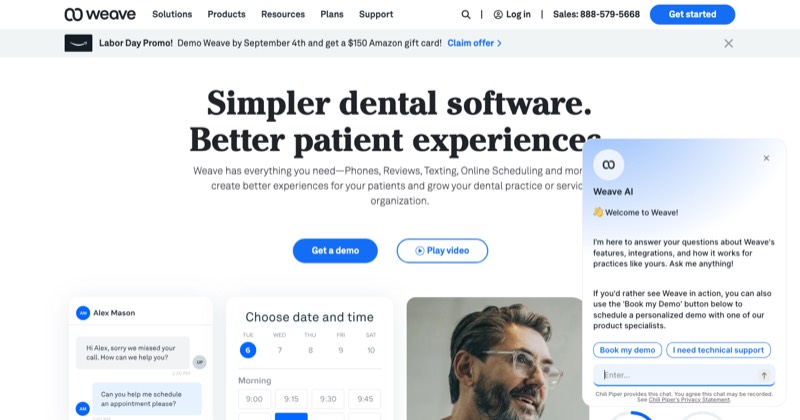
Weave is one of the more widely recognized names in dental patient communication, and the phone system is one part of a larger platform covering texting, reminders, reviews, forms, and payments. In August 2026 Weave agreed to be acquired by investment firm Francisco Partners at a valuation of about $650 million, and it says it would continue under the Weave name once the deal closes.
On integration depth, Weave is one of the few vendors making a write-back claim rather than a lookup claim. Its dental page lists “automatic appointment writebacks to your PMS” alongside the Call Pop feature that surfaces patient details on an incoming call. Weave also published a dedicated Dentrix Ascend integration covering schedule sync and patient profile display.
Weave publishes a Business Associate Addendum at a public URL, which is more transparency than most vendors in this category offer and makes the HIPAA conversation shorter.
On the directory question, Weave is where the sorting above put it: an authorized integration vendor whose published Dentrix feature list includes Call Pop, even though the directory listing itself carries no Voice tag. It is the clearest example on this page of why the tags are worth checking and worth reading carefully.
Where it gets complicated: pricing starts at $199 per month, but Weave does not state whether that figure is per location, per practice, or per user. For a single office that ambiguity is survivable. For a group evaluating twelve locations, it is the difference between a manageable line item and a serious one, so get the unit in writing before you compare it to anything else here.
2. Mango Voice: Open Rates and a Real Multi-Location Story
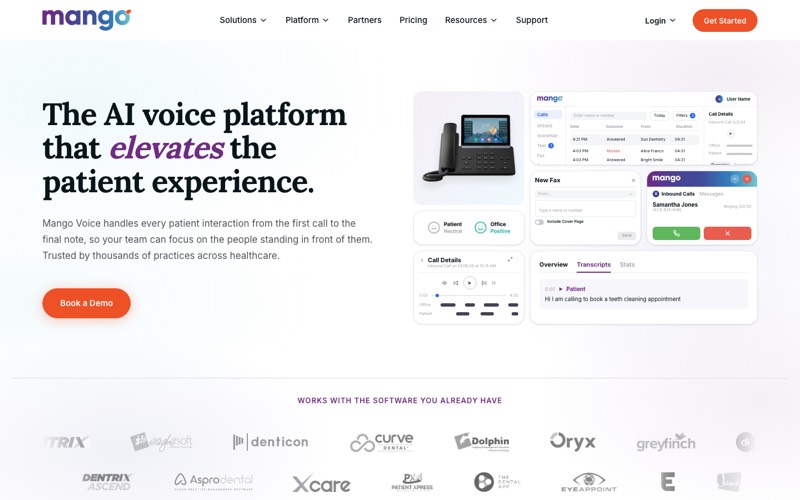
Mango is a dental-focused VoIP provider that publishes its rates openly and has a genuine multi-location story.
Published rates are $119 per month for the Phone Suite, $219 for Premier, and $419 for the AI Suite, which adds a 24/7 AI receptionist, per month with monthly billing, or $99, $199 and $399 per month with annual billing. Read that pricing page carefully, though: those numbers sit behind a phone-count selector set to 1 to 3 phones by default, and they scale as you add phones. Practices with ten operatories are not paying the advertised number. There is also a one-time implementation fee that the page requires but never quantifies.
On scale, Mango states it manages approximately 500 multi-location accounts with groups ranging from three locations to thirty or more, managed from a single admin portal. That is a self-reported figure, but it is a specific one, and multi-location administration is a real differentiator when your alternative is logging into a separate account per office.
Mango also appears on Henry Schein One’s authorized directory with the Voice capability attached for Dentrix Ascend, which is the narrowest and most relevant listing a phone vendor can have there.
The integration caveat: Mango’s marketing names most major practice management systems, but its own help center feature matrix documents integration depth only for a smaller set, with Curve Dental the most thoroughly detailed. Dentrix, Open Dental, Eaglesoft, and Denticon are named in marketing without published feature detail. If you run one of those, ask Mango to demonstrate the integration on your specific system rather than accepting the logo as proof.
3. Practice by Numbers: Voicemail That Lands in the Chart
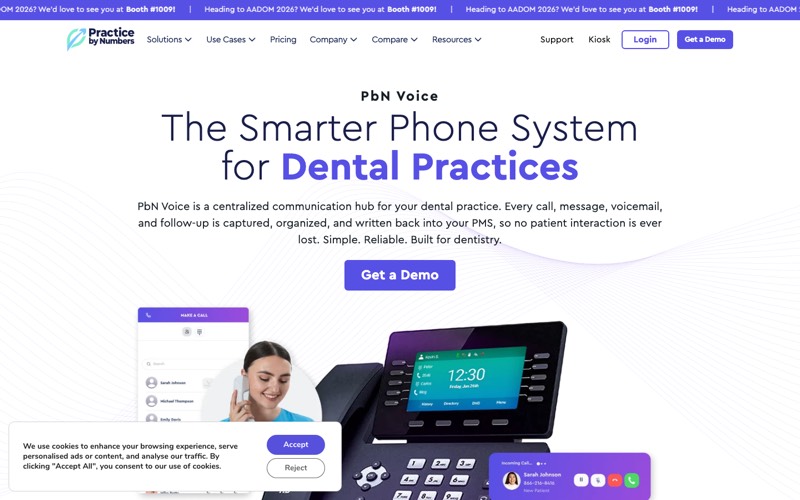
Practice by Numbers is an analytics platform first, with the phone system offered as a module inside it. That architecture is the reason it makes a claim none of the others make in the same words.
PbN states that voicemails are transcribed and logged directly into the PMS and that call outcomes feed into scheduling and analytics. That is a write-back claim, meaning data flows into the patient record rather than merely being read out of it. If your goal is that a call leaves a trace in the chart without someone retyping it, this is the most direct statement of that capability in the category.
The named integration list is broad and includes Dentrix, Dentrix Ascend, Eaglesoft, Open Dental, and Curve Dental, though not Denticon.
The compliance gap: the published starting price is $249 per month with the unit unstated, individual tier pricing is not public, and PbN Voice is a separately priced add-on on most plans. The PbN Voice page also does not mention HIPAA anywhere. For a product handling voicemail transcriptions of patient calls, that is a question to raise directly with the vendor before the contract stage.
4. RevenueWell Phone: Enterprise Controls, Quiet Phone Page
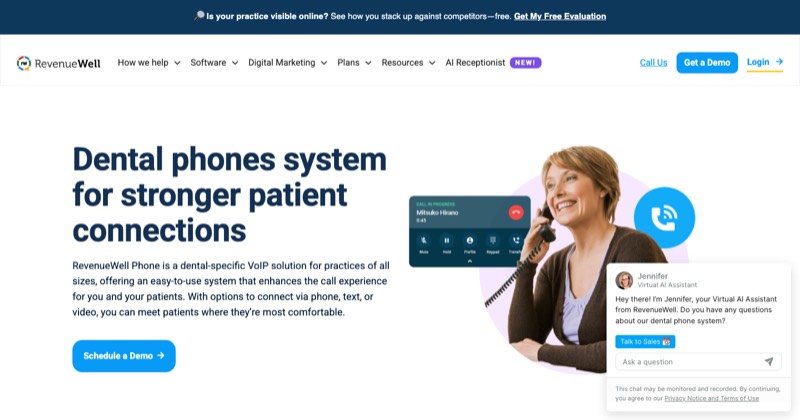
RevenueWell is a patient communication platform with a phone product attached, and its strongest asset for groups is a dedicated enterprise layer.
RevenueWell Enterprise is designed for groups and DSOs to manage every location as easily as a single office, with the ability to apply standard operating procedures across all locations or selected offices, segment and tag locations, and set custom access controls. For a group trying to enforce a consistent front desk process across acquisitions, that centralized control is the relevant feature.
On compliance, RevenueWell states plainly that it acts as your Business Associate and your office is the Covered Entity, with data sent over an encrypted connection to a HIPAA and HITECH compliant hosting facility.
What is missing from the phone page: the phone product page names zero practice management systems, saying only that Phone plugs into your PMS. The compatible-systems list appears on the Enterprise page and describes the platform rather than the phone product specifically, and Open Dental does not appear on it. Pricing is not published at all. Ask which systems the phone product supports, as distinct from the platform.
5. VoiceStack: The Only Vendor Filed as Phone on Both Directories
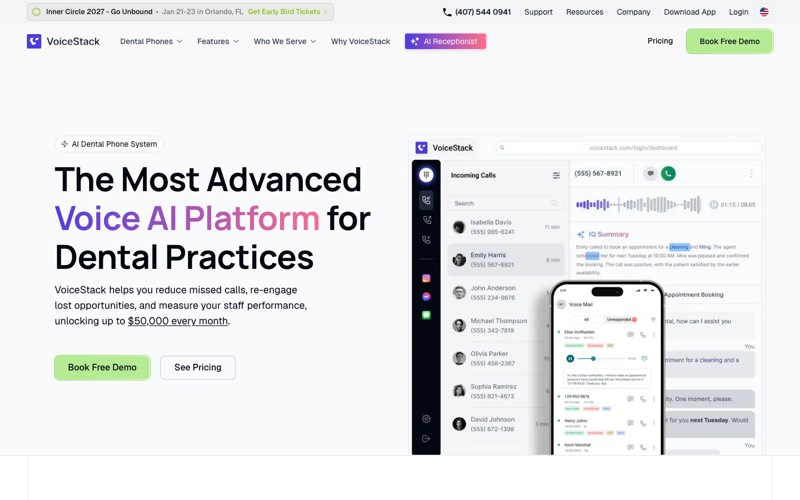
VoiceStack is the only vendor in this roundup that carries the phone-specific listing on both directories: it is one of two companies in Open Dental’s Phone Integrations category and it is authorized for Voice by Henry Schein One. Weave appears on both directories too, but under Marketing and Patient Communications at Open Dental and without a Voice tag at Henry Schein One, so VoiceStack is the only one filed as a phone vendor in both places. That is the reason it belongs here despite lower name recognition than the platforms above.
It names Open Dental, Dentrix Ascend, Eaglesoft, Planet DDS, and CareStack as integrations, and positions itself for groups and DSOs with multi-location call management. On compliance it states it supports privacy-first workflows with role-based access to recordings and transcripts, and addresses signing a Business Associate Agreement during contracting.
The asterisk: no pricing is published, and the BAA is described as a contracting conversation rather than a standing commitment. Being in Open Dental’s directory tells you the connection is recognized by the PMS vendor. It does not tell you what the platform costs or how it performs at your call volume.
6. Ooma Office: Clear Per-User Pricing, Borrowed Integration
Ooma is a general small business VoIP provider with a dental landing page, and it is the clearest illustration of a distinction this category tends to blur.
Its pricing is among the most directly comparable in the group, because it states its unit plainly: $19.95, $24.95, and $29.95 per user per month across three tiers. That is a figure you can plug into a spreadsheet without a follow-up call, which is not true of every vendor here.
Where it gets complicated, and this is the important part: Ooma does not integrate with any practice management system directly. It reaches your PMS through NexHealth, a separate third-party service, and only on Pro or Pro Plus plans. Through that bridge it names Dentrix, Open Dental, Eaglesoft, and Denticon, though NexHealth itself appears on Henry Schein One’s list of vendors that may be using an unauthorized connection, which is worth raising before you rely on the Dentrix side of it. The documented capability is read-only caller ID enrichment, showing name, date of birth, last visit, next visit, and family members. Nothing is written back. Ooma also does not cost what the headline says for a dental office, since the integration requires the Pro tier and NexHealth’s own cost is not disclosed. On compliance, note the careful wording: Ooma’s dental page says its service “can be used in a HIPAA compliant way,” which is a different statement than claiming the product is compliant.
7. RingCentral, Dialpad and Nextiva: Strong Platforms, No Dental PMS
These are grouped deliberately. All three are established business phone platforms, and none of them name a single dental practice management system.
We checked each vendor’s own integrations directory. Nextiva’s integrations page returns no matches for Dentrix, Open Dental, Eaglesoft, Denticon, or Curve Dental, listing general medical records platforms instead. RingCentral’s healthcare page never names a dental PMS. Dialpad documents no dental practice management integration either, and points customers toward its open API when one is needed. RingCentral does reach dental systems, but only through third-party apps like YAPI or PatientXpress that a practice buys separately, and the documented capability there is a caller ID screen pop.
Where they are genuinely strong is compliance paperwork. Dialpad states that once a Business Associate Agreement is signed, all Dialpad products can be used compliantly, with no plan tier required. RingCentral makes a BAA available to paying covered entity customers and holds HITRUST CSF certification, though its BAA footnote covers third-party products only unless their own terms specify otherwise, which matters precisely because the dental bridge is a third-party product.
The shared caveat for all three is that choosing one means accepting that the patient record will not appear on screen unless you buy and maintain a separate bridge, and that bridge is a second vendor relationship with its own contract and its own compliance terms. Beyond that, Nextiva is the one vendor publishing exactly what it disables to achieve compliance, and the list is operationally significant for a front desk. On a HIPAA-configured Nextiva account, visual voicemail is disabled, listening to voicemails in the app is disabled, and voicemail to email or text is disabled. Ask any vendor on this list which features they turn off in HIPAA mode. Nextiva is the only one that publishes the answer without being asked.
Dental Phone System Comparison
All figures below come from vendor and practice management vendor sources. Pricing and integration status in this category change without announcement, so confirm both directly before you sign.
| Provider | PMS systems the vendor names | Directory status | Connection method | Read or write | Published price | BAA |
|---|---|---|---|---|---|---|
| Weave | Dentrix, Dentrix Ascend, Open Dental, Eaglesoft, Curve, SoftDent, Dolphin, Fuse | Authorized integration vendor (announced Aug 2025); published Dentrix feature list includes Call Pop, though the listing carries no Voice tag | Direct | Call pop plus appointment write-back | From $199/mo, unit not stated | Published publicly |
| Mango Voice | Most major systems in marketing; depth documented mainly for Curve | Authorized for Voice (Dentrix Ascend only) | Direct | Screen pop | $119/$219/$419 per mo with monthly billing ($99/$199/$399 with annual billing) at 1-3 phones, scales with phone count | Not stated |
| Practice by Numbers | Dentrix, Dentrix Ascend, Eaglesoft, Open Dental, Curve; not Denticon | Authorized for Voice | Direct | Screen pop plus voicemail logged into the PMS | From $249/mo, unit not stated. Voice is an add-on | Not stated |
| RevenueWell Phone | None on the phone product page | Authorized for Voice | Direct, per the platform | Screen pop | Not published | Acts as Business Associate |
| VoiceStack | Open Dental, Dentrix Ascend, Eaglesoft, Planet DDS, CareStack | Authorized for Voice, and listed in Open Dental’s Phone Integrations category | Direct | Not detailed publicly | Not published | Addressed during contracting |
| DentalPaas | Not detailed publicly | Listed in Open Dental’s Phone Integrations category; not on the Henry Schein One directory | Direct | Not detailed publicly | Not published | Not stated |
| Adit | Dentrix, Dentrix Ascend, Open Dental, Eaglesoft, Denticon, Curve | Not on the authorized directory. Appears on Henry Schein One’s possible-unauthorized list | Direct, self-described as bypassing developer programs | Screen pop | Not published | Not stated for the phone product |
| Ooma Office | Dentrix, Open Dental, Eaglesoft, Denticon, via NexHealth | Not on the authorized directory. Bridge vendor NexHealth appears on the possible-unauthorized list | Indirect, third party, Pro tier only | Read-only caller ID | $19.95/$24.95/$29.95 per user/mo | “Can be used in a HIPAA compliant way” |
| RingCentral | None named by RingCentral | Not on either directory | Third-party apps only | Screen pop via third party | Contact sales | BAA for paying customers |
| Dialpad | None named | Not on either directory | Open API, build your own | Not applicable | From $15/user/mo annual | BAA, no tier required |
| Nextiva | None named | Not on either directory | None documented | Not applicable | From $15/user/mo annual | BAA, but disables several voicemail features |
Two clarifications on the directory column, because it is the one most likely to be misread. Being listed means the practice management vendor publicly recognizes that integration. The Voice tag is how the directory files it, not a specification of what the integration does, and Weave is the example that proves the difference. Absence does not mean a connection is broken, unauthorized, or unsafe, and Henry Schein One says plainly that its unauthorized list is incomplete. What absence does mean is that the PMS vendor has not publicly listed the integration, so ask how the connection is maintained and who fixes it when the PMS updates. Note that a listing is recognition rather than endorsement in either direction: Open Dental states on its own directory page that it does "not necessarily endorse any of these companies, nor do we provide technical support for their products."
What to Verify Before You Sign
Five checks, in the order we run them during a technology assessment. Most take only a few minutes, and they surface the problems that are expensive to discover after signing.
Confirm the integration is listed, not merely marketed. Open Henry Schein One’s authorized vendor directory and check Open Dental’s Phone Integrations category. Both take a minute. Use them to confirm a vendor is authorized, not to infer what the integration does: Weave is authorized and its published Dentrix feature list includes Call Pop while its listing carries no Voice tag, so the capability labels are a filing system rather than a specification. Absence from the directory is not proof a connection is broken or improper, but it does mean the PMS vendor has not publicly listed the integration, so ask how the connection is maintained and who fixes it when the PMS updates.
Ask whether it reads or writes. A screen pop reads your database. A write-back puts something into the chart. Those are different products at similar prices, and the demo looks identical for the first ten seconds.
Get the pricing unit in writing. Per user, per phone, per location, and per practice produce wildly different totals at scale. In this roundup only Ooma, Dialpad, and Nextiva state a unit plainly. Weave and Practice by Numbers publish a starting number with no unit attached, Mango Voice ties its rates to a phone-count tier, and RevenueWell, VoiceStack, DentalPaas and Adit publish no rate at all, while RingCentral sends you to sales. A number without a unit and no number at all are both reasons to ask.
Ask what gets disabled in HIPAA mode. Compliance configurations can remove voicemail to email, transcription in notifications, or texting. Find out before your front desk discovers it in week one.
Ask who owns the number. Porting a main practice line is straightforward when the contract is clear and painful when it is not. This becomes urgent during an acquisition, when you are consolidating numbers across offices on a deadline.
If a vendor gets evasive on any of the five, that is information worth weighing. It is the same set of questions we work through when a group asks us to look at its phone and VoIP options, and it is worth reading alongside our list of warning signs it is time to change IT providers.
The Bottom Line for Dental Groups
Here is the practical conclusion. The marketing in this category is consistently more confident than the documentation. The two directories are the cheapest way to see that gap for yourself, and they take about five minutes.
If published write-back matters most, Weave and Practice by Numbers are the two making that claim on their own product pages, and both are authorized Henry Schein One integration vendors, though both leave their pricing unit undefined. If you want pricing you can actually model, Ooma, Dialpad, and Nextiva publish per-user rates, but the general providers name no dental PMS at all and Ooma reaches yours only through a third party. If you are running multiple locations, Mango Voice and RevenueWell both document centralized multi-location administration in more detail than the rest.
For a group, the phone system quietly becomes an integration decision. Every location on a different platform means a different screen pop behavior, a different admin portal, and a different vendor relationship to manage. That is the pattern we see repeatedly: not one catastrophic failure, but twelve small inconsistencies that make a centralized front desk process very hard to enforce. It is the same standardization problem that shows up in every other layer of the stack, and it is why we treat phone systems as part of the wider IT checklist for dental practices rather than as a standalone purchase.
Deciding integrations can wait until later tends to get expensive in group dentistry, and phone systems expose it early, because the front desk touches them every hour of every day.
The demo will always show you the screen pop. It will not show you whether the connection behind it is listed, who maintains it when your PMS updates, or what the bill looks like at location twelve. Those three answers are the purchase.
Dental Office Phone System FAQs
What is the best VoIP phone system for a dental office?
The best fit depends on your practice management software and what you need the phone system to do. For Dentrix, RevenueWell, Practice by Numbers, and VoiceStack carry the Voice tag in Henry Schein One’s directory for both Dentrix and Dentrix Ascend. Mango Voice carries it for Dentrix Ascend only. Weave is also an authorized integration vendor for both and publishes Call Pop, although its listing has no Voice tag. Open Dental lists DentalPaas and VoiceStack under Phone Integrations. Use those listings to build a shortlist, then ask each vendor to demonstrate the specific workflow on your system. Practice by Numbers says it logs voicemails in the PMS; Weave publishes appointment write-backs.
What phone system integrates best with Dentrix?
Four vendors in this roundup appear on Henry Schein One’s authorized directory with the Voice capability attached: RevenueWell, Practice By Numbers, and VoiceStack for both Dentrix and Dentrix Ascend, and Mango Voice for Dentrix Ascend only. Weave is an authorized integration vendor as well, announced in August 2025 for Dentrix and Dentrix Ascend, though its directory listing is tagged for patient communications and reputation management rather than Voice. Adit names Dentrix among its integrations but appears on Henry Schein One’s list of vendors that may be using an unauthorized connection, so ask it about that status before signing. The lists change, so run the check yourself before you commit.
Which phone systems work with Open Dental?
Open Dental publishes a vendor directory with a Phone Integrations category, and it currently lists two companies, DentalPaas and VoiceStack. Several other vendors, including Weave, Practice by Numbers, and Adit, name Open Dental as a supported system on their own sites, and Ooma reaches it indirectly through NexHealth. Worth knowing that both Adit and NexHealth appear on Henry Schein One’s possible-unauthorized list, which is a Dentrix matter rather than an Open Dental one, but it is a reason to ask each vendor how its connections are maintained.
How much does a dental office phone system cost?
Published rates vary widely and are not directly comparable. Ooma lists $19.95 to $29.95 per user per month, Dialpad and Nextiva both start at $15 per user per month on annual billing, Mango Voice publishes $119 to $419 per month with monthly billing, or $99 to $399 with annual billing, for a practice with one to three phones, Weave starts at $199 per month, and Practice by Numbers starts at $249 per month. RevenueWell, VoiceStack, DentalPaas, Adit and RingCentral do not publish rates at all. The complication is that only the per-user providers state their unit, so a low headline number can cost more than a high one once you account for how it scales.
Do dental phone systems need to be HIPAA compliant?
A phone system that stores voicemail, call recordings, or transcriptions containing patient information is handling protected health information, which makes the vendor a business associate and means you should have a Business Associate Agreement in place. Vendors handle this differently. Weave publishes its Business Associate Addendum publicly, Dialpad and RingCentral make a BAA available, RevenueWell states it acts as your business associate, and several dental-specific vendors do not address it on their public pages at all. Ask for the BAA in writing during evaluation, not after.
Posted in PMS