June 5th, 2026
DentaQuest Data Breach: What It Means for Dental Practices
Industry Research — Dental Cybersecurity, News
Another week, another healthcare data breach in the headlines. This one is worth a closer look.
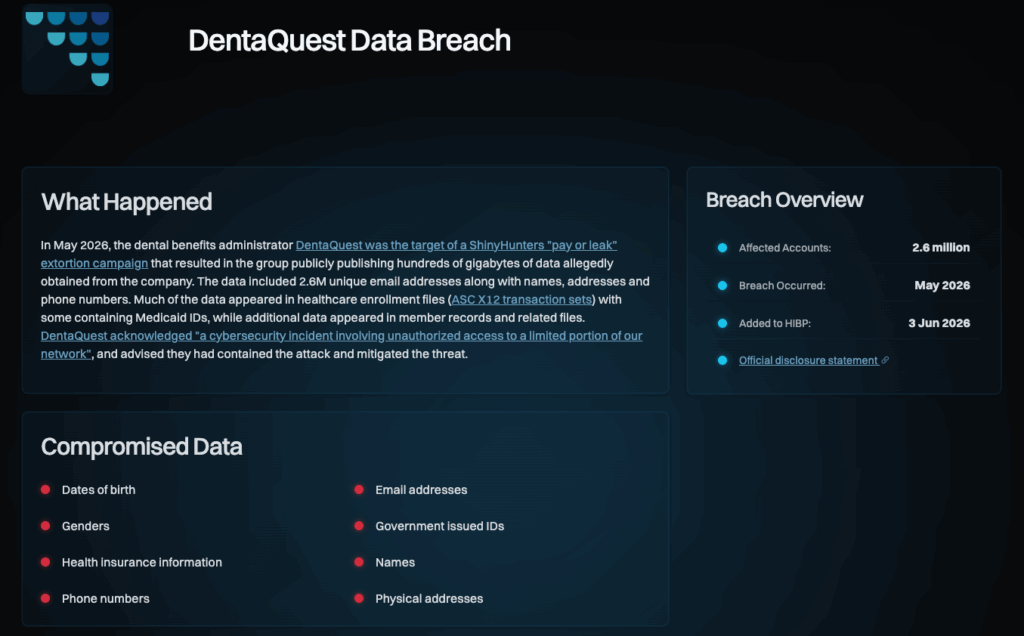
The DentaQuest data breach is one of the largest dental-sector data incidents on record, with roughly 2.6 million accounts exposed after an extortion group leaked the company’s data online. DentaQuest is not a dental practice. It is one of the biggest dental benefits administrators in the country, a Sun Life company that handles claims and enrollment data for tens of millions of members. And that is exactly why every dental practice and DSO leader should pay attention. When a vendor that holds your patients’ data gets breached, your patients get exposed, even if your own network was never touched.
What happened in the DentaQuest breach
In early June 2026, DentaQuest confirmed a cybersecurity incident involving unauthorized access to a portion of its network. The company says it contained the attack, kept its systems operational, and brought in law enforcement and forensic investigators.
The harder details came from outside the company. According to reporting from BleepingComputer, the extortion group ShinyHunters leaked more than 234GB of stolen DentaQuest data after the company did not meet its demands. The breach-tracking service Have I Been Pwned analyzed the leaked dataset and found records tied to roughly 2.6 million unique email addresses, much of it sitting inside healthcare enrollment files. The exposed data reportedly included names, email addresses, phone numbers, physical addresses, dates of birth, government-issued ID numbers including some Medicaid IDs, and health insurance information.
Worth noting: this was not a classic ransomware lockup where files get encrypted and operations stop. It was data theft and extortion. Steal the records, threaten to publish, demand payment to keep them private. DentaQuest did not pay, and the data went public. That distinction matters, because the defense against this kind of attack is different from the defense against ransomware, and most dental organizations are built for neither.
Why this is a vendor problem, not just a DentaQuest problem
Here is the part most of the coverage misses. If you run a dental practice or a DSO, you almost certainly do not have a direct security relationship with DentaQuest. You did not choose their firewall and you cannot audit their network. But your patients’ information may have been in that leaked dataset anyway, because that is how the modern dental data supply chain works.
Patient data does not sit in one place. It flows from your practice management system to your clearinghouse, your insurance administrators, your analytics tools, and your communication platforms. Every one of those vendors holds a copy of something, and every copy is a target. A breach at any link in that chain can expose your patients without a single alert firing on your own network. It is the same lesson the Change Healthcare incident taught the industry, and your patients will not call DentaQuest’s front desk about it. They will call yours.
Too many practices assume their vendors have security handled because the sales page says “HIPAA compliant.” That is not validation. It is marketing. If a vendor can see your data, they can expose it. Access equals risk.
What dental practices and DSOs should do now
You cannot patch DentaQuest’s network. But you can change how you manage the vendors who touch your data, and tighten your own posture so the leaked data does not become the opening move in an attack on you. A few things matter more than the rest:
- Treat every vendor as part of your attack surface. List every platform and integration that can access patient data, confirm there is a signed business associate agreement in place, and stop treating “HIPAA compliant” on a sales page as proof of anything. Verifying vendors is basic diligence, and almost nobody does it.
- Warn your front desk and patients about phishing. Leaked names and insurance details make impersonation easy, so expect a wave of calls and emails pretending to be your office or “your insurance.” A two-minute heads-up to staff and patients prevents a five-figure cleanup.
- Fix your own identity layer. Enforce multi-factor authentication everywhere, kill shared logins, and remove access for former employees today. Microsoft’s research found MFA blocks more than 99% of automated account-compromise attempts, yet many dental organizations still treat it as optional. The biggest blind spot in dentistry is the Microsoft 365 tenant nobody is watching, not the firewall.
- Have a breach-response plan before you need one. If a patient asks whether their data was caught up in this, you should have an answer ready, not a scramble. Our guide on what to do after a breach walks through it.
The pattern behind every one of these
DentaQuest is a big name, but the story is the same one that plays out across dentistry every month. We saw it with the Aspen Dental incident, and we see smaller versions of it constantly in the practices we protect. The common thread is not bad luck. It is underinvestment, blind trust in vendors, and the assumption that someone else is handling security. For DSOs the stakes are higher, because the exposure multiplies across every location and every vendor relationship you have not standardized, and a buyer doing diligence will price that risk straight into your valuation.
The shift that matters is moving from “do we have security tools” to “do we have a security posture.” Antivirus is not a security program, and a signed BAA is not a security audit. Real protection comes from knowing exactly who can touch your patient data, watching for the early signs of an attack, and locking down identity before a leaked record ever turns into a breach of your own.
That is the work we do for the dental groups and DSOs we protect at Medix Dental IT. We map every vendor and integration that can reach your patient data, monitor for the lateral movement and credential abuse that follows breaches like this one, and build the layered defense that keeps a third-party leak from becoming your incident. If you want a second set of eyes on how exposed your vendor chain actually makes you, a cybersecurity assessment is a good place to start. Prevention is always cheaper than panic.
Posted in Dental Cybersecurity, News