November 11th, 2026
Santa Barbara Endodontics Data Breach: What It Means for Dental Practices
Industry Research — Dental Cybersecurity, News
A one-office endodontic practice in California has told patients that ransomware hit its systems in October, and its notice is worth a dental operator’s time for one detail in particular.
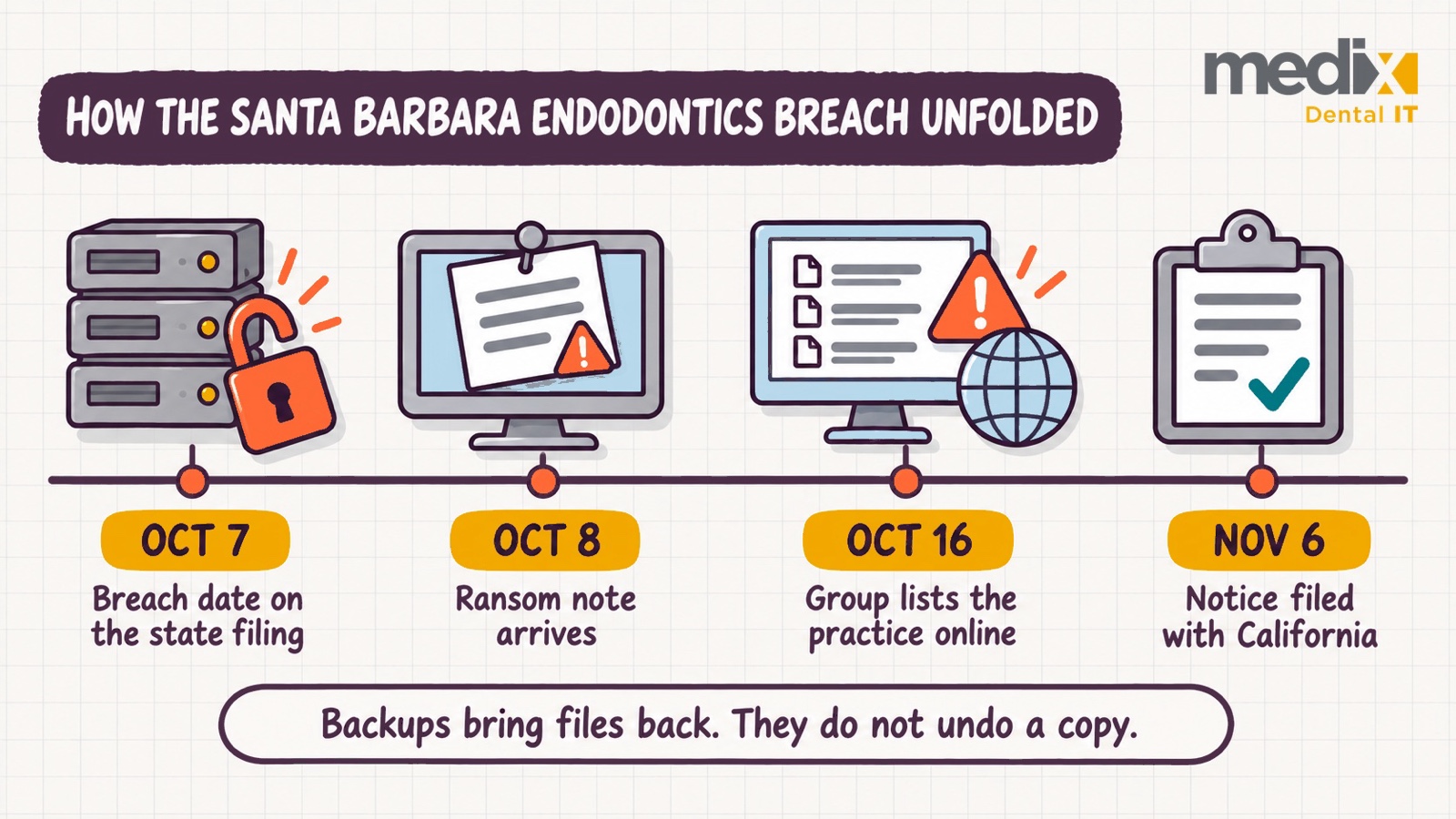
On November 6, 2026, Santa Barbara Endodontics reported a breach to the California Attorney General. The Santa Barbara Endodontics data breach is confirmed by the practice itself: its letter says an unknown threat actor got into its computer systems, encrypted patient record files, and may have moved copies of those records off its systems.
The short answer: Santa Barbara Endodontics has confirmed a ransomware attack. Its letter says the information involved may include Social Security numbers (where provided), medical and dental history, treatment and diagnosis details, and insurance and claims information. The Gentlemen ransomware group separately listed the practice on its leak site. The detail worth your attention: the practice restored its records from backups and still sent breach letters. A backup cannot undo a copy if one was made. Four things to do now: test a restore, keep one backup copy off the network, name who makes the breach call, and give the front desk a script that is true.
What is actually known about the Santa Barbara Endodontics ransomware attack
The practice has confirmed it. Its patient letter, dated November 7 and posted by the California Attorney General, describes how it found out:
“The incident came to our attention when we received a ransom note on October 8, 2026, from an unknown group implying that it wanted money from us for restoring our patient files. […] Fortunately, we were able to restore our patient records from backup files.”
It adds that the practice does “not know the exact date or dates of intrusion,” notified the FBI and hired a security firm. The practice also posted a notice dated November 6 on its homepage.
A ransomware group has claimed it. Ransomware.live recorded a listing by The Gentlemen naming the practice at 09:28 UTC on October 16. The letter does not name a group, but it says the attackers “stated their intentions to post the information” and that the practice has been informed of their online announcements about what they say they took.
Ransomware.live’s records show The Gentlemen listing at least five US dental businesses in October 2026: a Northern Virginia practice on October 9, Santa Barbara Endodontics and Newport Beach Dentistry about a minute apart on October 16, and a Massachusetts practice group and a Texas practice on October 31. A listing is not a confirmed breach for the others, and when our study of dental leak-site listings checked 42 US practices against HHS and four state attorney general lists, it found no matching filing for most.
What we have not found: a patient count.
Three claims being repeated, checked
“The practice did not pay the ransom.” The letter does not say. HIPAA Journal’s write-up says the practice restored its records “without paying the ransom,” and several AI search answers repeat it. Restoring and paying are separate questions, and the letter answers only the first.
“The Gentlemen sent the ransom note on October 7.” The letter says the note arrived October 8 “from an unknown group.” October 7 is the breach date on the state filing, and the group’s name comes from the October 16 listing. Claim Depot’s investigation page merges all three.
“Dates of birth were taken, and the data review finished October 7.” Those details belong to Park Dental Partners, covered in the same HIPAA Journal article, and one AI answer blended the two. Santa Barbara Endodontics’ list includes neither.
What the letter says was involved
The letter lists kinds of data that “may” have been accessed, without confirming which records, if any, were copied.
| What the letter lists | Why it matters to a practice |
|---|---|
| “social security number (if you provided one to us)” | The “if” matters. A number your office never collects cannot be taken from it |
| “your insurance carrier, your insurance policy number or subscriber identification number” | Details that can support insurance fraud, which is why the letter tells patients to read their benefit statements |
| “information relating to claims in the past for payments for our services” | Past claims show what care a patient received |
If you refer patients to Santa Barbara Endodontics
A specialist’s patients arrive from many general practices, and the radiographs and notes you send become part of its record.
Referring patients does not, by itself, create a notice duty for you. Notifying patients is the endodontist’s duty as a HIPAA covered entity, without unreasonable delay and no later than 60 calendar days after discovery. Your own duty turns on whether your practice has a breach of protected health information it is responsible for.
A treatment referral alone does not make the endodontist your business associate, whatever one AI answer tells referring dentists. HIPAA’s definition excludes a health care provider receiving disclosures about a patient’s treatment. Business associate agreements cover vendors that handle patient data on your behalf.
What you do own is the phone call. Your patients may call you first, because you sent them there.
What should a dental practice do now?
1. Test a restore, not just a backup
HIPAA requires a data backup plan and a disaster recovery plan, and this practice’s backups worked when it counted. You find out on the day it matters. Once a quarter, have IT restore the charting system and schedule to an isolated test machine, and time it. Our backup and disaster recovery guide covers the setup.
2. Keep one copy the office network cannot reach
Ransomware can encrypt any backup it can reach. Keep one copy offline or in storage that cannot be changed or deleted for a set period. This practice restored operations “in a new environment.”
3. Name who makes the breach call
A clean restore does not close the HIPAA question. Unauthorized access to patient data is presumed to be a breach unless a documented risk assessment shows a low probability the data was compromised. Decide now who leads that assessment and who calls the forensics firm and the insurer. The Hood River Dental breach shows why the dates matter: its filings separate the day an incident was detected from the day possible data access was discovered. Our ransomware incident response guide walks through day one.
4. Give the front desk a script that is true
For a referring office: “Santa Barbara Endodontics keeps its own records, and its letter has its contact details. We can help you find it.” Skip “our systems were not affected” unless someone has checked. Brief the team on fake billing calls that use patients’ insurance details. Our list of common IT scams aimed at dental practices covers the patterns.
For multi-location groups: every office’s backup is its own bet
Groups that buy specialty practices inherit each office’s backup arrangement. What we commonly see in acquired offices is a backup drive on the same network as the server it protects. Every location needs its own restore test, with results tracked centrally. Give patient calls one owner and one script, and use this incident in security awareness training.
Santa Barbara Endodontics Data Breach FAQs
Was Santa Barbara Endodontics hacked?
Yes, in a ransomware attack. The California Attorney General lists a November 6, 2026, report, and in a patient letter dated November 7 the practice says an unknown threat actor accessed its systems, encrypted patient record files and may have moved copies of patient records. It learned of the attack from a ransom note on October 8, 2026, and said its investigation was still underway.
What information was involved?
The letter lists Social Security numbers (if provided), medical and dental history, mental or physical condition, endodontic treatment or diagnosis information, insurance carrier, policy or subscriber numbers, insurer identifiers and past claims. It says this information may have been accessed, without confirming which records, if any, were copied.
How many patients were affected?
The practice has not said. Its California filing gives no count, and as of November 11, 2026, the incident is not on the federal HHS breach portal. That public list covers only breaches affecting 500 or more people, so its absence does not tell you the patient count.
Who is The Gentlemen ransomware group?
An extortion group that Ransomware.live first recorded in September 2025. The tracker had recorded 1,081 of its victim listings as of November 11, most often in manufacturing, technology, professional services and healthcare. The practice’s letter does not name the group, and a leak-site listing is the attacker’s claim until someone independent confirms it.
Is there a Santa Barbara Endodontics class action?
Several plaintiff firms have posted investigation pages, including Strauss Borrelli on November 9, 2026, and Shamis & Gentile through Claim Depot on November 10. The pages we reviewed do not identify a filed complaint.
Do referring dentists have to notify their own patients?
Referring patients to Santa Barbara Endodontics does not, by itself, create that duty. Notifying patients about this breach is the endodontist’s duty as a HIPAA covered entity. A referring practice’s own duty depends on whether it has a breach of protected health information it is responsible for. Our guide to dental data breach notification covers the deadlines.
The question to ask your office manager
If a ransom note appeared on the front desk screen tomorrow morning, who would decide what happens next, and how long until yesterday’s charts are back? If the answer depends on who opens it, start there. If you want a second set of eyes on it, the team at Medix Dental IT is happy to compare notes.
Posted in Dental Cybersecurity, News