
September 28th, 2026
Best Dental Clearinghouses for Multi-Location Groups (2026)
Industry Research — DSO
Every claim your group sends leaves the practice management system, usually passes through at least one clearinghouse, and reaches a payer. Most operators never think about the clearinghouse until it stops working, and few know how many companies sit in that chain.
A dental clearinghouse is the company that takes the claim your practice management system produces, converts it into the format each payer requires, routes it using that payer’s ID, and carries back whatever the payer returns. Almost every page ranking for this topic is published by a clearinghouse, a practice management vendor, or a billing company that sells the answer. We read the vendors’ own sites instead.
Why February 2024 Changed How Groups Should Pick a Clearinghouse
The Change Healthcare attack is why concentration risk is no longer theoretical in this category. The HHS Office for Civil Rights breach portal lists Change Healthcare, Inc. at 192,700,000 individuals affected, and OCR calls it an incident of “unprecedented magnitude.” We cover the breach itself in our roundup of the biggest dental data breaches.
The operator lesson is what happened downstream. Henry Schein One announced on February 26, 2024 that the incident “led to a temporary suspension of claims feeds across U.S. medical and dental practices, including those sent to Change Healthcare by Henry Schein One.” It moved to a new clearinghouse “within 48 hours” and “offered a short-term credit line to customers facing temporary financial strain.” No Henry Schein One systems were compromised. The dependency alone was enough.
The advice in circulation has not caught up. Open Dental’s manual now files Change Healthcare under No Longer Used / Not Recommended, noting “It appears Change Healthcare has stopped providing clearinghouse services after a cyber attack that took place in early 2024.” When we checked in September 2026, Google’s AI Overview still recommended “Optum (formerly Change Healthcare).” Both statements are live, and neither settles it: Open Dental hedges with “it appears,” while Optum still takes dental enrollment, as its entry below shows. So we read each vendor’s own site, terms and published payer lists, and where a vendor publishes nothing, we say so.
The 6 Dental Clearinghouses Multi-Location Groups Actually Choose Between
The closest thing to a public shortlist comes from Open Dental, a practice management vendor rather than a disinterested party: two clearinghouses recommended, five more known to work, one not recommended. We built from that list, then judged each vendor on what a group can check before signing: price, payer lists, the practice management systems it names, and stated compliance.
| Clearinghouse | Published price? | Payer list public? | PMSs it names publicly | Compliance stated |
|---|---|---|---|---|
| DentalXChange (ClaimConnect) | No, pricing page 404s | No, login required | Yes, a homepage partner wall naming about 30, including Henry Schein One, Eaglesoft, Open Dental and Curve | HITRUST certified, and “recently completed its SOC 2 examination” |
| Vyne Dental (Trellis) | No, pricing page 404s | No | Open Dental, Eaglesoft, but on its dispute page, not a product page | HITRUST CSF v11.3(i1) certified and BAA published on the site, SOC II Type 2 claimed in its own 2025 letter |
| Electronic Dental Services | No, pricing page 404s | Yes, open PDFs | Open Dental and Eaglesoft help centers, and Henry Schein One cites 40+ PMS integrations | None on the EDS site, and the product is Henry Schein One’s |
| Office Ally | Yes, until the enterprise tier | No | None | Claims HIPAA compliance and a BAA in its pricing FAQ, no HITRUST or SOC stated |
| Dentrix eClaims | No | Yes, a payor search page | Dentrix, Dentrix Ascend | Not published, partners named only in support notices |
| Optum (formerly Change Healthcare) | No | Partial, via payer portal | None on a dental page | Not stated on the dental pages we pulled |
1. DentalXChange: Open Dental’s Default, With a Partner List You Can Read
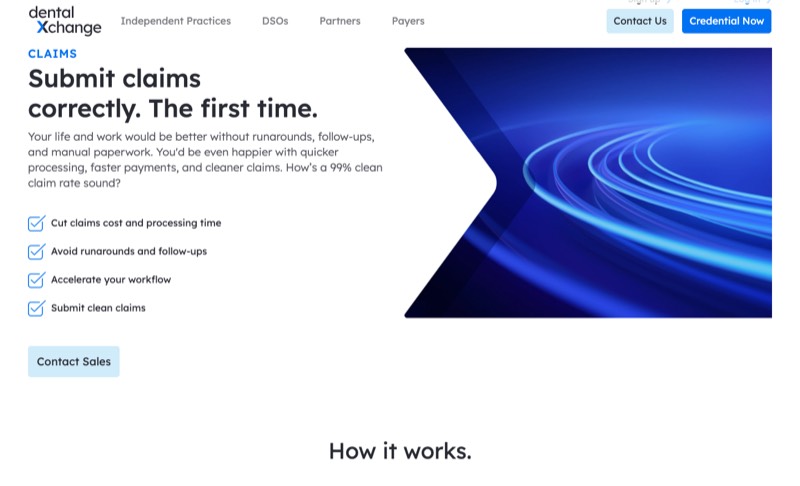
DentalXChange, legally EDI Health Group, runs ClaimConnect for claims, alongside ERAConnect, StatusConnect and an API product. It is one of two clearinghouses Open Dental marks recommended, and the one Patterson documents alongside Vyne for Eaglesoft.
Where it shines is breadth you can see. Its homepage partner wall names roughly thirty software partners, Henry Schein One, Eaglesoft, Open Dental, Curve, CareStack and Planet DDS among them. For a group pulling acquired offices onto one workflow, that settles the compatibility question early.
Where I’d hesitate is how little else is checkable. The payer list sits behind a login, so “nearly 1,400 payer connections” has to be taken on trust, and “recently completed its SOC 2 examination” is not a certification. Ownership gets garbled, too. One AI assistant we tested said Henry Schein One had acquired it. Its own press release says KKR recapitalized it in August 2025, and Henry Schein One says it has no ownership relationship with the company.
Best for: Open Dental and Eaglesoft groups that want one vendor their software already documents.
2. Vyne Dental: Strongest on Attachments, and the Clearest on Terms
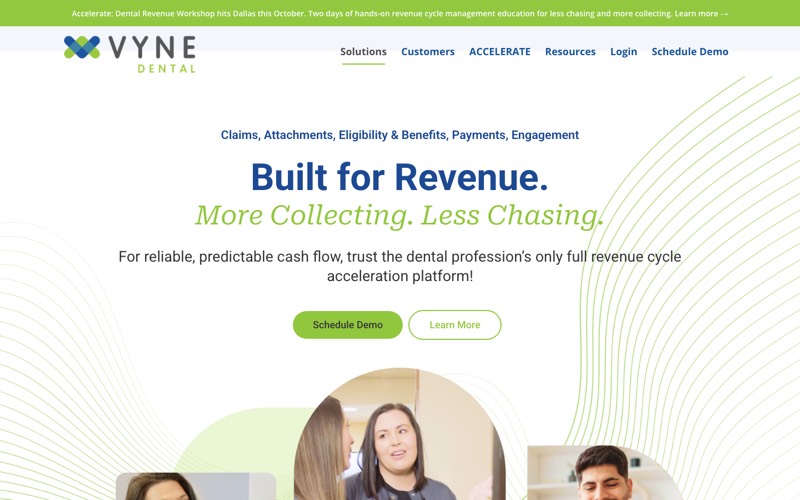
Contracting as National Electronic Attachment, Inc., Vyne comes at this from the attachment side. Trellis handles claims, attachments, eligibility and remittances, and Patterson names it as the second option for Eaglesoft.
Where it shines is paper you can read before you sign. It names its HITRUST version and assurance level, publishes its business associate agreement as an exhibit, and posts provider terms specific enough to quote, which matters in the downtime section below.
Where I’d hesitate is its numbers. “Over 800 connections for attachments,” “800 plans and payers,” and “more than 800 hospitals and health systems” all appear across the site. Three different things, one number. FastAttach’s “flat subscription fee” is asterisked to a per-location basis plus set-up and annual storage fees, so model it per site. Its SOC claim also varies: the website makes none, while an August 2025 letter calls the clearinghouse “SOC II Type 2 certified.” Ask for the report.
Best for: groups with heavy attachment volume that want contract terms they can read before signing.
3. Electronic Dental Services: The One That Shows Its Work
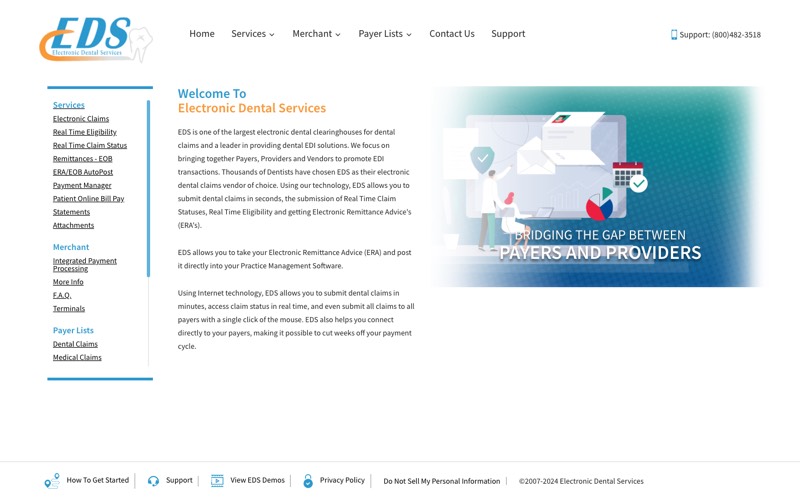
Open Dental marks this one recommended too, and lists it alone for medical claims, though that requires taking the dental service as well. It is a Henry Schein One product, marketed as “EDS Powered by Henry Schein One,” and the EDS site runs separate help centers for Open Dental and Eaglesoft users.
Where it shines is transparency. Open payer lists for claims, remittances, eligibility and claim status, published as PDFs anyone can count without an account, plus public enrollment forms. It is the one vendor whose payer coverage you can evaluate before a sales call rather than after one.
Where I’d hesitate is the compliance column. The EDS site itself states no HITRUST, SOC or HIPAA security certification and no business associate agreement language, so for a group running a vendor risk program that is the first thing to raise, and the answer will come from Henry Schein One. Ask about the attachment path too, since the site advertises attachments through NEA, which is Vyne’s legal entity.
Best for: Open Dental groups that want to check payer coverage themselves before any sales call.
4. Office Ally: Published Pricing Until the Tier You Need
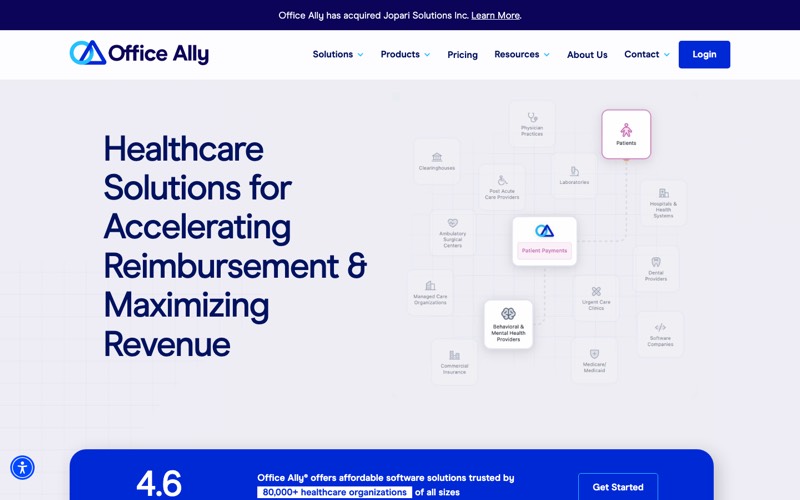
Office Ally sits on Open Dental’s “known to work well” list with one documented caveat: it requires manually uploading the claim file to its website rather than sending it straight through. It is a general healthcare clearinghouse, not a dental specialist, which cuts both ways for a group that also bills medical.
Where it shines is a real rate card, close to unique in this category. Eligibility runs $10 a month for the first 100 transactions and $0.10 each after, attachments $0.55 each. You can model a single site before speaking to anyone.
Where I’d hesitate is the tier a group actually buys. Its EDI Clearinghouse product reads “Customized Pricing,” so the transparency runs out exactly where a 20-location group lands. And the manual upload never appears on a rate card. It is per-location labor, every day, and it scales badly, so price it at every site alongside the software.
Best for: smaller groups that also bill medical and can absorb a manual upload step.
5. Dentrix eClaims: Henry Schein One’s Own Product, on Partners Named Only in Support Notices
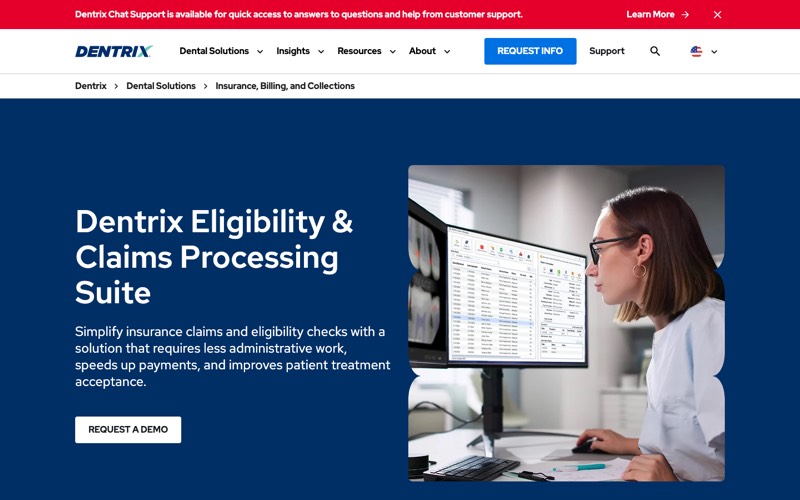
eClaims is Henry Schein One’s claims product inside its Eligibility and Claims Processing suite. For a Dentrix group it is both the path of least resistance and the option Henry Schein One markets.
Where it shines is being native. No integration argument with your vendor, no separate API negotiation, and far less exposure to a platform update breaking a third-party connection. Given the Dentrix section below, that last one is not small.
Where I’d hesitate is visibility. Henry Schein One publishes no price, and its product pages do not say which clearinghouse carries the claims. Its support notices do, naming DentalXChange as an enrollment and processing partner, and in February 2024 the claims it sent to Change Healthcare were caught in the suspension described above. The native option is the one where the infrastructure underneath is least visible, so ask for the current routing by transaction type.
Best for: groups standardized on Dentrix that value a native workflow over routing visibility.
6. Optum, Formerly Change Healthcare: Large, Still Enrolling, and Unmarketed for Dental
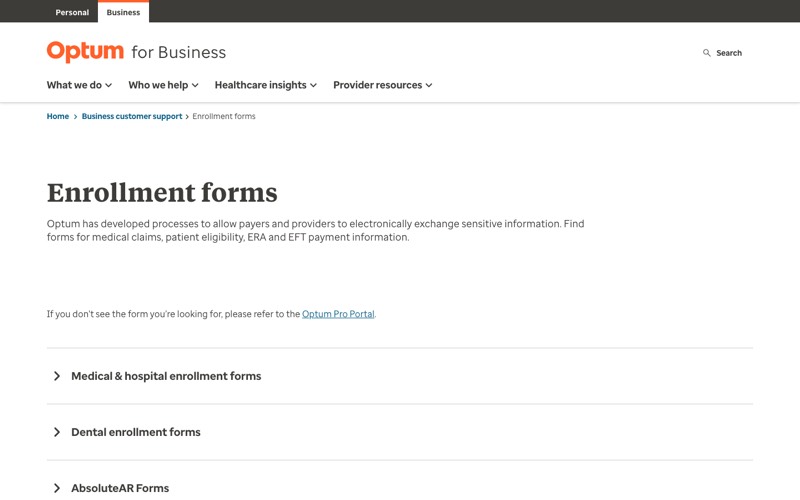
changehealthcare.com now redirects to Optum, and the dental clearinghouse function has not visibly disappeared. Optum’s payer portal still names “IEDI Dental” and a “Dental Payer List,” and its enrollment forms page lists claims-enrollment forms for about 30 dental payers, mostly Medicaid and regional plans, while MetLife, UnitedHealthcare Dental and about twenty Delta Dental plans appear with remittance forms only.
Where it shines is scale and medical-dental reach, if your group bills both.
Where I’d hesitate is everything around it. There is no marketed dental clearinghouse product page, and “Optum Real for Dental” is an interoperability and pre-treatment estimation product, not a clearinghouse. Open Dental has filed this option under not recommended, and none of the Optum dental pages we pulled mention the 2024 incident. This is the option where I would want the redundancy plan in writing first.
Best for: groups billing medical and dental that can document a second claims path first.
Open Dental names three more as known to work, which we are not ranking because that would imply an evaluation we have not done. What a buyer sees is still worth reporting. Ensora Health, listed as the former Apex, now titles its homepage as therapy practice software with no mention of dental. Etactics presents as general revenue cycle software, also with no dental mention. Post-n-Track now trades as P-n-T Data Corp at a different domain. None of that says how the three process claims. It says how much work a buyer does before they can even compare them.
Ask Which Transaction a Payer Count Covers
Electronic Dental Services is the only clearinghouse here publishing its payer lists as open PDFs with no login. We counted the unique payer IDs in each one, deduplicated, since a single ID can carry several plan names.
The claims list carries roughly 1,600 unique payer IDs. The remittance list is about 40 percent that size, eligibility about 14 percent, and claim status about 8 percent. A payer ID is not always a single payer, and a listed payer is not proof of a live connection, since many rows require enrollment first. The shape is the point.
An advertised payer count usually means the claims number, and it is rarely labeled. Eligibility is where your front desk spends its morning, and that list is a fraction of the size. A group consolidating on the broadest advertised reach can end up buying reach in the one transaction type that was never the bottleneck. None of this counts against EDS. Its published claims list is comfortably larger than the “over 800 payers” its own marketing page claims, and everyone else asks you to take the number on faith.
On Dentrix, the Choice May Not Be Yours
If your group runs Dentrix, the integrated claims paths open to you may be narrower than the market suggests, and your practice management vendor sets that range. Vyne Dental has published five dated statements since March 2025, most recently in April 2026, about its attempts to join the Dentrix API Exchange. Vyne cites “the absence of required data elements to support claims submission workflows” and says joining “would force Vyne to discontinue its claim submission services for Dentrix customers entirely.”
Henry Schein One has answered in its own customer FAQ on the API Exchange. It says a practice whose claims vendor is affected “can continue to use them in a more manual manner,” or move to Dentrix eClaims or EDS, or submit directly to a clearinghouse or payer. Its Dentrix Developer Program FAQ states that “certain software types (e.g., patient financing, credit card processing, insurance claim processing) or non-commercial API accounts aren’t allowed in the program or marketplace,” and the only claims-related API it offers is a Claims Summary API, described as “summarized claims data for practice level reporting and integration purposes.” Summary data, not submission.
The two companies are also in federal litigation (National Electronic Attachment v. Henry Schein One, D. Md.). The court entered a preliminary injunction in 2026, both companies have appealed, and the docket shows the court has since suspended and stayed that injunction while it sets a bond. The case is moving quickly, so read the docket rather than either company’s summary before you standardize on anything.
When the Clearinghouse Goes Down
None of the vendor pages we pulled carry an uptime percentage or a documented fallback. Vyne is the one vendor whose availability terms a customer can read. Section 12 of Vyne’s provider terms, effective June 22, 2026, commits to “commercially reasonable efforts to ensure availability consistent with, but not beyond, what is provided by our third-party service providers,” then carves out exceptions that explicitly include “network intrusions, or denial of service attacks.” It adds: “Your right to cancel the Services is your only right in the event the availability of the Services does not meet your business or technical requirements.”
A cyberattack is named as an exception, and your remedy is to leave. That is standard software contract language, and Vyne deserves credit for publishing it. Ask every candidate for their availability section.
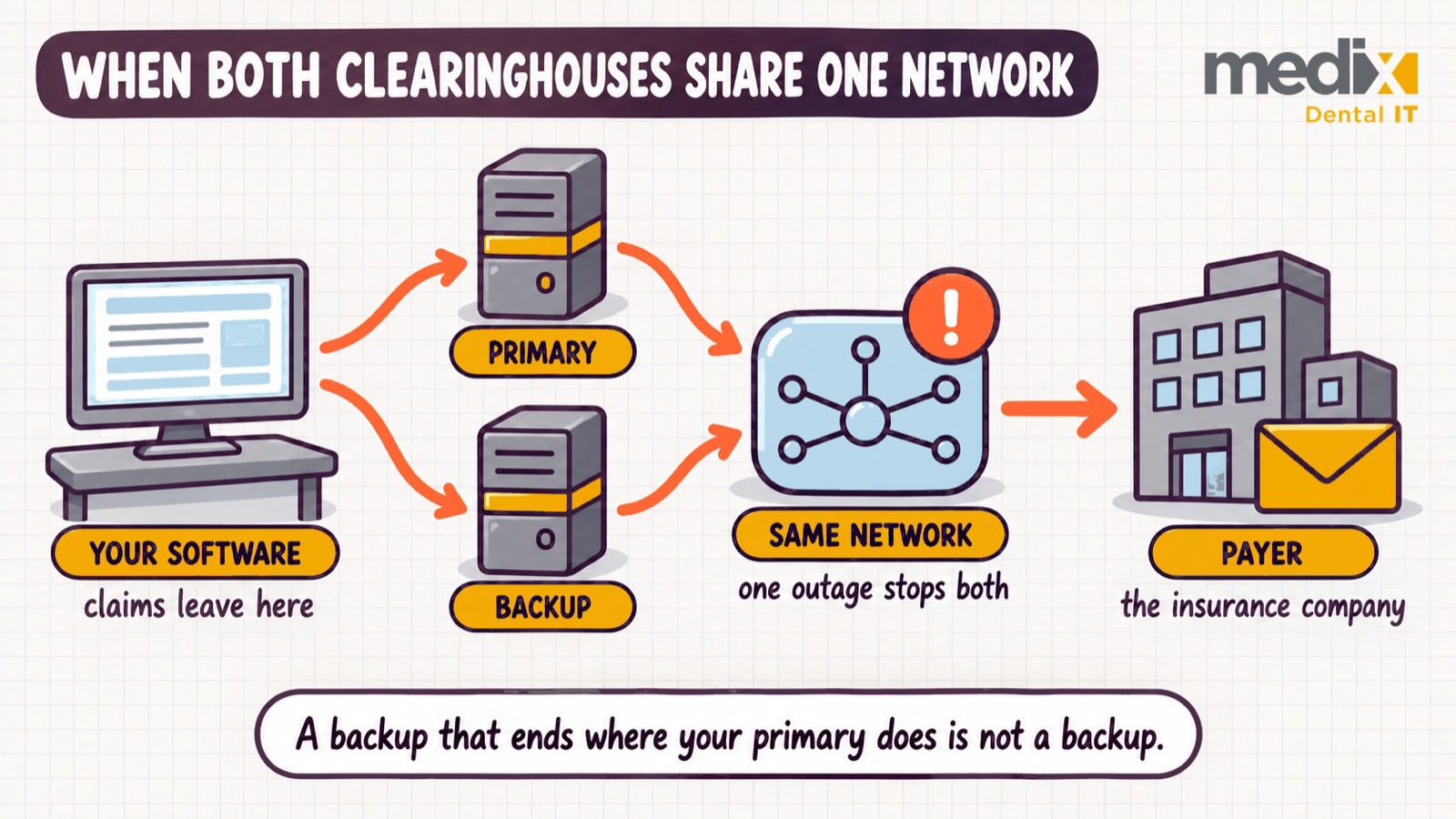
So the protection has to come from your own setup. A true backup is a second claims path, already enrolled for your highest-volume payers, set up during a migration rather than during an outage. Then check where that second path ends. Open Dental warns that some companies marketing themselves as clearinghouses “are more accurately described as aggregators, having a direct connection to only a few payers and sending the bulk of their claims to another clearinghouse.”
Enrollment is the switching cost nobody quotes. Patterson states it plainly in a note about moving onto Vyne: “Additional enrollment is required per clearinghouse.” For a 22-location group, payers that require enrollment have to be re-enrolled for each billing entity, and claims to those payers can stall until it is done.
Where a Multi-Location Group Should Land
Where you land depends mostly on your practice management system. On Open Dental, the shortlist is DentalXChange or Electronic Dental Services, the two the vendor recommends, but Henry Schein One’s own notices route EDS remittance enrollment through DentalXChange, so confirm the pair does not end at the same network before treating one as the other’s backup. On Dentrix, ask Henry Schein One which clearinghouse carries your claims today. On Eaglesoft, you are choosing between DentalXChange and Vyne, and Patterson’s troubleshooting notes give you a tiebreaker: DentalXChange routes on payer ID, Vyne on payer name and address, so messy payer records fail differently depending on which you pick. Our breakdown of dental practice management systems covers the platform side.
Whichever vendor wins, ask four questions before you sign. Which payers do you reach directly, and which do you hand to another clearinghouse? What does your availability clause commit to, and what does it exclude? How many payers support eligibility and claim status, since each one that does not sends your team back to the shared credentials problem on payer portals? And what is our re-enrollment exposure if we leave? The clearinghouse also holds protected health information for every patient you bill, so it belongs in the same review as every place your dental vendors are copying patient data.
The clearinghouse is the narrowest point in your revenue cycle and the least examined. Nobody notices it until claims stop, and by then the evaluation you skipped is the one you are doing under pressure.
Dental Clearinghouse FAQs
What clearinghouse does Dentrix use?
It depends on the transaction. Henry Schein One’s Dentrix claims-updates page names DentalXChange, offering a “multi-payer ERA Enrollment Service powered by DentalXChange,” and its EDS status page says it “relies on third-party clearinghouses for processing claims.” In February 2024, claims routed to Change Healthcare were caught in the suspension that followed the attack. Ask your account team which clearinghouse carries each transaction type today, and get it in writing.
Can I use more than one dental clearinghouse at once?
Yes, and on Open Dental it is a documented configuration rather than a workaround. It sets separate defaults for dental claims, medical claims and eligibility, so a group can route eligibility through one vendor and claims through another. Its fallback order is a setup rule, not an outage plan: with no eligibility default chosen, eligibility uses the dental default, and with no dental default either, the medical one. That spreads services across vendors, but it is not outage failover, since claims do not reroute on their own when a clearinghouse goes down.
How much does a dental clearinghouse cost?
Almost none will tell you before a sales call. We could not find a published rate card from DentalXChange, Vyne Dental or Electronic Dental Services, and the per-location figures circulating in blog posts and AI answers do not match any vendor pricing page we could locate. Treat those as an opening position, not a benchmark, and ask for pricing per transaction type rather than a bundled per-location rate so you can see what eligibility and attachment volume actually cost.
Is a dental clearinghouse a HIPAA business associate?
Usually both. CMS classifies health care clearinghouses as HIPAA covered entities in their own right, and separately names them as an example of a business associate providers must have written agreements with. The practical consequence is that a signed agreement is the floor, not the finish line, since it establishes responsibility without telling you anything about the vendor’s security posture.
What happens to our claims if the clearinghouse goes down?
Claims stop until the vendor recovers or you send them another way, and paper does not always travel the same route. Delta Dental of Michigan stopped accepting paper claims from clearinghouses in June 2022, though offices can still mail them directly. Before an outage forces the question, confirm the paper route for each of your highest-volume payers, and keep a second electronic path enrolled for the payers that matter most to cash flow.
Posted in DSO