
September 25th, 2026
7 Best Dental Insurance Verification Software Tools (2026)
Industry Research — DSO
Insurance verification rarely reaches a leadership agenda, and in a multi-location group that is part of the problem.
Dental insurance verification software checks a patient’s eligibility and benefits with the payer before the appointment, then records the answer, ideally inside your practice management system. What separates the tools is where that answer ends up, and whether a human retypes it, which decides whether verification scales across twelve locations or just moves the work somewhere you cannot see it.
Three Ways a Platform Gets Your Benefit Data
Before any vendor comparison makes sense, know that “we verify insurance” describes three different machines.
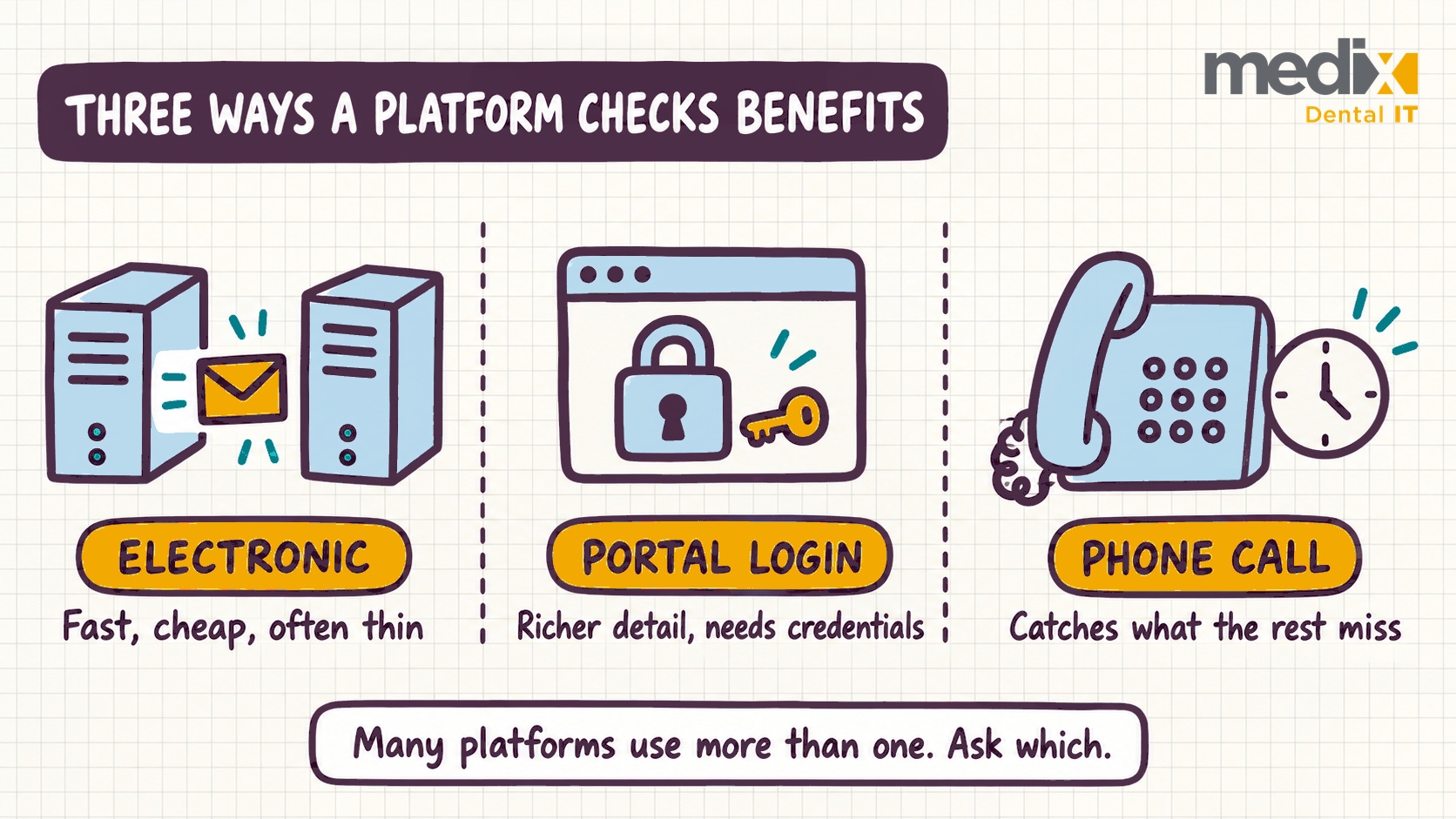
The first is the electronic transaction. Your system sends a standardized request, the payer returns a standardized response in seconds. Fast, cheap, frequently thin. Henry Schein One, which sells one of these products, said so itself in a September 2024 press release: standard electronic connections “often do not deliver responses from many payors, and when they do, the information is frequently incomplete. This forces staff to call help lines or access payor portals for required coverage data.”
The second is portal retrieval. Software logs into the carrier’s website the way your insurance coordinator would and reads the richer detail there: frequency limits, patient history, procedure-level percentages. Better data, but it depends on portals that change without notice and credentials somebody holds.
The third is people. Somebody calls the payer, waits on hold, and writes down what they hear. Many platforms fall back to this for carriers the first two cannot reach, though at least one says it never does. Several products combine two or three, and the combination is the product. Each fails differently at scale: electronic transactions return thin data everywhere, portal automation breaks per carrier, human fallback gets expensive per verification.
The 7 Best Dental Insurance Verification Software Tools, Compared
We read the vendor-owned pages for each tool and recorded only what each states about itself. Seven vendors made the list, eight products once DentalXChange’s two eligibility products are counted separately.
Counting what is published proved more revealing than the feature lists. Three of the eight never say whether they use electronic transactions or payer portals. Three name no practice management system. Three never claim to write results back into one. One names ten systems and still claims no write-back. Exactly one publishes a price. In the table, “does not state” means exactly that, and is not a limitation.
| Platform | How it gets the data | PMSs named | Write-back stated | Price published |
|---|---|---|---|---|
| Dentrix Eligibility Pro | Electronic plus payer portals and data partners, AI voice fallback announced June 2026 | Dentrix, Dentrix Ascend | Yes, into coverage tables | No |
| Curve Eligibility+ | Payer portals | Curve only | Yes, with your approval | No |
| Needletail AI | Portal agent, voice agent, human QA | Varies by page, incl. Open Dental | Yes, three stated depths | No |
| AirPay | Software only, no phone calls, method not stated | Ten, incl. Dentrix Enterprise | Not stated | No |
| iCoreVerify | Direct from payers, no phone calls, method not stated | None | Yes, generic | Yes, $450 to $1,250/mo, then custom |
| DentalXChange Eligibility | EDI 270/271 | None | Not stated | No |
| DentalXChange Eligibility AI | Payer sites | None | Not stated | No |
| Stratus AI | No manual calls, method not stated | Open Dental, Eaglesoft, Dentrix | Yes, advanced writebacks | No |
1. Dentrix Eligibility Pro: The Clearest Public Explanation of the Tradeoff
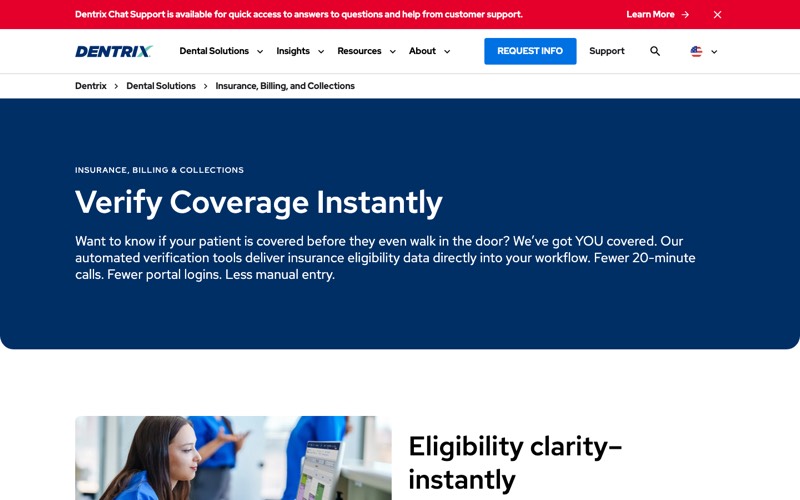
Eligibility Pro is Henry Schein One’s verification product, built into Dentrix and Dentrix Ascend. A September 2024 press release explains its two tiers in one unusually useful sentence: Pro “unlocks more benefits data by delivering information from payor portals in addition to the EDI data provided by Essentials.” A June 2026 Henry Schein One release, announcing Dentrix Ascend updates, adds that Pro draws from Tuuthfairy, Zuub and DentalXchange at once, with AI voice agents through a SuperDial partnership covering what those miss.
Where it shines: the write-back is specific and native. Verified benefits “automatically populate Dentrix coverage tables,” naming deductibles, maximums and co-insurance, with no separate dashboard.
Where I would hesitate: it only helps locations already on Dentrix or Ascend, the wrong shape for a group mid-roll-up running three systems. The Essentials tier name also appears on no current product page we pulled, so confirm what is sold before budgeting.
Best for: groups standardized on Dentrix or Ascend that want verification inside the system of record.
2. Curve Eligibility+: Write-Back That Asks Permission First
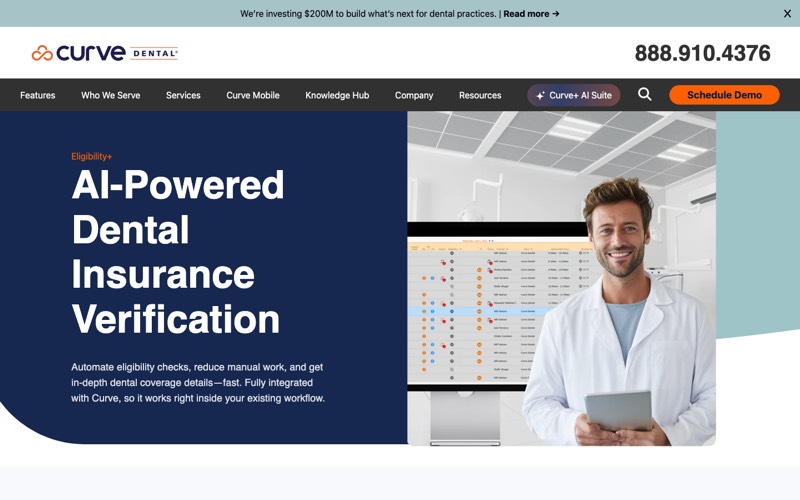
Eligibility+ is Curve’s verification module, and Curve states its retrieval method openly: it pulls “real-time, code-level coverage straight from payer portals.”
Where it shines: the write-back design is the most operationally honest we found. SmartSync compares what the portal returned against what is in the system, flags differences, and updates records “with your approval.” A reviewable diff beats a silent overwrite when the number drives an estimate.
Where I would hesitate: it is “available with a Curve subscription” and writes into Curve only, so it is a reason to choose Curve rather than a tool you bring to the system you already run. Curve’s own multi-location page does not mention Eligibility+ at all.
Best for: groups standardized on Curve, or evaluating Curve as the platform.
3. Needletail AI: The Most Candid About Its Own Failure Modes
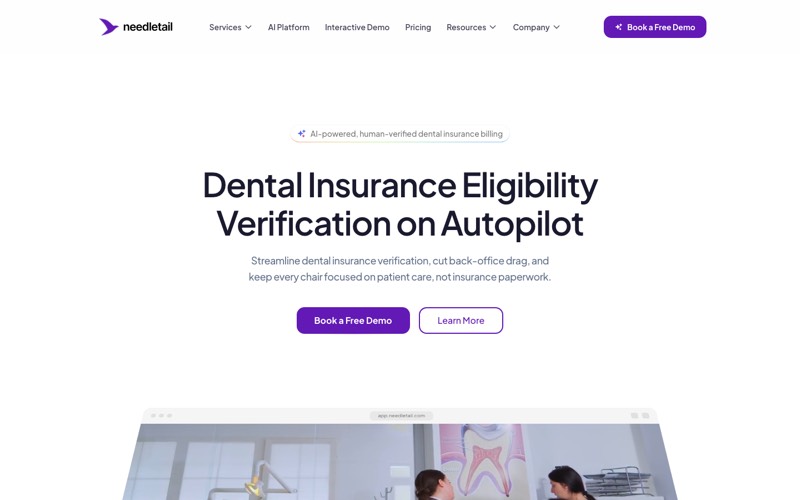
Needletail describes its machine in the most detail: a portal agent that logs into payer sites, a voice agent calling carriers where portals are unreliable, and a human quality-assurance team reviewing edge cases before results reach the practice management system. Write-back comes in three stated depths, and the company is candid that depth depends on the system: cloud platforms get full plan-level write-back, while server-based Dentrix gets PDF attachment plus limited note fields.
Where it shines: its trust center states it signs a business associate agreement with every customer, and it names carriers, such as Cigna and MetLife, where its voice agent meets more resistance.
Where I would hesitate: its four public pages named four different practice management system lists on the same day, so get the supported list in writing. Its security page lists SOC 2 Type 2 as “in progress,” not complete.
Best for: groups whose payer mix includes carriers portal automation misses.
4. AirPay: Ten Systems Named, No Write-Back Claimed
AirPay, operated by Smylen, names the broadest set of practice management systems here, including Dentrix Enterprise, Cloud 9, Dolphin, Denticon, CareStack, Curve, Eaglesoft and Open Dental. It is also unusually direct about staffing: “AirPay is strictly a software solution. There are no humans behind the scenes dialing payers.”
Where it shines: for a group carrying several systems through acquisition, that list is the widest available, and the no-humans statement sets a clear expectation.
Where I would hesitate: AirPay says it integrates with those systems and never states that it writes verified benefits back into them. The only directional language on its site describes pulling appointments out. It also does not say whether data arrives by electronic transaction or portal retrieval. Ask both.
Best for: multi-system groups wanting the widest named compatibility, who will pressure-test write-back.
5. iCoreVerify: Priced by Verification Volume, in Public
iCoreVerify runs verification inside iCoreConnect’s broader platform, checking benefits up to seven days ahead. Alone among the eight products, it puts numbers on a public page: $450, $675, $950 and $1,250 a month for its Done for You option across four volume bands, with custom pricing above 250 verifications.
Where it shines: published pricing is rare here, and the billing unit is verification volume rather than location count, which suits groups with uneven schedules.
Where I would hesitate: its verification page names no practice management system, claiming write-back only to “your PMS,” and says only that it retrieves benefits “directly from payers without manual phone calls,” never whether by electronic transaction or portal. A footnote reads “Retail Price: $250 | Includes unlimited verifications and full automation,” which the page does not reconcile with the table. Get the number and system list in writing.
Best for: groups whose verification volume swings month to month and who want a published number to budget against.
6. DentalXChange: Two Products, Two Different Machines
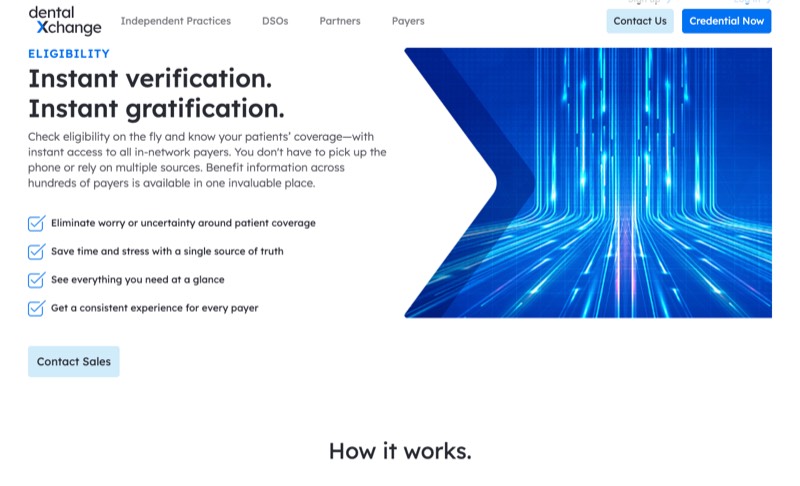
DentalXChange sells verification twice, and the split maps onto the tradeoff above. Its standard Eligibility product runs on the electronic transaction and says so: it “utilizes HIPAA, EDI 270/271” with everything “standardized in X12 formatting.” Its Eligibility AI product instead “gathers benefit details from payer sites,” never mentioning the electronic standard.
Where it shines: the clearinghouse depth is real, and it publishes more security credentials than the others here, stating HITRUST certification and a completed SOC 2 examination.
Where I would hesitate: neither eligibility page names a practice management system, and both describe integration without claiming write-back. The two are easy to conflate in a demo, and they are not the same purchase.
Best for: groups already running DentalXChange for claims who want eligibility on the same connection.
7. Stratus AI: Named Write-Back, Unnamed Method
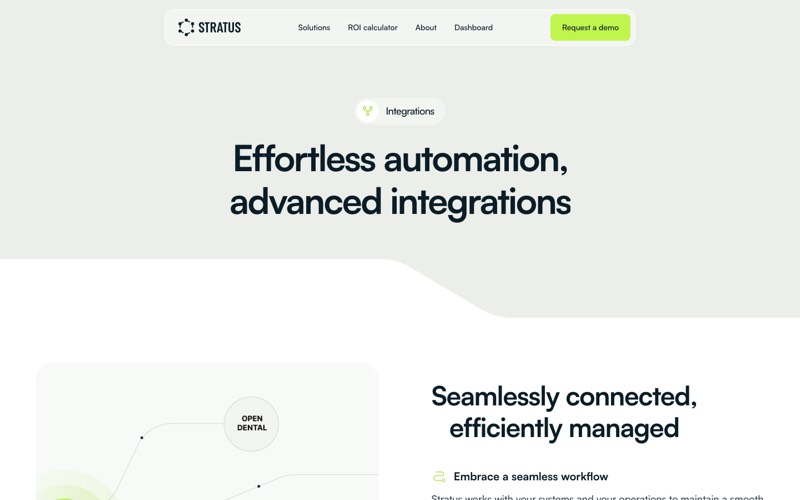
Stratus is the clearest independent tool on the question that matters most operationally. It names Open Dental, Eaglesoft and Dentrix and attaches “advanced writebacks” to each, with Eaglesoft listed as near real-time and the other two as instant.
Where it shines: naming systems and committing to write-back on each is the specificity this category avoids, and the shortest path to a demo you can test.
Where I would hesitate: Stratus says it eliminates manual calls to insurers but never states how it obtains benefit data, whether by electronic transaction or portal retrieval. Its multi-location page returns an error, and its savings figures have no methodology. For a group, any location outside those three systems falls outside the write-back claim.
Best for: practices on one of its three named systems where write-back is the deciding feature.
Outside the ranked list, one more name needs a word, because Zuub showed up in every AI answer we ran and ranks first in at least one roundup published by a competing vendor. It is not on this list because Zuub’s own homepage says it is “built for dental technology companies and RCM providers,” with the tagline “Your product. Your brand. Powered by Zuub.” It is a white-label payer data layer that normalizes results from several connection types into one interface. No practice management system is named on its marketing pages, no write-back is claimed there, and its pricing URL returns an error. It belongs in your evaluation if your group is building verification into its own software or runs a central billing team prepared to integrate an API. Groups on Dentrix Eligibility Pro may already be using its data, since Henry Schein One names Zuub as one of Pro’s sources.
Buy Software or Hire a Verification Service
Software is only one answer, and plenty of groups are not looking for software at all.
Outsource Strategies runs a hybrid, “using both automated tools and manual phone verification,” priced per eligibility request “as low as $3.00.” Its specialists “log in to your EMR system,” and will update coverage tables “if authorized.”
That last detail is where the decision stops being about price. A service working inside your system needs live credentials. Dental Support Specialties describes it without varnish: a “secure remote network connection between our office and yours,” with staff accessing your software “in a very similar way to how your onsite team does.” Whether that is fine or alarming depends on whether your identity governance can scope and revoke that access per person, the same problem shared carrier portal logins create on the front end. None of the outsourced providers we reviewed mentions a business associate agreement publicly. Ask before the first login is issued.
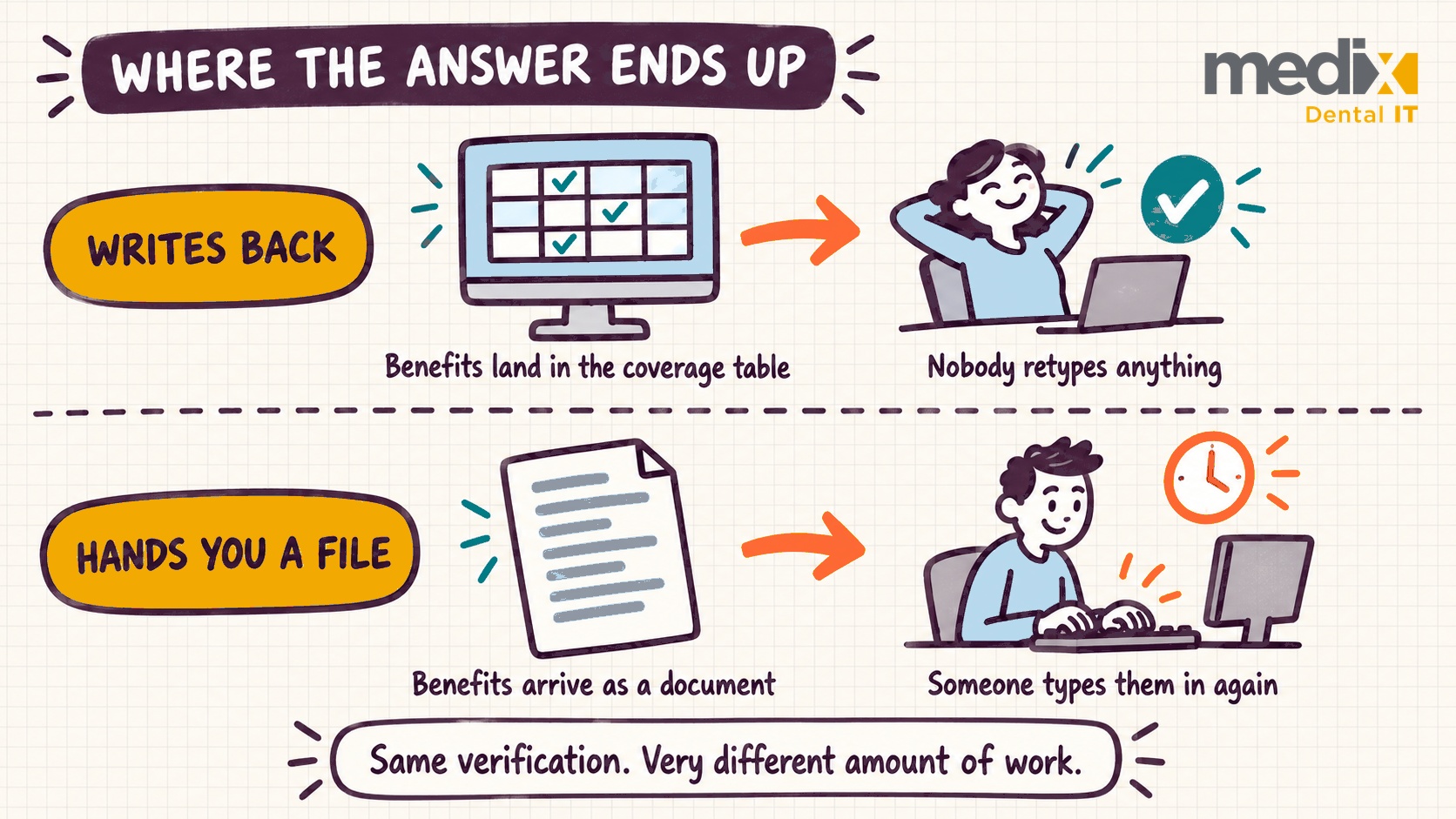
Then there is the handoff itself, which one vendor has helpfully priced. eAssist sells verification under two options: Done-For-You Data-Entry and Do-It-Yourself Data-Entry. The options are named for one thing: whether somebody types the result into your system or hands it to you to type. Its published rates are $260, $660 and $840 per location per month with the typing included, against $235, $535 and $690 without. The typing itself is the gap: $25 to $150 per location per month depending on tier. For a twenty-five location group at the middle tier, that gap is $37,500 a year.
Read that as a published price premium for data entry rather than a measured cost, since package pricing carries margin and scope. It is still the closest public number for what re-keying costs a dental group, which is the cost write-back is meant to reduce. A platform that cannot tell you which fields it populates cannot tell you which side of that gap you are buying.
If eAssist is on your shortlist for verification, weigh its September 2026 security incident as well. Our coverage of the eAssist data breach tracks what the company has acknowledged and what practices are still waiting to hear.
The Question That Sorts This Faster Than a Demo
Most groups evaluate these tools on accuracy and turnaround. Both matter, and write-back is the criterion that gets left out. Ask instead: when verification finishes, which named fields in which named system hold the answer, and who put them there? A platform that populates coverage tables has removed the retyping, though it may still ask someone to approve the change. One that produces a PDF has relocated most of the job to your team, at a price you can now compare against the figure above.
The second question decides whether any of this survives your next acquisition. A group running three systems buys this decision three times, maintaining three sets of payer credentials and reconciling three data shapes into one billing operation. I have seen groups acquire 10 practices on 3 different PMS platforms and then wonder why centralized billing does not work.
That is not a verification problem. It is a practice management system decision resurfacing two years later, which is why we treat this as infrastructure rather than front-office tooling. The same logic governs the AI tooling layer that sits on top of your practice management system, and it pays to know what the underlying software costs to operate before adding another vendor.
Where We Would Start
If your group runs one system across every location, start with the verification product living natively inside it and make the third-party tools beat it. If you run several, the named-write-back question sorts the market faster than any feature comparison, and vendors who cannot answer it in writing have told you something useful.
Most DSOs treat verification as a staffing question. The number of people it takes is usually set by a data decision made years earlier.
Dental Insurance Verification Software FAQs
How do you verify dental insurance across multiple locations?
The transaction is the same one a single office runs. What changes is who holds the carrier credentials. The goal is one set of payer logins the group can scope and revoke per person, rather than each location keeping its own, a control most groups find they lack only after someone leaves. Verification tools attach to the practice management system, so locations on different systems cannot share one workflow until the data shapes are reconciled.
What does insurance verification write-back actually mean?
It means verified benefits land in structured fields rather than a document. The test is whether the answer reaches the coverage table, the field your system reads when calculating a patient estimate. A PDF in a document center does not, which is why a plan can be verified correctly and still produce a wrong estimate at the front desk.
Can you verify insurance directly in Open Dental?
Open Dental supports electronic eligibility checking, and several third-party platforms name it, including Stratus AI and Needletail, which both claim write-back, and AirPay, which lists it without claiming write-back. Because published system lists vary between a vendor’s own pages, confirm current support in writing with the vendor rather than trusting a roundup.
Is outsourced dental insurance verification cheaper than software?
It depends on volume and how much work you hand over. Published outsourced rates run a few dollars per verification, predictable at low volume and growing with your schedule. Software pricing varies more than people expect: the one verification platform here that publishes numbers, iCoreVerify, prices its Done for You option by monthly verification volume, and Needletail describes a per-location fee plus a per-verification rate. The comparison people miss is the data-entry step: at least one service prices it separately, and that gap is what write-back removes.
Why do AI assistants recommend different verification platforms?
Because almost everything published about this category was written by someone selling in it, and assistants summarize that material. An AI Overview we pulled in September 2026 named Zentist “best for multi-location DSOs,” but the Zentist homepage and FAQ describe EOB and ERA payment posting and never use the words eligibility or verification. A Zentist blog post from September 2026 says its Remit AI now runs eligibility checks ahead of visits, so the vendor’s own pages tell two stories. Treat any recommendation as a starting point to check at the vendor’s own site.
Posted in DSO